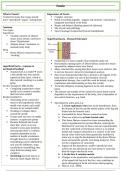
Fascia
What is Fascia? Importance of Fascia
Connective tissue that wraps around Complex structure
more ‘specialised’ organs =unimportant Holds everything together– support and structure =mechanical
integrated movement of the body
Repair and defence (limiting spread of infection)
Anatomy Site of pain and pathology
Two types: Sports massage/Acupuncture/Fascial manipulation
Superficial
Variable amounts of adipose
tissue, loose areolar connective Superficial fascia - Research literature
tissue ‘Hypodermis’
Adipose tissue= insulation, to
maintain body temp
Deep
Dense fibrous connective tissue
‘stocking’
Found that it is more complex than textbooks make out
Horizontally running layers of Dense fibrous connective tissue
superficial fascia - response to separated by adipose tissue were found
mechanical loading? Many criticised this, saying that these layers were artefacts, this
Acupuncture as a model insert is not true however, shown by histological analysis
a fine needle into skin and the Stecco has demonstrated that this is present in all regions of the
superficial fatty layer, which is body (steccos father was one of the founders of facial
then twisted, resulting in a needle manipulation therapy, thus could this work be biased, to give
grasp explanation and understanding on how this works)
In mice (Langevin 2001,02,06) Vertically/obliquely retaining ligaments to the skin and deep
Comparing acupuncture where fascia
needle is not rotated to needles The amount and number of the connective tissue sheets varied
that have been rotated dependent on the requirements of the body, thus is dependent of
Rotated resulted in: area and its function– e.g. hand
Thickening of the connective
tissue in the hypodermis where Specialised in some areas e.g :
needle was rotated, only small o 1. Great saphenous vein (runs in the hypodermis, from
increase in not rotated model the dorsum of the foot up the medial aspect of the leg and
Winding of collagen fibres drains into the femoral vein)
around the needle o Surrounded by dense fibrous connective tissue
Greater pull-out force in needle o These are referred to as Inter fascial veins
rotation –acupuncture points o This dense fibrous connective tissue surrounding the
Became flattened and Looks veins is hypothesised to prevent dilation, reducing the
sheet like, where as in non- likelihood of varicosity in those veins (to experimentally
rotated it looks quite dendritic, test this could look at interfascial veins in a an animal
showing that there’s a cellular model and compare untouched as a control, to the inter
response dependent on the fascial veins which have been genetically modified in
number of needle revolutions , some way to stop the development of the dense fibrous
brought about by cytoskeletal tissue surround the specific vein being looked at. Then
remodelling (can be inhibited by see the comparison in varicosity)
rack and rho inhibitors, stops o Support of this hypothesis: smaller superficial veins
cytoskeleton remodelling, thus (which are not interfascial are more prone to varicosity
stops them becoming more than the larger interfascial veins
complex) o 2. In the face it contains muscle
Stretching has been shown to
o Changes in the quantitative and qualitative characteristics
have the same impact (04;11)
of the superficial fascia of the face, may contribute to
ptosis (drooping) of facial soft tissues during ageing
o (Stecco et al., 2009)
What is Fascia? Importance of Fascia
Connective tissue that wraps around Complex structure
more ‘specialised’ organs =unimportant Holds everything together– support and structure =mechanical
integrated movement of the body
Repair and defence (limiting spread of infection)
Anatomy Site of pain and pathology
Two types: Sports massage/Acupuncture/Fascial manipulation
Superficial
Variable amounts of adipose
tissue, loose areolar connective Superficial fascia - Research literature
tissue ‘Hypodermis’
Adipose tissue= insulation, to
maintain body temp
Deep
Dense fibrous connective tissue
‘stocking’
Found that it is more complex than textbooks make out
Horizontally running layers of Dense fibrous connective tissue
superficial fascia - response to separated by adipose tissue were found
mechanical loading? Many criticised this, saying that these layers were artefacts, this
Acupuncture as a model insert is not true however, shown by histological analysis
a fine needle into skin and the Stecco has demonstrated that this is present in all regions of the
superficial fatty layer, which is body (steccos father was one of the founders of facial
then twisted, resulting in a needle manipulation therapy, thus could this work be biased, to give
grasp explanation and understanding on how this works)
In mice (Langevin 2001,02,06) Vertically/obliquely retaining ligaments to the skin and deep
Comparing acupuncture where fascia
needle is not rotated to needles The amount and number of the connective tissue sheets varied
that have been rotated dependent on the requirements of the body, thus is dependent of
Rotated resulted in: area and its function– e.g. hand
Thickening of the connective
tissue in the hypodermis where Specialised in some areas e.g :
needle was rotated, only small o 1. Great saphenous vein (runs in the hypodermis, from
increase in not rotated model the dorsum of the foot up the medial aspect of the leg and
Winding of collagen fibres drains into the femoral vein)
around the needle o Surrounded by dense fibrous connective tissue
Greater pull-out force in needle o These are referred to as Inter fascial veins
rotation –acupuncture points o This dense fibrous connective tissue surrounding the
Became flattened and Looks veins is hypothesised to prevent dilation, reducing the
sheet like, where as in non- likelihood of varicosity in those veins (to experimentally
rotated it looks quite dendritic, test this could look at interfascial veins in a an animal
showing that there’s a cellular model and compare untouched as a control, to the inter
response dependent on the fascial veins which have been genetically modified in
number of needle revolutions , some way to stop the development of the dense fibrous
brought about by cytoskeletal tissue surround the specific vein being looked at. Then
remodelling (can be inhibited by see the comparison in varicosity)
rack and rho inhibitors, stops o Support of this hypothesis: smaller superficial veins
cytoskeleton remodelling, thus (which are not interfascial are more prone to varicosity
stops them becoming more than the larger interfascial veins
complex) o 2. In the face it contains muscle
Stretching has been shown to
o Changes in the quantitative and qualitative characteristics
have the same impact (04;11)
of the superficial fascia of the face, may contribute to
ptosis (drooping) of facial soft tissues during ageing
o (Stecco et al., 2009)