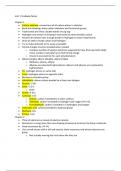
Unit 1 Textbook Notes
Chapter 1
• Carbon skeleton: connections of all carbon atoms in skeleton
• Bond-line drawings show carbon skeletons and functional groups
• Triple bonds are linear; double bonds are zig-zag
• Hydrogen only shown in drawing if connected to atoms besides carbon
• Assume all carbons have enough bonds to Hydrogen to have 4 total bonds
• Draw all atoms except carbon and hydrogen
• Try to make all bonds as far away as possible
• Formal charges must be included when needed
o Compare number of valence electrons supposed to have (from periodic table)
minus number it actually has to find formal charge
o A bond is one electron for each attached atom
• Alkane (single), alkene (double), alkyne (triple)
o Methane, ethane, ethyne
o Alkanes are saturated hydrocarbons; alkenes and alkynes are unsaturated
hydrocarbons
• Cis: hydrogen atoms on same side
• Trans: hydrogen atoms on opposite sides
• Benzene is aromatic group
• Haloalkane: alkane carbon bonded to at least one halogen
• Alcohol: C-OH
• Ether: C-O-C
o polar
• Amine: H-N-C
• Carbonyl: C=O
o Ketone: carbon is bonded to 2 other carbons
o Aldehyde: carbon is bonded to hydrogen and oxygen (H-C=O)
o Formaldehyde: carbon is bonded to 2 hydrogens and oxygen
• Carboxylic acid: carbonyl bonded to hydroxyl group
• Methane: CH4
• Ethane: C2H6
Chapter 2
• Think of electrons as clouds of electron density
• Resonance is using more than one drawing (resonance structure) to show a molecule
• Show resonance by [ ßà ]
• Use curved arrows with a tail and head to show resonance and where electrons are
going
o Not actually moving but treat them like they are
, •
o Electrons can only come from a bond or lp
o Ex:
§ Electrons are being moved from a bond
o Ex:
§ Electrons are being moved from a lp
• Never draw an arrow that comes from a positive charge
• Never draw an arrow going into empty space
• Rules
o Never break a single bond
o Never break the octet rule for second-row elements
§ NOF
o Always go towards cations and away from anions
• Resonance structures must have the same atoms connected in the same order
• Never draw the tail of an arrow on a single bond
• Count formal charges after moving electrons
• Resonance shows regions of high and low electron density because of formal charger
• An arrow on a negative FC means it’s on the lone pair
• Total charge between resonance should be the same
o Conservation of charge
• Steps for drawing resonance
o Can we convert lp into pi bonds?
o Can we convert pi bonds into lp?
o Can we convert pi bonds into pi bonds?
• Lp to lp is not possible
• Patterns
o Lp next to pi bond
§ Next to means separated from double bond by exactly one single bond
Chapter 1
• Carbon skeleton: connections of all carbon atoms in skeleton
• Bond-line drawings show carbon skeletons and functional groups
• Triple bonds are linear; double bonds are zig-zag
• Hydrogen only shown in drawing if connected to atoms besides carbon
• Assume all carbons have enough bonds to Hydrogen to have 4 total bonds
• Draw all atoms except carbon and hydrogen
• Try to make all bonds as far away as possible
• Formal charges must be included when needed
o Compare number of valence electrons supposed to have (from periodic table)
minus number it actually has to find formal charge
o A bond is one electron for each attached atom
• Alkane (single), alkene (double), alkyne (triple)
o Methane, ethane, ethyne
o Alkanes are saturated hydrocarbons; alkenes and alkynes are unsaturated
hydrocarbons
• Cis: hydrogen atoms on same side
• Trans: hydrogen atoms on opposite sides
• Benzene is aromatic group
• Haloalkane: alkane carbon bonded to at least one halogen
• Alcohol: C-OH
• Ether: C-O-C
o polar
• Amine: H-N-C
• Carbonyl: C=O
o Ketone: carbon is bonded to 2 other carbons
o Aldehyde: carbon is bonded to hydrogen and oxygen (H-C=O)
o Formaldehyde: carbon is bonded to 2 hydrogens and oxygen
• Carboxylic acid: carbonyl bonded to hydroxyl group
• Methane: CH4
• Ethane: C2H6
Chapter 2
• Think of electrons as clouds of electron density
• Resonance is using more than one drawing (resonance structure) to show a molecule
• Show resonance by [ ßà ]
• Use curved arrows with a tail and head to show resonance and where electrons are
going
o Not actually moving but treat them like they are
, •
o Electrons can only come from a bond or lp
o Ex:
§ Electrons are being moved from a bond
o Ex:
§ Electrons are being moved from a lp
• Never draw an arrow that comes from a positive charge
• Never draw an arrow going into empty space
• Rules
o Never break a single bond
o Never break the octet rule for second-row elements
§ NOF
o Always go towards cations and away from anions
• Resonance structures must have the same atoms connected in the same order
• Never draw the tail of an arrow on a single bond
• Count formal charges after moving electrons
• Resonance shows regions of high and low electron density because of formal charger
• An arrow on a negative FC means it’s on the lone pair
• Total charge between resonance should be the same
o Conservation of charge
• Steps for drawing resonance
o Can we convert lp into pi bonds?
o Can we convert pi bonds into lp?
o Can we convert pi bonds into pi bonds?
• Lp to lp is not possible
• Patterns
o Lp next to pi bond
§ Next to means separated from double bond by exactly one single bond