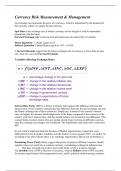
Currency Risk Measurement & Management
An exchange rate represents the price of a currency, which is determined by the demand for
that currency relative to supply for that currency.
Spot Rate is the exchange rate at which a currency can be bought or sold for immediate
transaction. (On the Spot)
Forward Exchange rate is rate for forward transaction into future like 3,6 months.
Direct Quotation - 1 Dollar equals to 65.
Indirect Quotation 1 Indian Rupee equals to 1/65 = 0.0154
A forward discount suggest that the future exchange rate of currency is lower than its spot
rate. And vice-versa for Forward Premium.
Variables affecting Exchange Rates
Interest Rate Parity (IRP) is a theory in finance that suggests the difference between the
interest rates of two countries should equal the difference between the spot exchange rate and
the future exchange rate of their currencies. Simply put, it means if one country's interest
rates are higher, its currency should depreciate in the future compared to the currency of the
country with lower interest rates, and this should balance out the interest rate difference. This
concept helps investors ensure they get similar returns from investing in different countries,
once the exchange rate changes are considered. The Equilibrium state achieved is referred as
IRP.
In real world it might not hold true because of Market imperfections, transaction costs,
differential tax law & market condition as Cuba market is not as good as NYC or London. So
according to the above theory there is no Arbitrage opportunities. But in real world there is.
Purchasing Power Parity theory suggest that prices of goods in different countries should
equalize when converted into a common currency, considering exchange & inflation rates.
• This does not hold true at all in real world, India vs UK is a classic example.
The absolute form of PPP is like law of one price, whereas Relative form of PPP accounts
for market imperfections like transportation costs, tariffs, political relation among countries.
An exchange rate represents the price of a currency, which is determined by the demand for
that currency relative to supply for that currency.
Spot Rate is the exchange rate at which a currency can be bought or sold for immediate
transaction. (On the Spot)
Forward Exchange rate is rate for forward transaction into future like 3,6 months.
Direct Quotation - 1 Dollar equals to 65.
Indirect Quotation 1 Indian Rupee equals to 1/65 = 0.0154
A forward discount suggest that the future exchange rate of currency is lower than its spot
rate. And vice-versa for Forward Premium.
Variables affecting Exchange Rates
Interest Rate Parity (IRP) is a theory in finance that suggests the difference between the
interest rates of two countries should equal the difference between the spot exchange rate and
the future exchange rate of their currencies. Simply put, it means if one country's interest
rates are higher, its currency should depreciate in the future compared to the currency of the
country with lower interest rates, and this should balance out the interest rate difference. This
concept helps investors ensure they get similar returns from investing in different countries,
once the exchange rate changes are considered. The Equilibrium state achieved is referred as
IRP.
In real world it might not hold true because of Market imperfections, transaction costs,
differential tax law & market condition as Cuba market is not as good as NYC or London. So
according to the above theory there is no Arbitrage opportunities. But in real world there is.
Purchasing Power Parity theory suggest that prices of goods in different countries should
equalize when converted into a common currency, considering exchange & inflation rates.
• This does not hold true at all in real world, India vs UK is a classic example.
The absolute form of PPP is like law of one price, whereas Relative form of PPP accounts
for market imperfections like transportation costs, tariffs, political relation among countries.