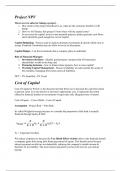
Project NPV
There are two sides for taking a project -
1. How much is this project beneficial to us, what are the economic benefits it will
bring?
2. How we will finance this project? From where will the capital come?
• So you raise the capital, invest it into potential projects, project generate cash flows
and it should be good enough for cost of capital.
Capital Budgeting - Process used to analyze alternate investments & decide which ones to
accept. Financial Constraints may not allow to invest in all projects.
Capital Budget - List the investments that a company plans to undertake
Role of Financial Manager-
1. Investment decisions - Identify good projects ( projects that will maximize
shareholders wealth in the long run)
2. Financing decisions - how to finance these projects, how to raise capital?
3. Working Capital Management - Ensure availability of cash (outside the scope of
this module), managing short terms assets & liabilities.
NPV = PV (benefits) - PV (Cost)
Cost of Capital
Cost of Capital or WACC is the discount rate that firms use to discount the cash flows back
to present value. It is also known as Investor's opportunity cost. It represents the return
offered in financial market on investments of equivalent risk. (Required rate of return)
Cost of Equity + Cost of Debt = Cost of Capital
Assumption - Project Risk = Firm Risk.
Its called Weighted average because we consider the proportion of the fund is actually
financed through equity & debt.
Tc = Corporate Tax Rate
We reduce corporate tax because the Tax Shield Effect of debt refers to the financial benefit
a company gains from using debt financing instead of equity. This benefit arises because
interest payment on debt are tax-deductible, reducing the company's taxable income &
therefore its tax liability. The more interest payments you have the less tax you end up
paying.
There are two sides for taking a project -
1. How much is this project beneficial to us, what are the economic benefits it will
bring?
2. How we will finance this project? From where will the capital come?
• So you raise the capital, invest it into potential projects, project generate cash flows
and it should be good enough for cost of capital.
Capital Budgeting - Process used to analyze alternate investments & decide which ones to
accept. Financial Constraints may not allow to invest in all projects.
Capital Budget - List the investments that a company plans to undertake
Role of Financial Manager-
1. Investment decisions - Identify good projects ( projects that will maximize
shareholders wealth in the long run)
2. Financing decisions - how to finance these projects, how to raise capital?
3. Working Capital Management - Ensure availability of cash (outside the scope of
this module), managing short terms assets & liabilities.
NPV = PV (benefits) - PV (Cost)
Cost of Capital
Cost of Capital or WACC is the discount rate that firms use to discount the cash flows back
to present value. It is also known as Investor's opportunity cost. It represents the return
offered in financial market on investments of equivalent risk. (Required rate of return)
Cost of Equity + Cost of Debt = Cost of Capital
Assumption - Project Risk = Firm Risk.
Its called Weighted average because we consider the proportion of the fund is actually
financed through equity & debt.
Tc = Corporate Tax Rate
We reduce corporate tax because the Tax Shield Effect of debt refers to the financial benefit
a company gains from using debt financing instead of equity. This benefit arises because
interest payment on debt are tax-deductible, reducing the company's taxable income &
therefore its tax liability. The more interest payments you have the less tax you end up
paying.