Wills and the Administration of Estates
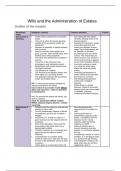
Outline of the module
Workshop/ Subtopics covered Common mistakes Tracker
Topic
Succession & • Assets which comprise the succession • Not reading the fact pattern
Intestacy estate. carefully. Missing some of the
• How and to whom the assets passing relevant parties.
outside of the succession estate are • Rushing the calculation. Adopt
distributed. a formulaic approach and
• Whether an intestacy or partial intestacy check your answers at each
had occurred. stage. Each of the options will
• How the intestacy rules applied to a be ‘feasible’ on the facts
given scenario, which beneficiaries were provided but only one will be
entitled and in what proportion. correct. This means that you
• The value each beneficiary is entitled to cannot assume your answer is
receive. correct just because it appears
• The terms of the statutory trusts as one of the possible answers.
(contingency and substitution parts). • Incorrectly valuing an asset
• Beneficiaries with vested interests and e.g. using the whole value
contingent interests. where the asset was jointly
• The definition of ‘chattels’. owned.
• The amount of the statutory legacy and • Confusing the treatment of
other rights for a surviving spouse. assets owned as joint tenants
• The distinction between the succession and tenants in common.
estate and taxable estate. • Not distinguishing between
vested and contingent
TIP: To work out the balance available for interests.
intestacy distribution see below: • Where there is a partial
Gross value of succession estate MINUS intestacy, failing to accurately
debts and expenses = value to distribute identify which part of the estate
to beneficiaries. is intestate. Likewise,
confusing full /partial intestacy.
And, if a spouse/civil partner will inherit, you
need to continue:
Value for distribution MINUS chattels
MINUS statutory legacy amount = residue
remaining.
Succession & • Requirements for making a valid will and • Misunderstanding the
Wills whether a will is valid. requirements of s.9 Wills Act
• Test for testamentary capacity in Banks 1837.
v Goodfellow, and the rule in Parker v • Confusing the test for
Felgate. testamentary capacity under
• Provisions of s. 9 Wills Act 1837 to a Banks v Goodfellow with the
given scenario and the requirements for statutory test for mental
witnesses. capacity under the Mental
• Role of the attestation clause and the Capacity Act 2005.
presumptions that arise when this is • Failing to identify when a
appropriately drafted. relevant statutory provision
• Testator’s intention (i.e. knowledge and applies, or, incorrectly applying
approval) and the effect of undue the rule.
influence. • Considering a clause in a will in
• Consequences of a testator being isolation, or in an illogical order
unable to read and or sign their will and e.g. starting with the residue.
the role of the attestation clause in these • Concluding the intestacy rules
scenarios. apply when they do not (thus
• Advice given to a client about their will suggesting a lack of
, and its execution. understanding about the
• Relevant professional conduct issues. function and drafting of the
residue clause, or the effect of
any substitution provision).
Likewise, failing to recognise
• Distinction between an inheritance
when a partial intestacy does
received outside of the distribution
occur (the failure of all or part
estate, received under a will, and
of the residue).
received under an intestacy.
• Confusing statutory trusts
• Assets comprising the succession estate
under intestacy with express
passing under the will.
substitution and contingent gifts
• Distribution of an estate by will - based
in a will.
on a description of the effect of a will, or
Drafting & • Confusing the statutory trusts
from reading a copy of the whole/part of
Interpretation under intestacy with s.33 Wills
a will.
of a will Act 1837.
• Legal effect of different types of clauses
• Not knowing the effect of a
within a will.
statutory provision or
• Definition of the residuary estate and the
misunderstanding the rules of
role this clause plays within a will.
construction
• Effect of different types of residue clause
(whether worded as a class gift or a gift
of a discrete share to a particular
person).
• Effect of substitution provisions and the
creation of contingent interests and/or
trusts.
• Consequences of a failure of a gift in a
will.
• Effect of sections 9, 15, 18, 18A-C, 20,
21, 24, 33 Wills Act 1837 and when/if
each is relevant.
• Law regarding the burden of tax and
transfer costs where the will is silent, as
well as other rules of construction.
• Role of express administrative powers,
and the scope of the statutory powers of
a PR appointed by will.
• Function of a codicil and how a codicil
affects a previous will.
• Different methods of revoking a valid
will.
• Relevant professional conduct issues
Changes to • Scenario where claim might arise and • Confusing the party (the
estate the relevant sections of the IPFDA. deceased or the applicant) the
distribution • Rules relating to the timing and domicile jurisdictional requirement
following death requirements. applies to.
- Inheritance • Ground on which a claim can be brought • Confusing the date from which
Provision for and the category of applicants entitled to the time limit for an application
Family & do so. runs from/to.
Dependents • Distinction between the spouse standard • Not appreciating the difference
Act 1975 and the maintenance standard and when between the ‘right to apply’ (i.e.
(‘IPFDA’) each applies anyone who falls within the
• Common guidelines and applied these to category of applicant) with the
a scenario. ‘likelihood of success’ (where
• Particular guidelines (i.e. those specific the personal circumstances are
to the type of applicant) and applied considered).
these to a scenario. • Mixing the common guidelines
• Possible court orders can be made and (which apply to all applicants)
assets which are or can be considered with the particular guidelines
part of the estate for these purposes. (which only apply to specific
• Possible alternatives to litigation e.g. applicants).
deeds of variation. • Applying a specific guideline to
an applicant where it does not
, apply.
• Mis-reading the question and
considering aspects of the
claim that are not relevant
Post-death • Reasons for making a deed of variation • Confusing the statutory
arrangements of a will or other post death provisions (s.142,143 IHTA,
arrangement. s.62 TCGA)
• Difference between a variation and a • Not appreciating whether the
disclaimer. post-death arrangement will
• s.142 IHTA 1984 (IHT writing back) and result in; no change to the IHT
when this would be useful position on death, an increase
• s.62 TCGA 1992 (CGT writing back) and in IHT, or an IHT saving.
when this would be useful • Not knowing the restrictions
• Correct / required parties to a deed of that apply with a disclaimer.
variation • Thinking that an election under
• Nature of a precatory trust and effect of s.62 is relevant for a cash
s.143 IHTA transfer
Administration • Role of a PR and know the steps that • Confusing terminology e.g.
should be followed to administer an ‘grant of administration with will
estate. annexed’ (instead of ‘grant of
• Grant of representation required for an letters of administration with
estate. will annexed’).
• Situations where an estate can be • Incorrectly applying NCPR 20 /
administered without a grant. NCPR 22.
• The application of NCPR 20 and NCPR • Not knowing the number of
22 and the applicants for a grant of PRs required for a given
representation. scenario.
• Effect of s.7 Administration of Estates • Incorrectly describing the steps
Act 1925 (i.e. chain of representation). required to make an application
• Difference between an excepted and for the grant e.g. sending a will
non-excepted estate and identifying to HMRC, or referring to the
whether an estate is low value excepted, wrong form PA1A/P.
exempt excepted or not excepted. • Failing to recognise when
• Documentation required to obtain a additional items are needed for
grant of representation for an excepted a grant application e.g.
and non-excepted estate, and explain affidavits regarding execution
where these items need to be sent. or alterations, form of
• Options for PRs who do not wish to act renunciation, death certificate
and which would be best for a particular of pre-deceased executor.
client. • Not knowing when s.27 Trustee
• Deadline for paying IHT, and Act 1925 applies and when it
distinguishing this from the deadline for does not. Misunderstanding the
providing HMRC with information about timing requirements.
an estate. • Not being able to identify
• Consider different options available to whether an estate is excepted
raise funds to pay IHT and the use of or not.
instalment option • Not understanding how a claim
• Following forms and should be able to for the transferred NRB affects
explain when and why each would be the excepted status of an
used: estate.
o PA1A/PA1P • Misunderstanding the deadline
o IHT 400 for paying IHT. Not considering
o C4 instalment option
• Rules relating to payment of the
deceased’s debts, including the
distinction between secured and
unsecured debts.
• Law relating to protection of personal
representatives with regards to missing
or unidentified beneficiaries or creditors.
• Fiduciary nature of the role of a PR and
how this can result in personal liability.
, • Statutory, common law and professional
duties of a PR.
• Scope of the statutory powers available
to enable the PRs to carry out the
administration of the estate. Common
areas tested included the power to
charge for time and/or claim expenses,
the power of investment, the power of
appropriation and powers to apply
income and capital from a trust.
• Effect of post-death changes in value of
assets in the estate – either by way of
adjustment/correction of the death value
or where values have changed since the
date of death.
• Distinction between a solvent and
insolvent estate and apply the relevant
statutory provisions.
• Order of payment of debts and legacies
in a solvent estate and which part of the
estate can be used to meet these.
• Role and structure of estate accounts
and should appreciate what information
would be recorded in each of the capital,
income and distribution accounts, and
whose approval is required.
• Relevant professional conduct issues.
Taxation There is greater emphasis on IHT but Income • Arithmetic errors. Use a
Tax (IT) and Capital Gains Tax (CGT) where calculator even if you think you
these relate to the administration of an estate can do parts of the calculation
or tax planning advice are also considered. without one and always check
your answer.
It is common to be asked about the IHT • Transposition errors. Take care
position following someone’s death. It is when copying figures from the
important that you can differentiate between question.
the treatment of lifetime transfers and the • Rushing the calculation. Adopt
taxation of the death estate. When a person a formulaic approach and
dies there may be IHT due in respect of check your answers at each
lifetime transfers in addition to the IHT due stage. Each of the options will
in respect of their death estate. Although the be ‘feasible’ on the facts
lifetime transfers and the death estate are provided but only one will be
taxed separately, the lifetime transfers have correct. This means that you
an effect on the death estate by contributing cannot assume your answer is
to the cumulative total as at the date of correct just because it appears
death. as one of the possible answers.
• Reading the question
incorrectly and focusing on the
incorrect tax. Confusing IHT
and CGT.
• Panic! Read the question
careful and adopt a logical
approach.
• Lack of basic understanding
due to insufficient revision.
• Not understanding terminology
e.g. settlor, trustee, beneficiary,
life tenant, remainder interest
IHT – Lifetime • Concept of the cumulative total and its • Not following the formula for
effect on both taxation of lifetime gifts the calculation.
and the death estate. • Incorrectly identifying the tax
• PETs and LCTs – and recognise when year in which a lifetime gift is
each has occurred on the facts provided. made.
Outline of the module
Workshop/ Subtopics covered Common mistakes Tracker
Topic
Succession & • Assets which comprise the succession • Not reading the fact pattern
Intestacy estate. carefully. Missing some of the
• How and to whom the assets passing relevant parties.
outside of the succession estate are • Rushing the calculation. Adopt
distributed. a formulaic approach and
• Whether an intestacy or partial intestacy check your answers at each
had occurred. stage. Each of the options will
• How the intestacy rules applied to a be ‘feasible’ on the facts
given scenario, which beneficiaries were provided but only one will be
entitled and in what proportion. correct. This means that you
• The value each beneficiary is entitled to cannot assume your answer is
receive. correct just because it appears
• The terms of the statutory trusts as one of the possible answers.
(contingency and substitution parts). • Incorrectly valuing an asset
• Beneficiaries with vested interests and e.g. using the whole value
contingent interests. where the asset was jointly
• The definition of ‘chattels’. owned.
• The amount of the statutory legacy and • Confusing the treatment of
other rights for a surviving spouse. assets owned as joint tenants
• The distinction between the succession and tenants in common.
estate and taxable estate. • Not distinguishing between
vested and contingent
TIP: To work out the balance available for interests.
intestacy distribution see below: • Where there is a partial
Gross value of succession estate MINUS intestacy, failing to accurately
debts and expenses = value to distribute identify which part of the estate
to beneficiaries. is intestate. Likewise,
confusing full /partial intestacy.
And, if a spouse/civil partner will inherit, you
need to continue:
Value for distribution MINUS chattels
MINUS statutory legacy amount = residue
remaining.
Succession & • Requirements for making a valid will and • Misunderstanding the
Wills whether a will is valid. requirements of s.9 Wills Act
• Test for testamentary capacity in Banks 1837.
v Goodfellow, and the rule in Parker v • Confusing the test for
Felgate. testamentary capacity under
• Provisions of s. 9 Wills Act 1837 to a Banks v Goodfellow with the
given scenario and the requirements for statutory test for mental
witnesses. capacity under the Mental
• Role of the attestation clause and the Capacity Act 2005.
presumptions that arise when this is • Failing to identify when a
appropriately drafted. relevant statutory provision
• Testator’s intention (i.e. knowledge and applies, or, incorrectly applying
approval) and the effect of undue the rule.
influence. • Considering a clause in a will in
• Consequences of a testator being isolation, or in an illogical order
unable to read and or sign their will and e.g. starting with the residue.
the role of the attestation clause in these • Concluding the intestacy rules
scenarios. apply when they do not (thus
• Advice given to a client about their will suggesting a lack of
, and its execution. understanding about the
• Relevant professional conduct issues. function and drafting of the
residue clause, or the effect of
any substitution provision).
Likewise, failing to recognise
• Distinction between an inheritance
when a partial intestacy does
received outside of the distribution
occur (the failure of all or part
estate, received under a will, and
of the residue).
received under an intestacy.
• Confusing statutory trusts
• Assets comprising the succession estate
under intestacy with express
passing under the will.
substitution and contingent gifts
• Distribution of an estate by will - based
in a will.
on a description of the effect of a will, or
Drafting & • Confusing the statutory trusts
from reading a copy of the whole/part of
Interpretation under intestacy with s.33 Wills
a will.
of a will Act 1837.
• Legal effect of different types of clauses
• Not knowing the effect of a
within a will.
statutory provision or
• Definition of the residuary estate and the
misunderstanding the rules of
role this clause plays within a will.
construction
• Effect of different types of residue clause
(whether worded as a class gift or a gift
of a discrete share to a particular
person).
• Effect of substitution provisions and the
creation of contingent interests and/or
trusts.
• Consequences of a failure of a gift in a
will.
• Effect of sections 9, 15, 18, 18A-C, 20,
21, 24, 33 Wills Act 1837 and when/if
each is relevant.
• Law regarding the burden of tax and
transfer costs where the will is silent, as
well as other rules of construction.
• Role of express administrative powers,
and the scope of the statutory powers of
a PR appointed by will.
• Function of a codicil and how a codicil
affects a previous will.
• Different methods of revoking a valid
will.
• Relevant professional conduct issues
Changes to • Scenario where claim might arise and • Confusing the party (the
estate the relevant sections of the IPFDA. deceased or the applicant) the
distribution • Rules relating to the timing and domicile jurisdictional requirement
following death requirements. applies to.
- Inheritance • Ground on which a claim can be brought • Confusing the date from which
Provision for and the category of applicants entitled to the time limit for an application
Family & do so. runs from/to.
Dependents • Distinction between the spouse standard • Not appreciating the difference
Act 1975 and the maintenance standard and when between the ‘right to apply’ (i.e.
(‘IPFDA’) each applies anyone who falls within the
• Common guidelines and applied these to category of applicant) with the
a scenario. ‘likelihood of success’ (where
• Particular guidelines (i.e. those specific the personal circumstances are
to the type of applicant) and applied considered).
these to a scenario. • Mixing the common guidelines
• Possible court orders can be made and (which apply to all applicants)
assets which are or can be considered with the particular guidelines
part of the estate for these purposes. (which only apply to specific
• Possible alternatives to litigation e.g. applicants).
deeds of variation. • Applying a specific guideline to
an applicant where it does not
, apply.
• Mis-reading the question and
considering aspects of the
claim that are not relevant
Post-death • Reasons for making a deed of variation • Confusing the statutory
arrangements of a will or other post death provisions (s.142,143 IHTA,
arrangement. s.62 TCGA)
• Difference between a variation and a • Not appreciating whether the
disclaimer. post-death arrangement will
• s.142 IHTA 1984 (IHT writing back) and result in; no change to the IHT
when this would be useful position on death, an increase
• s.62 TCGA 1992 (CGT writing back) and in IHT, or an IHT saving.
when this would be useful • Not knowing the restrictions
• Correct / required parties to a deed of that apply with a disclaimer.
variation • Thinking that an election under
• Nature of a precatory trust and effect of s.62 is relevant for a cash
s.143 IHTA transfer
Administration • Role of a PR and know the steps that • Confusing terminology e.g.
should be followed to administer an ‘grant of administration with will
estate. annexed’ (instead of ‘grant of
• Grant of representation required for an letters of administration with
estate. will annexed’).
• Situations where an estate can be • Incorrectly applying NCPR 20 /
administered without a grant. NCPR 22.
• The application of NCPR 20 and NCPR • Not knowing the number of
22 and the applicants for a grant of PRs required for a given
representation. scenario.
• Effect of s.7 Administration of Estates • Incorrectly describing the steps
Act 1925 (i.e. chain of representation). required to make an application
• Difference between an excepted and for the grant e.g. sending a will
non-excepted estate and identifying to HMRC, or referring to the
whether an estate is low value excepted, wrong form PA1A/P.
exempt excepted or not excepted. • Failing to recognise when
• Documentation required to obtain a additional items are needed for
grant of representation for an excepted a grant application e.g.
and non-excepted estate, and explain affidavits regarding execution
where these items need to be sent. or alterations, form of
• Options for PRs who do not wish to act renunciation, death certificate
and which would be best for a particular of pre-deceased executor.
client. • Not knowing when s.27 Trustee
• Deadline for paying IHT, and Act 1925 applies and when it
distinguishing this from the deadline for does not. Misunderstanding the
providing HMRC with information about timing requirements.
an estate. • Not being able to identify
• Consider different options available to whether an estate is excepted
raise funds to pay IHT and the use of or not.
instalment option • Not understanding how a claim
• Following forms and should be able to for the transferred NRB affects
explain when and why each would be the excepted status of an
used: estate.
o PA1A/PA1P • Misunderstanding the deadline
o IHT 400 for paying IHT. Not considering
o C4 instalment option
• Rules relating to payment of the
deceased’s debts, including the
distinction between secured and
unsecured debts.
• Law relating to protection of personal
representatives with regards to missing
or unidentified beneficiaries or creditors.
• Fiduciary nature of the role of a PR and
how this can result in personal liability.
, • Statutory, common law and professional
duties of a PR.
• Scope of the statutory powers available
to enable the PRs to carry out the
administration of the estate. Common
areas tested included the power to
charge for time and/or claim expenses,
the power of investment, the power of
appropriation and powers to apply
income and capital from a trust.
• Effect of post-death changes in value of
assets in the estate – either by way of
adjustment/correction of the death value
or where values have changed since the
date of death.
• Distinction between a solvent and
insolvent estate and apply the relevant
statutory provisions.
• Order of payment of debts and legacies
in a solvent estate and which part of the
estate can be used to meet these.
• Role and structure of estate accounts
and should appreciate what information
would be recorded in each of the capital,
income and distribution accounts, and
whose approval is required.
• Relevant professional conduct issues.
Taxation There is greater emphasis on IHT but Income • Arithmetic errors. Use a
Tax (IT) and Capital Gains Tax (CGT) where calculator even if you think you
these relate to the administration of an estate can do parts of the calculation
or tax planning advice are also considered. without one and always check
your answer.
It is common to be asked about the IHT • Transposition errors. Take care
position following someone’s death. It is when copying figures from the
important that you can differentiate between question.
the treatment of lifetime transfers and the • Rushing the calculation. Adopt
taxation of the death estate. When a person a formulaic approach and
dies there may be IHT due in respect of check your answers at each
lifetime transfers in addition to the IHT due stage. Each of the options will
in respect of their death estate. Although the be ‘feasible’ on the facts
lifetime transfers and the death estate are provided but only one will be
taxed separately, the lifetime transfers have correct. This means that you
an effect on the death estate by contributing cannot assume your answer is
to the cumulative total as at the date of correct just because it appears
death. as one of the possible answers.
• Reading the question
incorrectly and focusing on the
incorrect tax. Confusing IHT
and CGT.
• Panic! Read the question
careful and adopt a logical
approach.
• Lack of basic understanding
due to insufficient revision.
• Not understanding terminology
e.g. settlor, trustee, beneficiary,
life tenant, remainder interest
IHT – Lifetime • Concept of the cumulative total and its • Not following the formula for
effect on both taxation of lifetime gifts the calculation.
and the death estate. • Incorrectly identifying the tax
• PETs and LCTs – and recognise when year in which a lifetime gift is
each has occurred on the facts provided. made.