100% satisfaction guarantee Immediately available after payment Both online and in PDF No strings attached 4.2 TrustPilot
logo-home
Exam (elaborations)

Data Structures and Algorithm Analysis in C++

Rating
-
Sold
-
Pages
23
Grade
A+
Uploaded on
12-04-2025
Written in
2024/2025

Data Structures Through C - Third Edition Exam Questions with Answers Algorithm Analysis - Correct Answers: Evaluating efficiency of algorithms based on performance. Asymptotic Notation - Correct Answers: Mathematical notation for describing algorithm growth rates. Time Complexity - Correct Answers: Quantitative measure of algorithm execution time. Arrays - Correct Answers: Collection of elements stored at contiguous memory locations. Two-Dimensional Arrays - Correct Answers: Arrays organized in rows and columns format. Sparse Matrices - Correct Answers: Matrices predominantly filled with zero values. Linked List - Correct Answers: Data structure consisting of nodes connected by pointers. Stack - Correct Answers: LIFO data structure for storing elements. Queue - Correct Answers: FIFO data structure for managing elements. Binary Tree - Correct Answers: Tree structure where each node has at most two children. Binary Search Tree - Correct Answers: Binary tree with ordered nodes for efficient searching. Graph - Correct Answers: Collection of vertices connected by edges. Depth First Search - Correct Answers: Traversal method exploring as far down a branch. Breadth First Search - Correct Answers: Traversal method exploring all neighbors before deeper nodes. Dijkstra's Algorithm - Correct Answers: Algorithm for finding shortest paths in weighted graphs. Sorting Algorithms - Correct Answers: Methods for arranging elements in a specific order. Bubble Sort - Correct Answers: Simple sorting algorithm comparing adjacent elements. Merge Sort - Correct Answers: Divide and conquer algorithm for sorting elements. Heap Sort - Correct Answers: Sorting algorithm using a binary heap data structure. Linear Search - Correct Answers: Sequential search method checking each element. Binary Search - Correct Answers: Efficient search method on sorted arrays. AVL Trees - Correct Answers: Self-balancing binary search trees for efficient operations. Kruskal's Algorithm - Correct Answers: Algorithm for finding minimum spanning trees in graphs. Prim's Algorithm - Correct Answers: Algorithm for constructing minimum spanning trees from graphs. Topological Sorting - Correct Answers: Ordering of vertices in a directed acyclic graph. Polynomial Multiplication - Correct Answers: Combining polynomials using array representations. Deque - Correct Answers: Double-ended queue allowing insertion/removal from both ends. Priority Queue - Correct Answers: Queue where elements are processed based on priority. Algorithm - Correct Answers: Sequence of instructions for problem-solving. Input - Correct Answers: Data supplied externally to an algorithm. Output - Correct Answers: Result produced by an algorithm. Finiteness - Correct Answers: Algorithm must terminate in finite steps. Definiteness - Correct Answers: Steps in an algorithm must be clear. Effectiveness - Correct Answers: Steps must be executable without intelligence. Time Analysis - Correct Answers: Evaluating algorithms based on execution time. Space Analysis - Correct Answers: Evaluating algorithms based on memory usage. Prominent Operations - Correct Answers: Key operations that determine algorithm efficiency. Growth Rate - Correct Answers: Rate at which operation count increases with input size. Significant Operations - Correct Answers: Operations that consume the most time in algorithms. Comparison Operations - Correct Answers: Operations that compare values in algorithms. Arithmetic Operations - Correct Answers: Operations involving calculations like addition or multiplication. Additive Operators - Correct Answers: Include addition, subtraction, increment, decrement. Multiplicative Operators - Correct Answers: Include multiplication, division, modulus. Algorithm Efficiency - Correct Answers: Determined by comparing different algorithms. Overhead Operations - Correct Answers: Operations that do not significantly affect performance. Initialization - Correct Answers: Setting initial values before algorithm execution. Conditional Checks - Correct Answers: Evaluating conditions during algorithm execution. Increment - Correct Answers: Increasing a counter in an algorithm. Pythagorean Triplet - Correct Answers: Three integers satisfying a² + b² = c². Searching Algorithms - Correct Answers: Algorithms that locate specific data in structures. Doubly Linked List - Correct Answers: Linked list allowing traversal in both directions. Quick Sort - Correct Answers: Efficient sorting algorithm using divide-and-conquer. Exercises - Correct Answers: Practice problems at chapter end to enhance skills. Animations - Correct Answers: Visual aids demonstrating data structure operations. Initialization Operation - Correct Answers: First step in an algorithm, often negligible in large files. Printing Operation - Correct Answers: Outputting data, remains constant regardless of file size. Best Case Input - Correct Answers: Input allowing fastest algorithm performance, minimal work. Worst Case Input - Correct Answers: Input causing maximum algorithm workload, slowest performance. Average Case Input - Correct Answers: Input representing typical performance of an algorithm. Rate of Growth - Correct Answers: Increase in operations as problem size expands. Big Omega (Ω) - Correct Answers: Lower bound of algorithm performance, best case. Big Oh (O) - Correct Answers: Upper bound of algorithm performance, worst case. Big Theta (θ) - Correct Answers: Tight bound, algorithm performance grows at same rate. Constant Time - Correct Answers: Execution time does not change with input size. N Comparisons - Correct Answers: Total checks in worst-case searching scenario. Input Set - Correct Answers: Collection of data used to analyze algorithm performance. Algorithm Complexity - Correct Answers: Measure of algorithm's resource usage as input grows. Input Size (n) - Correct Answers: Number of elements in the input data set. Number of Groups (m) - Correct Answers: Distinct categories in average-case analysis. Probability of Input - Correct Answers: Likelihood of input belonging to a specific group. Time for Group i - Correct Answers: Execution time for inputs from a specific group. Performance Analysis - Correct Answers: Evaluating how well an algorithm executes under conditions. Input Arrangement - Correct Answers: Order of data affecting algorithm performance. Dominating Functions - Correct Answers: Faster growing functions overshadow slower ones. Threshold Value - Correct Answers: Minimum input size where performance characteristics change. Graphical Representation - Correct Answers: Visual depiction of algorithm growth behavior. Algorithm Workload - Correct Answers: Total operations required by an algorithm to complete. Input List - Correct Answers: Data sequence used for testing algorithm performance. Asymptotic Analysis - Correct Answers: Evaluates algorithm performance based on input size. Big O Notation - Correct Answers: Describes worst-case time complexity of algorithms. Big Ω Notation - Correct Answers: Defines tightest lower bound for algorithm growth. Big θ Notation - Correct Answers: Indicates tight bounds for algorithm growth rates. Tightest Lower Bound - Correct Answers: Smallest growth rate that still satisfies performance. Tightest Upper Bound - Correct Answers: Largest growth rate that still satisfies performance. Iterative Algorithms - Correct Answers: Algorithms that repeat a set of instructions. Recursive Algorithms - Correct Answers: Algorithms that call themselves for problem-solving. Backtracking Algorithms - Correct Answers: Algorithms that explore all possible solutions. Divide and Conquer Algorithms - Correct Answers: Algorithms that break problems into smaller subproblems. Dynamic Programming Algorithms - Correct Answers: Algorithms that solve problems by combining solutions. Greedy Algorithms - Correct Answers: Algorithms that make the best local choice at each step. Branch and Bound Algorithms - Correct Answers: Algorithms that systematically explore solution space. Brute Force Algorithms - Correct Answers: Algorithms that try all possible solutions. Randomized Algorithms - Correct Answers: Algorithms that use randomness to make decisions. Dominant Operation - Correct Answers: The most significant operation affecting time complexity. Logarithmic Comparison - Correct Answers: Using logarithms to compare growth rates of functions. Constant Value - Correct Answers: A fixed number that does not change with input size. Execution Count - Correct Answers: Number of times a specific operation is performed. Algorithm Characteristics - Correct Answers: Features that define the behavior of algorithms. Algorithm Input - Correct Answers: Data provided to an algorithm for processing. Algorithm Output - Correct Answers: Results produced by an algorithm after processing. A1 - Correct Answers: More efficient for all inputs except small. A2 - Correct Answers: More efficient for small inputs. Asymptotic Complexity - Correct Answers: Describes performance of algorithms as input size grows. fun3(n) - Correct Answers: Has time complexity of n log n. fun4(n) - Correct Answers: Has time complexity of n^(log n). for loop - Correct Answers: Control structure for repeating code a set number of times. O notation - Correct Answers: Describes upper bound of algorithm's growth rate. θ notation - Correct Answers: Describes tight bound of algorithm's growth rate. Ω notation - Correct Answers: Describes lower bound of algorithm's growth rate. fun(int n) - Correct Answers: Calculates Fibonacci sequence up to n. Recursive Calls - Correct Answers: Function calls itself to solve smaller instances. Linear Data Structures - Correct Answers: Elements arranged in a sequential manner. Nonlinear Data Structures - Correct Answers: Elements arranged in a hierarchical manner. Array - Correct Answers: Collection of similar elements in contiguous memory. Index - Correct Answers: Position of an element in an array. Traversal - Correct Answers: Accessing each element in a data structure. Search - Correct Answers: Finding an element in a data structure. Sort - Correct Answers: Arranging elements in a specified order. Fixed Size - Correct Answers: Array size determined at creation time. Variable Size - Correct Answers: Linked list size can change dynamically. Memory Locations - Correct Answers: Addresses where data is stored in memory. Node - Correct Answers: Basic unit of a linked list containing data. Pointers - Correct Answers: Variables that store memory addresses. Performance Issues - Correct Answers: Problems affecting efficiency of data structures. Computational Time - Correct Answers: Time taken by an algorithm to complete execution. Function Comparison - Correct Answers: Analyzing efficiency of two or more functions. Exercise Level II - Correct Answers: Intermediate problems to practice algorithm analysis. Insert Function - Correct Answers: Adds an element at a specified position in array. Delete Function - Correct Answers: Removes an element from a specified position in array. Reverse Function - Correct Answers: Swaps elements to reverse the order of the array. Display Function - Correct Answers: Traverses and prints all elements of the array. Search Function - Correct Answers: Finds a specified element in the array. MAX - Correct Answers: Constant defining maximum array size (5). Two-Dimensional Array - Correct Answers: Array organized in rows and columns (m x n). Row Major Arrangement - Correct Answers: Stores array elements row-wise in memory. Column Major Arrangement - Correct Answers: Stores array elements column-wise in memory. Base Address - Correct Answers: Starting address of an array in memory. Element Access - Correct Answers: Accessing array elements using subscripts. Address Calculation - Correct Answers: Formula to find memory location of array element. Common Matrix Operations - Correct Answers: Includes addition, multiplication, and transposition. Element Overwrite - Correct Answers: Replacing an array element with a new value. Shift Elements - Correct Answers: Moving elements in an array to make space. Looping - Correct Answers: Iterating through array elements using loops. Temp Variable - Correct Answers: Used for swapping elements in reverse function. Print Function - Correct Answers: Outputs data to the console. Matrix Representation - Correct Answers: Visual depiction of a 2-D array structure. Function Parameters - Correct Answers: Arguments passed to functions for processing. Element Absent - Correct Answers: Indicates a searched element is not found. C Language - Correct Answers: Programming language that supports array operations. Program Output - Correct Answers: Results displayed after executing array operations. Matrix Addition - Correct Answers: Combining two matrices element-wise to form a new matrix. Matrix Multiplication - Correct Answers: Calculating the product of two matrices using dot product. Matrix Transpose - Correct Answers: Interchanging rows and columns of a matrix. Function create() - Correct Answers: Initializes a 3x3 matrix with user input. Function display() - Correct Answers: Outputs the elements of a 3x3 matrix. Function matadd() - Correct Answers: Adds two 3x3 matrices and stores result. Function matmul() - Correct Answers: Multiplies two 3x3 matrices and stores result. Function transpose() - Correct Answers: Creates a transposed version of a matrix. 3D Array - Correct Answers: An array of arrays of arrays, storing multiple 2D arrays. Row Major Order - Correct Answers: Memory arrangement where rows are stored sequentially. Column Major Order - Correct Answers: Memory arrangement where columns are stored sequentially. Element Access Formula (Row Major) - Correct Answers: Base address + i * y * z + j * z + k. Element Access Formula (Column Major) - Correct Answers: Base address + i * y * z + k * y + j. Polynomial Representation - Correct Answers: Storing polynomial coefficients and exponents in an array. Polynomial Degree - Correct Answers: Highest exponent in a polynomial expression. Coefficient - Correct Answers: Numerical factor in a polynomial term. Exponent - Correct Answers: Indicates the power of a variable in a term. Common Polynomial Operations - Correct Answers: Operations like addition and multiplication on polynomials. C Programming - Correct Answers: Language used for implementing matrix operations. Input/Output Functions - Correct Answers: Functions like printf() and scanf() for user interaction. MAX Constant - Correct Answers: Defines the size of the matrix as 3. Matrix Element - Correct Answers: Individual value in a matrix at specified indices. Memory Representation - Correct Answers: Physical layout of array elements in computer memory. Multidimensional Arrays - Correct Answers: Arrays with more than one dimension for complex data. struct term - Correct Answers: Stores coefficient and exponent of polynomial terms. struct poly - Correct Answers: Contains an array of terms and term count. initpoly - Correct Answers: Initializes polynomial structure elements to zero. polyappend - Correct Answers: Adds a term with coefficient and exponent. polyadd - Correct Answers: Adds two polynomials and returns the result. display - Correct Answers: Prints polynomial in human-readable format. noofterms - Correct Answers: Tracks total number of terms in polynomial. coeff - Correct Answers: Coefficient of a polynomial term. exp - Correct Answers: Exponent of a polynomial term. p1 - Correct Answers: First polynomial variable in addition. p2 - Correct Answers: Second polynomial variable in addition. p3 - Correct Answers: Resultant polynomial variable after addition. printf - Correct Answers: Outputs formatted text to the console. flag - Correct Answers: Indicates if constant term has been printed. c - Correct Answers: Temporary variable for maximum term count. i, j - Correct Answers: Index variables for traversing polynomial terms. resultant polynomial - Correct Answers: Final polynomial after adding p1 and p2. term comparison - Correct Answers: Checks exponents to determine addition order. exponent - Correct Answers: Power to which the variable is raised. polynomial multiplication - Correct Answers: Next operation to be implemented in code. array t - Correct Answers: Array holding polynomial terms in struct poly. display function - Correct Answers: Function used to show polynomial equations. Polynomial - Correct Answers: Mathematical expression involving variables and coefficients. Struct - Correct Answers: User-defined data type for grouping related variables. Term - Correct Answers: Individual component of a polynomial with coefficient and exponent. Function - Correct Answers: Block of code designed to perform a specific task. Append - Correct Answers: Add an element to the end of a data structure. Display - Correct Answers: Output the contents of a polynomial to the console. Addition of Polynomials - Correct Answers: Combining coefficients of like terms from two polynomials. Multiplication of Polynomials - Correct Answers: Combining terms by multiplying coefficients and adding exponents. Searching - Correct Answers: Finding a specific element within a data structure. Sorting - Correct Answers: Arranging elements in a specified order. Insertion - Correct Answers: Adding a new element into a data structure. Deletion - Correct Answers: Removing an element from a data structure. Merging - Correct Answers: Combining two or more data structures into one. Reversal - Correct Answers: Changing the order of elements to the opposite sequence. Two-dimensional Array - Correct Answers: Array organized in rows and columns. Row-major Order - Correct Answers: Storing multi-dimensional array by rows in memory. Column-major Order - Correct Answers: Storing multi-dimensional array by columns in memory. Matrix Operations - Correct Answers: Operations like addition, multiplication on two-dimensional arrays. Data Structure - Correct Answers: Organized format for storing and managing data. Frequency - Correct Answers: Count of occurrences of elements in a dataset. Mode - Correct Answers: Most frequently occurring value in a dataset. Duplicate Elements - Correct Answers: Repeated values in an array that need removal. Symmetric Matrix - Correct Answers: Matrix where a[i][j] = a[j][i]. Orthogonal Matrix - Correct Answers: Matrix multiplied by its transpose equals identity. Identity Matrix - Correct Answers: Square matrix with 1s on diagonal, 0s elsewhere. Longest Increasing Subsequence - Correct Answers: Longest subsequence with elements in ascending order. Contiguous Memory - Correct Answers: Memory locations stored in adjacent addresses. Non-contiguous Memory - Correct Answers: Memory locations not required to be adjacent. Insertion in Linked List - Correct Answers: Adding a node without shifting existing elements. Deletion in Linked List - Correct Answers: Removing a node without shifting existing elements. NULL Pointer - Correct Answers: Indicates the end of a linked list. Linked List Operations - Correct Answers: Includes adding, deleting, and displaying nodes. Array Limitations - Correct Answers: Fixed size, tedious insertion, inefficient deletion. Flexibility of Linked Lists - Correct Answers: Can grow or shrink in size dynamically. Ascending Order - Correct Answers: Sequence arranged from smallest to largest. Random Matrix Theory - Correct Answers: Study of matrices with random elements. Representation Theory - Correct Answers: Mathematical study of abstract algebraic structures. Applications of Orthogonal Matrices - Correct Answers: Used in numerical linear algebra. Program for Mode - Correct Answers: Accepts array and returns mode or indication. Program for Symmetric Matrix - Correct Answers: Verifies if a 5x5 matrix is symmetric. Program for Longest Increasing Subsequence - Correct Answers: Finds longest subsequence in a given sequence. Add at Beginning - Correct Answers: Insert a new node at the start of the list. Add After - Correct Answers: Insert a node after a specified position. Count - Correct Answers: Return the total number of nodes in the list. Delete - Correct Answers: Remove a specified node from the list. malloc - Correct Answers: Allocate memory dynamically for a node. p - Correct Answers: Pointer to the first node in the list. temp - Correct Answers: Temporary pointer used for node traversal. r - Correct Answers: Pointer to the new node being added. Link - Correct Answers: Pointer to the next node in the list. First Node - Correct Answers: The initial node pointed by p. Empty List - Correct Answers: Indicated by p being NULL. Node Count - Correct Answers: Total nodes calculated during traversal. Intermediate Node - Correct Answers: Node between the first and last nodes. End of List - Correct Answers: Condition when the last node's link is NULL. Memory Freeing - Correct Answers: Releasing memory occupied by a deleted node. Error Message - Correct Answers: Displayed when a node to delete is not found. Node Data - Correct Answers: Integer value stored in a node. Link Part - Correct Answers: Pointer to the next node in a node. Loop Condition - Correct Answers: Checks if current node link is not NULL. For Loop - Correct Answers: Used to skip nodes before insertion. First Node Link - Correct Answers: Updated to point to the new first node. Node Insertion - Correct Answers: Adding a new node to the list. Node Removal - Correct Answers: Deleting a specific node from the list. addafter() - Correct Answers: Function to insert node after specified position. r->link - Correct Answers: Pointer to the next node in linked list. display() - Correct Answers: Function to print linked list contents. count() - Correct Answers: Function to count nodes in linked list. del() - Correct Answers: Function to delete a specified node. linked list - Correct Answers: Data structure consisting of nodes with links. malloc() - Correct Answers: Function to allocate memory for new nodes. reverse() - Correct Answers: Function to reverse the order of nodes. append() - Correct Answers: Function to add node at the end of list. concat() - Correct Answers: Function to concatenate two linked lists. erase() - Correct Answers: Function to delete all nodes in list. struct node - Correct Answers: Structure defining a linked list node. data - Correct Answers: Holds the value stored in a node. while loop - Correct Answers: Control structure for traversing linked list. first node - Correct Answers: The initial node in a linked list. intermediate node - Correct Answers: Node located between the first and last nodes. NULL - Correct Answers: Indicates end of the linked list. Figure 3-5 - Correct Answers: Illustration of addafter() function process. Figure 3-6 - Correct Answers: Illustration of del() function process. Figure 3-7 - Correct Answers: Illustration of different linked list types. Figure 3-8 - Correct Answers: Illustration of reversing links in a list. traverse - Correct Answers: Process of visiting each node in a list. shift p - Correct Answers: Move pointer to the next node. link adjustment - Correct Answers: Reassigning pointers to maintain list integrity. Concatenate - Correct Answers: Combines two linked lists into one. Erase - Correct Answers: Removes all nodes from the linked list. Recursive Function - Correct Answers: Function that calls itself within its body. Length - Correct Answers: Counts nodes using recursion. Compare - Correct Answers: Checks if two linked lists are equal. Copy - Correct Answers: Duplicates one linked list into another. Add at End - Correct Answers: Adds a new node at the list's end. Static Variable - Correct Answers: Retains value between function calls. Malloc - Correct Answers: Allocates memory dynamically for nodes. Data - Correct Answers: Information stored in a node. Free - Correct Answers: Deallocates memory occupied by a node. Return - Correct Answers: Outputs a value from a function. Null - Correct Answers: Indicates the end of the linked list. Figure 3-9 - Correct Answers: Illustration of a doubly linked list. dnode - Correct Answers: Structure representing a node in a doubly linked list. d_append - Correct Answers: Adds a new node at the end of the list. d_addatbeg - Correct Answers: Adds a new node at the beginning of the list. d_addafter - Correct Answers: Inserts a new node after a specified position. d_display - Correct Answers: Displays the contents of the linked list. d_count - Correct Answers: Counts the number of nodes in the list. d_delete - Correct Answers: Removes a specified node from the list. prev - Correct Answers: Pointer to the previous node in the list. next - Correct Answers: Pointer to the next node in the list. struct dnode** - Correct Answers: Pointer to the pointer of the first node. int data - Correct Answers: Holds the integer value of the node. last node - Correct Answers: The final node in the doubly linked list. loc - Correct Answers: Specifies the position for insertion in d_addafter. q - Correct Answers: Pointer used for traversing the list. Figure 3-10 - Correct Answers: Illustration of adding a node to the list. Figure 3-11 - Correct Answers: Illustration of d_addatbeg() operations. first node deletion - Correct Answers: Updates head pointer to next node. last node deletion - Correct Answers: Updates previous node's next pointer to NULL. intermediate node deletion - Correct Answers: Links previous and next nodes together. loop in d_addafter - Correct Answers: Traverses to the specified position for insertion. node insertion - Correct Answers: Links new node with adjacent nodes. memory allocation - Correct Answers: Reserves space for new nodes in the list. data comparison - Correct Answers: Checks if node data matches the deletion target. node traversal - Correct Answers: Iterates through the list to find nodes. first node pointer update - Correct Answers: Sets first node to the next node. next node pointer update - Correct Answers: Sets next node's previous pointer to new node.

Show more Read less
Institution
Data Structures And Algorithm Analysis In C+
Module
Data Structures and Algorithm Analysis in C+


Whoops! We can’t load your doc right now. Try again or contact support.

Written for

Institution
Data Structures and Algorithm Analysis in C+
Module
Data Structures and Algorithm Analysis in C+

Document information

Uploaded on
April 12, 2025
Number of pages
23
Written in
2024/2025
Type
Exam (elaborations)
Contains
Questions & answers

Subjects

Content preview

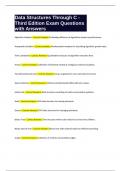
Data Structures Through C -
Third Edition Exam Questions
with Answers
Algorithm Analysis - Correct Answers: Evaluating efficiency of algorithms based on performance.


Asymptotic Notation - Correct Answers: Mathematical notation for describing algorithm growth rates.


Time Complexity - Correct Answers: Quantitative measure of algorithm execution time.


Arrays - Correct Answers: Collection of elements stored at contiguous memory locations.


Two-Dimensional Arrays - Correct Answers: Arrays organized in rows and columns format.


Sparse Matrices - Correct Answers: Matrices predominantly filled with zero values.


Linked List - Correct Answers: Data structure consisting of nodes connected by pointers.


Stack - Correct Answers: LIFO data structure for storing elements.


Queue - Correct Answers: FIFO data structure for managing elements.


Binary Tree - Correct Answers: Tree structure where each node has at most two children.


Binary Search Tree - Correct Answers: Binary tree with ordered nodes for efficient searching.


Graph - Correct Answers: Collection of vertices connected by edges.

,Depth First Search - Correct Answers: Traversal method exploring as far down a branch.


Breadth First Search - Correct Answers: Traversal method exploring all neighbors before deeper nodes.


Dijkstra's Algorithm - Correct Answers: Algorithm for finding shortest paths in weighted graphs.


Sorting Algorithms - Correct Answers: Methods for arranging elements in a specific order.


Bubble Sort - Correct Answers: Simple sorting algorithm comparing adjacent elements.


Merge Sort - Correct Answers: Divide and conquer algorithm for sorting elements.


Heap Sort - Correct Answers: Sorting algorithm using a binary heap data structure.


Linear Search - Correct Answers: Sequential search method checking each element.


Binary Search - Correct Answers: Efficient search method on sorted arrays.


AVL Trees - Correct Answers: Self-balancing binary search trees for efficient operations.


Kruskal's Algorithm - Correct Answers: Algorithm for finding minimum spanning trees in graphs.


Prim's Algorithm - Correct Answers: Algorithm for constructing minimum spanning trees from graphs.


Topological Sorting - Correct Answers: Ordering of vertices in a directed acyclic graph.


Polynomial Multiplication - Correct Answers: Combining polynomials using array representations.


Deque - Correct Answers: Double-ended queue allowing insertion/removal from both ends.

, Priority Queue - Correct Answers: Queue where elements are processed based on priority.


Algorithm - Correct Answers: Sequence of instructions for problem-solving.


Input - Correct Answers: Data supplied externally to an algorithm.


Output - Correct Answers: Result produced by an algorithm.


Finiteness - Correct Answers: Algorithm must terminate in finite steps.


Definiteness - Correct Answers: Steps in an algorithm must be clear.


Effectiveness - Correct Answers: Steps must be executable without intelligence.


Time Analysis - Correct Answers: Evaluating algorithms based on execution time.


Space Analysis - Correct Answers: Evaluating algorithms based on memory usage.


Prominent Operations - Correct Answers: Key operations that determine algorithm efficiency.


Growth Rate - Correct Answers: Rate at which operation count increases with input size.


Significant Operations - Correct Answers: Operations that consume the most time in algorithms.


Comparison Operations - Correct Answers: Operations that compare values in algorithms.


Arithmetic Operations - Correct Answers: Operations involving calculations like addition or
multiplication.
£11.99
Get access to the full document:

100% satisfaction guarantee
Immediately available after payment
Both online and in PDF
No strings attached

Get to know the seller
Seller avatar
EXAMSTUVIA

Also available in package deal

Get to know the seller

Seller avatar
EXAMSTUVIA stuvia
Follow You need to be logged in order to follow users or courses
Sold
2
Member since
1 year
Number of followers
2
Documents
1102
Last sold
3 months ago
Stuvia Exam

Assignments, Case Studies, Research, Essay writing service, Questions and Answers, Discussions etc. for students who want to see results twice as fast. I have done papers of various topics and complexities. I am punctual and always submit work on-deadline. I write engaging and informative content on all subjects. Send me your research papers, case studies, psychology papers, etc, and I’ll do them to the best of my abilities. Writing is my passion when it comes to academic work. I’ve got a good sense of structure and enjoy finding interesting ways to deliver information in any given paper. I love impressing clients with my work, and I am very punctual about deadlines. Send me your assignment and I’ll take it to the next level. I strive for my content to be of the highest quality. Your wishes come first— send me your requirements and I’ll make a piece of work with fresh ideas, consistent structure, and following the academic formatting rules. For every student you refer to me with an order that is completed and paid transparently, I will do one assignment for you, free of charge!!!!!!!!!!!!

Read more Read less
0.0

0 reviews

5
0
4
0
3
0
2
0
1
0

Recently viewed by you

Why students choose Stuvia

Created by fellow students, verified by reviews

Quality you can trust: written by students who passed their exams and reviewed by others who've used these revision notes.

Didn't get what you expected? Choose another document

No problem! You can straightaway pick a different document that better suits what you're after.

Pay as you like, start learning straight away

No subscription, no commitments. Pay the way you're used to via credit card and download your PDF document instantly.

Student with book image

“Bought, downloaded, and smashed it. It really can be that simple.”

Alisha Student

Frequently asked questions