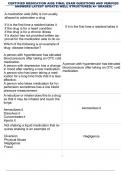
CERTIFIED MEDICATION AIDE FINAL EXAM QUESTIONS AND VERIFIED
ANSWERS LATEST UPDATE| WELL STRUCTURED| A+ GRADED|
A medication aide (MA) is not usually
allowed to administer a drug
If it is the first time a resident takes it
If it is the first time a resident takes it
If the drug is for a heart condition
If the drug is for a chronic illness
If a doctor has not provided written ap-
proval for the medication aide to do so
Which of the following is an example of
drug- disease interaction?
A person with hypertension has elevated
blood pressure after taking an OTC cold
medication.
A person with hypertension has elevated
A person with depression has a change
blood pressure after taking an OTC cold
in mood after starting a new medication.
medication.
A person who has been taking a med-
ication for a long time finds that it is less
effective.
A person who takes medication for hy-
pertension sometimes has a low blood
pressure measurement.
A nebulizer or inhaler does this to a drug
so that it may be inhaled and reach the
lungs:
Aerosolizes it
Aerosolizes it
Dissolves it
Concentrates it
Injects it
Not shaking a liquid medication that re-
quires shaking is an example of
Diversion Negligence
Physical Abuse
Negligence
Fraud
1/7
, CERTIFIED MEDICATION AIDE FINAL EXAM QUESTIONS AND VERIFIED
ANSWERS LATEST UPDATE| WELL STRUCTURED| A+ GRADED|
Which of these is a topical medication?
A powder that is stirred into liquid and
swallowed
A liquid that is emptied into a machine An ointment that is applied to the skin
and made into a mist to be inhaled
A fine spray that is administered through
the nostrils
An ointment that is applied to the skin
If a resident's MAR indicates that the
pulse rate should be counted before ad-
ministering a medication, how often does
the MA need to count and document the
resident's pulse rate?
Every time that medication is adminis- Every time that medication is adminis-
tered tered
Once a day, when the medication is first
administered
When the resident looks tired or seems
unresponsive
When the resident looks anxious or hy-
peractive
Which of the following is an example of
respecting a resident's right to partici-
pate in her own care?
Making sure the resident takes every
medication on the MAR no matter what Respecting the resident's right to refuse
Respecting the resident's right to refuse a medication
a medication
Giving a resident privacy when she has
visitors
Promptly reporting any medication er-
rors
The therapeutic dose of a medication is
high enough to be and low
enough to avoid .
2/7
ANSWERS LATEST UPDATE| WELL STRUCTURED| A+ GRADED|
A medication aide (MA) is not usually
allowed to administer a drug
If it is the first time a resident takes it
If it is the first time a resident takes it
If the drug is for a heart condition
If the drug is for a chronic illness
If a doctor has not provided written ap-
proval for the medication aide to do so
Which of the following is an example of
drug- disease interaction?
A person with hypertension has elevated
blood pressure after taking an OTC cold
medication.
A person with hypertension has elevated
A person with depression has a change
blood pressure after taking an OTC cold
in mood after starting a new medication.
medication.
A person who has been taking a med-
ication for a long time finds that it is less
effective.
A person who takes medication for hy-
pertension sometimes has a low blood
pressure measurement.
A nebulizer or inhaler does this to a drug
so that it may be inhaled and reach the
lungs:
Aerosolizes it
Aerosolizes it
Dissolves it
Concentrates it
Injects it
Not shaking a liquid medication that re-
quires shaking is an example of
Diversion Negligence
Physical Abuse
Negligence
Fraud
1/7
, CERTIFIED MEDICATION AIDE FINAL EXAM QUESTIONS AND VERIFIED
ANSWERS LATEST UPDATE| WELL STRUCTURED| A+ GRADED|
Which of these is a topical medication?
A powder that is stirred into liquid and
swallowed
A liquid that is emptied into a machine An ointment that is applied to the skin
and made into a mist to be inhaled
A fine spray that is administered through
the nostrils
An ointment that is applied to the skin
If a resident's MAR indicates that the
pulse rate should be counted before ad-
ministering a medication, how often does
the MA need to count and document the
resident's pulse rate?
Every time that medication is adminis- Every time that medication is adminis-
tered tered
Once a day, when the medication is first
administered
When the resident looks tired or seems
unresponsive
When the resident looks anxious or hy-
peractive
Which of the following is an example of
respecting a resident's right to partici-
pate in her own care?
Making sure the resident takes every
medication on the MAR no matter what Respecting the resident's right to refuse
Respecting the resident's right to refuse a medication
a medication
Giving a resident privacy when she has
visitors
Promptly reporting any medication er-
rors
The therapeutic dose of a medication is
high enough to be and low
enough to avoid .
2/7