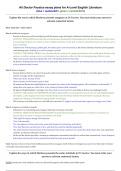
All Doctor Faustus essay plans for A-Level English Literature
(blue = quotes/AO1, green = context/AO3)
Explore the way in which Marlowe presents arrogance in Dr Faustus. You must relate your answer to
relevant contextual factors.
Intro: main idea + main context
Para 1: intellectual arrogance
- Faustus is driven to seek knowledge beyond the human scope and rejects traditional scholarism for necromancy
- CONTEXT: HUMANISM stems from the new Renaissance learning that had emerged and is the idea that man is at the centre
of everything and there are no limits to man’s abilities, therefore it is the duty of man to extend their brain as far as they can to
learn everything
- ‘Glutted more with learning’s golden gifts, he surfers upon cursed necromancy’ the chorus introduce Faustus’ preoccupation
with learning more ‘Nothing is so sweet as magic is to him’
- CONTEXT: THE GREEK CHORUS was a theatrical device made up of a group of performers who would speak directly to the
audience to outline coming events, reveal characters true intentions or allow for the convincing passing of time in a play
- ‘Then read no more; thou hast attained the end’ ‘necromantic books are heavenly’
- He desires ‘all things that move between the quiet poles shall be at my command’ ‘his dominion that exceeds in this stretcheth
as far as doth the mind of man’
Para 2: divine arrogance
- Faustus believes that he can outwit God and Lucifer for his benefit and ultimately triumph as a God-like figure with his
mastery of magic and the supernatural
- ‘When all is done, divinity is best’
- ‘Here, Faustus, try thy brains to gain a deity’
- He creates an illusion for himself that he is in control ‘how pliant is this Mephistopheles, full of obedience and humility!’ ‘I
charge thee wait upon me whilst I live, to do whatever Faustus shall command’
- He ignores Mephistopheles’ warnings ‘why this is hell, nor am I out of it’ as he believes that he can challenge Lucifer
- CONTEXT: THE ANGLICAN DEFINITION OF HELL defined Hell as everywhere that God is not to fit with Mephistopheles’
description, as the Anglican Church had recently broken from the Roman Catholic Church Marlowe opting for this may
suggest his criticising of Catholicism seeping further into the play
- This is shown as he believes he can visit Hell and come back ‘O, might I see hell and return again, how happy were I then’
Para 3: arrogance as leading to tragedy
- Ultimately it is overarching and arrogance that leads to Faustus’ downfall
- CONTEXT: ARISTOTLE’S RULES FOR TRAGEDY dictated that the protagonist must have a fatal flaw or hamartia, for
Faustus this is his pride or arrogance that leads to his death
- ‘This night I’ll conjure, though I die therefore’
- ‘Now I die eternally’
- ‘For vain pleasure of four-and-twenty years hath Faustus lost eternal joy and felicity’
- ‘Now hast thou but one bare hour to live, and then thou must be damned perpetually’
- ‘See where Christs’s blood streams in the firmament! One drop would save my soul, half a drop’ shows how easy repentance
could be, yet Faustus still cannot reach it
- At the end the chorus provides a warning to subsequent overreachers that this too will be their eventual fate ‘whose deepness
doth entice such forward wits to practise more than heavenly power permits’
Conc: Faustus is shown to have both intellectual and divine arrogance, both of these are dangerous as proven as they lead to Faustus’
eventually eternal damnation in Hell
Explore the ways in which Marlowe presents the comic interlude in Dr Faustus. You must relate your
answer to relevant contextual factors.
INTRO introduced comic interlude context as relevant throughout and outline main futility point
, PARA 1 - comic interludes mock the drama and provide light relief
- Does this limit the power of a main plot scene?
- Theatrical carnival
- ‘Well I will cause two devils presently to fetch thee away - Balioll and Belcher’
- ‘So I should be called ‘Kill devil’ all the parish over’ echos how Faustus wishes to be known around the whole world but
Robin simply wishes to be known in the parish
- CONTEXT: THE COMIC INTERLUDE - during the Elizabethan period the audiences loved to see diversity in their
entertainment, the theatre was seen as an escape from the strictures of Elizabethan life, the interplay between the tragic and
the comedic presented the audience with a new genre of entertainment
- The Pope scene adds an element of light relief through use of slapstick comedy
- ‘How now, who’s that which snatched the meat from me?’
- ‘My lord, it may be some ghost, newly crept out of purgatory’ the puerile entertainment mocking and vilifying the Pope
delights the audience
- These scenes go much faster as they are easier to watch and provide relief from the main plot as well as facilitating the
movement of time beyond the main plot
- CONTEXT: POPE CLEMENT VIII - a financially unsystematic and very unpopular in Germany, he was known to alter his
political views to suit who was most wealthy or powerful at the time; this mockery seems to be a direct attack on his
corruption and financial dishonesty as well as the wider Catholic faith
PARA 2 - they offer an insight into the true futile nature of the main plot
- ‘Says he who surrenders up to him his soul, so he will spare him four-and-twenty years’ sees Faustus surrender his soul for 24
years of power vs ‘I know he would give his soul to the devil for a shoulder of mutton’
- There is an idea of pushback from lowlife characters that Faustus lacks ‘I had need it well roasted, and a good sauce to it, if I
pay so dear’ as Robin recognises the dear price he is paying where Faustus cannot (because he is so desperate for power)
- CONTEXT: FATAL FLAW - pride and need for power is Faustus fatal flaw (something dictated by Aristotle’s rules for
tragedy, Faustus must have a hamartia), this mocks his fatal flaw
- ‘Bind yourself presently unto me for seven years, or I’ll turn all the lice about thee into familiars’
- Also mocks wife scene with Robin and Rafe’s infantile attitude towards sex and women when Mephistopheles says ‘I prithee,
Faustus, talk not of a wife’ yet Robin and Rafe can have a wife
- ‘Nan Spit, our kitchen maid, then turn her and wind her to thy own use as often as thou wilt’, ‘Shall I have Nan Spit, and to
mine own use?’
PARA 3 - when they come together at the end to underpin Marlowe’s message
- Amid a long speech from the Emperor asking for Alexander to be conjured the knight begins with micro comic interludes that
infiltrate the main plot
- After Fautus declares he is able to conjure the dead ‘(Aside) I’faith, that’s nothing at all’, mocking sarcasm brings comedy in
- ‘(Aside) Ay, marry, Master Doctor, now there’s a sign of grace in you, when you will confess the truth’ as Faustus says he
cannot conjure the true dead
- Mocking tone of ‘Do you hear, Master Doctor? You bring Alexander and his paramour before the Emperor?’
- Sarcasm in ‘that’s as true as Diana turned me to a stag’
- CONTEXT: DIANA AND ACTAEON - Actaeon came across Diana bathing on Mount Cithaeron, outraged she turned him to
a stag where he was pursed and killed by his own 50 hounds; seems to echo a warning to Faustus as the comedic character of
the knight invokes this classical reference
- The two plots merge as ‘Enter the KNIGHT with a pair of horns on his head’ leading into horse-courser scene
- CONTEXT: MORALITY PLAYS - the comic character of the knight is an allegorical character of a morality play showing the
audience the clear merging of plots
- Language starts to become comedic ‘I have been all this day seeking one Master Fustian’ ‘If he had but the quality of hey,
ding, ding, hey, ding, ding’
- Scene becomes more absurd as the leg joke takes hold ‘O my leg, my leg! Help Mephistopheles!’ characters become corrupted
(also foreshadows Faustus being torn apart limb by limb)
- Faustus himself becomes a clown as he partakes in jokes and slapstick comedy
CONCLUSION
Comic is presented not only as light relief but as an insight into the true nature of the plot, as the two come together at the end of the
play it is clear how time speeds up and Faustus accelerates towards his death presented as a fool for indulging in necromantic learning
(blue = quotes/AO1, green = context/AO3)
Explore the way in which Marlowe presents arrogance in Dr Faustus. You must relate your answer to
relevant contextual factors.
Intro: main idea + main context
Para 1: intellectual arrogance
- Faustus is driven to seek knowledge beyond the human scope and rejects traditional scholarism for necromancy
- CONTEXT: HUMANISM stems from the new Renaissance learning that had emerged and is the idea that man is at the centre
of everything and there are no limits to man’s abilities, therefore it is the duty of man to extend their brain as far as they can to
learn everything
- ‘Glutted more with learning’s golden gifts, he surfers upon cursed necromancy’ the chorus introduce Faustus’ preoccupation
with learning more ‘Nothing is so sweet as magic is to him’
- CONTEXT: THE GREEK CHORUS was a theatrical device made up of a group of performers who would speak directly to the
audience to outline coming events, reveal characters true intentions or allow for the convincing passing of time in a play
- ‘Then read no more; thou hast attained the end’ ‘necromantic books are heavenly’
- He desires ‘all things that move between the quiet poles shall be at my command’ ‘his dominion that exceeds in this stretcheth
as far as doth the mind of man’
Para 2: divine arrogance
- Faustus believes that he can outwit God and Lucifer for his benefit and ultimately triumph as a God-like figure with his
mastery of magic and the supernatural
- ‘When all is done, divinity is best’
- ‘Here, Faustus, try thy brains to gain a deity’
- He creates an illusion for himself that he is in control ‘how pliant is this Mephistopheles, full of obedience and humility!’ ‘I
charge thee wait upon me whilst I live, to do whatever Faustus shall command’
- He ignores Mephistopheles’ warnings ‘why this is hell, nor am I out of it’ as he believes that he can challenge Lucifer
- CONTEXT: THE ANGLICAN DEFINITION OF HELL defined Hell as everywhere that God is not to fit with Mephistopheles’
description, as the Anglican Church had recently broken from the Roman Catholic Church Marlowe opting for this may
suggest his criticising of Catholicism seeping further into the play
- This is shown as he believes he can visit Hell and come back ‘O, might I see hell and return again, how happy were I then’
Para 3: arrogance as leading to tragedy
- Ultimately it is overarching and arrogance that leads to Faustus’ downfall
- CONTEXT: ARISTOTLE’S RULES FOR TRAGEDY dictated that the protagonist must have a fatal flaw or hamartia, for
Faustus this is his pride or arrogance that leads to his death
- ‘This night I’ll conjure, though I die therefore’
- ‘Now I die eternally’
- ‘For vain pleasure of four-and-twenty years hath Faustus lost eternal joy and felicity’
- ‘Now hast thou but one bare hour to live, and then thou must be damned perpetually’
- ‘See where Christs’s blood streams in the firmament! One drop would save my soul, half a drop’ shows how easy repentance
could be, yet Faustus still cannot reach it
- At the end the chorus provides a warning to subsequent overreachers that this too will be their eventual fate ‘whose deepness
doth entice such forward wits to practise more than heavenly power permits’
Conc: Faustus is shown to have both intellectual and divine arrogance, both of these are dangerous as proven as they lead to Faustus’
eventually eternal damnation in Hell
Explore the ways in which Marlowe presents the comic interlude in Dr Faustus. You must relate your
answer to relevant contextual factors.
INTRO introduced comic interlude context as relevant throughout and outline main futility point
, PARA 1 - comic interludes mock the drama and provide light relief
- Does this limit the power of a main plot scene?
- Theatrical carnival
- ‘Well I will cause two devils presently to fetch thee away - Balioll and Belcher’
- ‘So I should be called ‘Kill devil’ all the parish over’ echos how Faustus wishes to be known around the whole world but
Robin simply wishes to be known in the parish
- CONTEXT: THE COMIC INTERLUDE - during the Elizabethan period the audiences loved to see diversity in their
entertainment, the theatre was seen as an escape from the strictures of Elizabethan life, the interplay between the tragic and
the comedic presented the audience with a new genre of entertainment
- The Pope scene adds an element of light relief through use of slapstick comedy
- ‘How now, who’s that which snatched the meat from me?’
- ‘My lord, it may be some ghost, newly crept out of purgatory’ the puerile entertainment mocking and vilifying the Pope
delights the audience
- These scenes go much faster as they are easier to watch and provide relief from the main plot as well as facilitating the
movement of time beyond the main plot
- CONTEXT: POPE CLEMENT VIII - a financially unsystematic and very unpopular in Germany, he was known to alter his
political views to suit who was most wealthy or powerful at the time; this mockery seems to be a direct attack on his
corruption and financial dishonesty as well as the wider Catholic faith
PARA 2 - they offer an insight into the true futile nature of the main plot
- ‘Says he who surrenders up to him his soul, so he will spare him four-and-twenty years’ sees Faustus surrender his soul for 24
years of power vs ‘I know he would give his soul to the devil for a shoulder of mutton’
- There is an idea of pushback from lowlife characters that Faustus lacks ‘I had need it well roasted, and a good sauce to it, if I
pay so dear’ as Robin recognises the dear price he is paying where Faustus cannot (because he is so desperate for power)
- CONTEXT: FATAL FLAW - pride and need for power is Faustus fatal flaw (something dictated by Aristotle’s rules for
tragedy, Faustus must have a hamartia), this mocks his fatal flaw
- ‘Bind yourself presently unto me for seven years, or I’ll turn all the lice about thee into familiars’
- Also mocks wife scene with Robin and Rafe’s infantile attitude towards sex and women when Mephistopheles says ‘I prithee,
Faustus, talk not of a wife’ yet Robin and Rafe can have a wife
- ‘Nan Spit, our kitchen maid, then turn her and wind her to thy own use as often as thou wilt’, ‘Shall I have Nan Spit, and to
mine own use?’
PARA 3 - when they come together at the end to underpin Marlowe’s message
- Amid a long speech from the Emperor asking for Alexander to be conjured the knight begins with micro comic interludes that
infiltrate the main plot
- After Fautus declares he is able to conjure the dead ‘(Aside) I’faith, that’s nothing at all’, mocking sarcasm brings comedy in
- ‘(Aside) Ay, marry, Master Doctor, now there’s a sign of grace in you, when you will confess the truth’ as Faustus says he
cannot conjure the true dead
- Mocking tone of ‘Do you hear, Master Doctor? You bring Alexander and his paramour before the Emperor?’
- Sarcasm in ‘that’s as true as Diana turned me to a stag’
- CONTEXT: DIANA AND ACTAEON - Actaeon came across Diana bathing on Mount Cithaeron, outraged she turned him to
a stag where he was pursed and killed by his own 50 hounds; seems to echo a warning to Faustus as the comedic character of
the knight invokes this classical reference
- The two plots merge as ‘Enter the KNIGHT with a pair of horns on his head’ leading into horse-courser scene
- CONTEXT: MORALITY PLAYS - the comic character of the knight is an allegorical character of a morality play showing the
audience the clear merging of plots
- Language starts to become comedic ‘I have been all this day seeking one Master Fustian’ ‘If he had but the quality of hey,
ding, ding, hey, ding, ding’
- Scene becomes more absurd as the leg joke takes hold ‘O my leg, my leg! Help Mephistopheles!’ characters become corrupted
(also foreshadows Faustus being torn apart limb by limb)
- Faustus himself becomes a clown as he partakes in jokes and slapstick comedy
CONCLUSION
Comic is presented not only as light relief but as an insight into the true nature of the plot, as the two come together at the end of the
play it is clear how time speeds up and Faustus accelerates towards his death presented as a fool for indulging in necromantic learning