

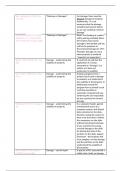
Roe v Kingerlee [1986] Crim. “Destroys or Damages” For damage, there must be
L.R. 735 physical damage to property.
Additionally, “It is not
necessary that the damage
should be permanent before
an act can constitute criminal
damage.”
Fiak [2005] EWCA Crim 2381 “Destroys or Damages” Facts: The flooding of a police
[2005] Po. L.R. 211 and [21] cell by placing a blanket down
per The Rt Hon. Sir Igor Judge the lavatory had caused
damage to the blanket and the
cell for the purposes of
the Criminal Damage Act 1971.
Principle: damage can occur
when property is rendered
“imperfect or inoperative”.
Drake v DPP [1994] Crim. L.R. Damage – undermining the It could not be said that the
855 usability of property application of a clamp
amounted to "damage" to a
vehicle as it does not
undermine its usability.
Cox v Riley (1986) 83 Cr. App. Damage – undermining the Erasing a program from a
R. 54 usability of property printed circuit card is damage
to property as it undermines
the usability of the property. D
deliberately erased the
program from a printed circuit
card that operated an
automatic computerised saw,
rendering the saw inoperable.
He was convicted of criminal
damage.
Whiteley (1991) 93 Cr. App. R. Damage – undermining the D, a computer hacker, gained
25 usability of property unauthorised access to a
computer system, and altered
data contained on the disks,
thereby causing the system to
have to be shut down. Neither
the computers nor the disks
suffered any physical damage.
D was convicted of causing
criminal damage to the disks
by altering the state of the
particles on the disks. Appeal
dismissed – the property had
to be tangible, not the damage
and the particles on the disks
undermined the usability of
the property.
A(A Juvenile) v The Queen Damage – cost of repair A spat on a PO’s coat and left a
[1978] Crim. L.R. 689 visible stain. Held: no damage
, as PO made no effort to wipe it
off (which then meant it
wouldn’t be stained and have
to be repaired i.e. dry cleaned)
and the coat wasn’t rendered
imperfect or inoperative.
Hardman v Chief Constable of Damage – cost of repair Damage had occurred when
Avon and Somerset the appellants painted
Constabulary [1986] Crim. L.R. silhouettes on a pavement as
330 part of a protest, using soluble
paint which would be washed
away eventually by rainwater.
Fancy [1980] [1980] Crim .L.R. Damage – cost of repair The defendant painted over a
171 national front slogan that had
been painted on the victim’s
property by a third party: held
no criminal damage.
Seray-Wurie v DPP [2012] Mens rea of Criminal Damage Principle: it had not been
EWHC 208 (Admin) necessary for the prosecution
to prove more than a
defendant's intentional act of
writing on parking notices with
a marker pen. It was necessary
to prove at least recklessness
as to whether damage might
be caused, but there was no
requirement to show
recklessness as to whether
that damage constituted
damage in law. Facts: S had
used a marker pen to write on
parking notices which had
been placed in the private
residential estate where he
lived by a management
company. He claimed that he
had not intended to damage
the parking notices, but simply
to pass information to other
leaseholders in the estate. He
maintained that he had not
appreciated that damage
would be caused and therefore
could not have been reckless.
Appeal dismissed.
Smith [1974] QB 354 [1974] 2 Mens rea of Criminal Damage The honest but mistaken belief
W.L.R. 20 that property is the
defendant's own is a defence
to a charge of criminally
damaging it. and could be a
lawful excuse providing a
L.R. 735 physical damage to property.
Additionally, “It is not
necessary that the damage
should be permanent before
an act can constitute criminal
damage.”
Fiak [2005] EWCA Crim 2381 “Destroys or Damages” Facts: The flooding of a police
[2005] Po. L.R. 211 and [21] cell by placing a blanket down
per The Rt Hon. Sir Igor Judge the lavatory had caused
damage to the blanket and the
cell for the purposes of
the Criminal Damage Act 1971.
Principle: damage can occur
when property is rendered
“imperfect or inoperative”.
Drake v DPP [1994] Crim. L.R. Damage – undermining the It could not be said that the
855 usability of property application of a clamp
amounted to "damage" to a
vehicle as it does not
undermine its usability.
Cox v Riley (1986) 83 Cr. App. Damage – undermining the Erasing a program from a
R. 54 usability of property printed circuit card is damage
to property as it undermines
the usability of the property. D
deliberately erased the
program from a printed circuit
card that operated an
automatic computerised saw,
rendering the saw inoperable.
He was convicted of criminal
damage.
Whiteley (1991) 93 Cr. App. R. Damage – undermining the D, a computer hacker, gained
25 usability of property unauthorised access to a
computer system, and altered
data contained on the disks,
thereby causing the system to
have to be shut down. Neither
the computers nor the disks
suffered any physical damage.
D was convicted of causing
criminal damage to the disks
by altering the state of the
particles on the disks. Appeal
dismissed – the property had
to be tangible, not the damage
and the particles on the disks
undermined the usability of
the property.
A(A Juvenile) v The Queen Damage – cost of repair A spat on a PO’s coat and left a
[1978] Crim. L.R. 689 visible stain. Held: no damage
, as PO made no effort to wipe it
off (which then meant it
wouldn’t be stained and have
to be repaired i.e. dry cleaned)
and the coat wasn’t rendered
imperfect or inoperative.
Hardman v Chief Constable of Damage – cost of repair Damage had occurred when
Avon and Somerset the appellants painted
Constabulary [1986] Crim. L.R. silhouettes on a pavement as
330 part of a protest, using soluble
paint which would be washed
away eventually by rainwater.
Fancy [1980] [1980] Crim .L.R. Damage – cost of repair The defendant painted over a
171 national front slogan that had
been painted on the victim’s
property by a third party: held
no criminal damage.
Seray-Wurie v DPP [2012] Mens rea of Criminal Damage Principle: it had not been
EWHC 208 (Admin) necessary for the prosecution
to prove more than a
defendant's intentional act of
writing on parking notices with
a marker pen. It was necessary
to prove at least recklessness
as to whether damage might
be caused, but there was no
requirement to show
recklessness as to whether
that damage constituted
damage in law. Facts: S had
used a marker pen to write on
parking notices which had
been placed in the private
residential estate where he
lived by a management
company. He claimed that he
had not intended to damage
the parking notices, but simply
to pass information to other
leaseholders in the estate. He
maintained that he had not
appreciated that damage
would be caused and therefore
could not have been reckless.
Appeal dismissed.
Smith [1974] QB 354 [1974] 2 Mens rea of Criminal Damage The honest but mistaken belief
W.L.R. 20 that property is the
defendant's own is a defence
to a charge of criminally
damaging it. and could be a
lawful excuse providing a


