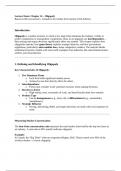
Lecture Notes: Chapter 14 – Oligopoly
Based on Microeconomics: Canada in the Global Environment (11th Edition)
Introduction
Oligopoly is a market structure in which a few large firms dominate the industry. Unlike in
perfect competition or monopolistic competition, firms in an oligopoly are interdependent—
their pricing and output decisions significantly affect one another. This chapter explores how
oligopolies operate, how game theory explains strategic behavior, and how government
regulations, particularly anti-combine laws, shape competitive conduct. The analysis blends
traditional economic models with real-world examples from industries like telecommunications,
airlines, and oil production.
1. Defining and Identifying Oligopoly
Key Characteristics of Oligopoly:
1. Few Dominant Firms
o Each firm holds significant market power.
o Actions by one firm directly affect the others.
2. Interdependence
o Firms must consider rivals' potential reactions when making decisions.
3. Barriers to Entry
o High startup costs, economies of scale, and brand loyalty deter new entrants.
4. Product Type
o Can be homogeneous (e.g., steel, oil) or differentiated (e.g., automobiles,
smartphones).
5. Strategic Behavior
o Pricing, advertising, R&D, and output decisions are made with rival responses in
mind.
Measuring Market Concentration:
The four-firm concentration ratio measures the total market share held by the top four firms in
an industry. A ratio above 60% usually indicates oligopoly.
Example:
In Canada, the “Big Three” telecom companies (Rogers, Bell, Telus) control over 90% of the
wireless market—a classic oligopoly.
, 2. Price and Output Determination in Oligopoly Using Game Theory
Because firms are interdependent, oligopoly outcomes can’t be predicted with supply and
demand curves alone. Instead, economists use game theory to analyze strategic decision-
making.
What is Game Theory?
Game theory studies how individuals or firms make decisions when their payoffs depend on the
actions of others. It involves:
Players: The firms
Strategies: Pricing, output, advertising decisions
Payoffs: Profits based on combined strategies
Rules: Market conditions, regulations
Outcomes: Often shown in payoff matrices
The Duopoly Model (Two-Firm Oligopoly)
Consider two competing firms, A and B, each deciding whether to set a high price or low price.
Payoff Matrix Example:
Firm A \ Firm B High Price (B) Low Price (B)
High Price (A) A: $10M, B: $10M A: $4M, B: $12M
Low Price (A) A: $12M, B: $4M A: $6M, B: $6M
If both charge high prices, they maximize joint profits.
If one undercuts the other, it gains at the other’s expense.
If both undercut, profits shrink.
Nash Equilibrium
A Nash equilibrium occurs when neither firm can improve its payoff by changing its strategy
unilaterally.
In the matrix above:
Both firms setting a low price is a Nash equilibrium, even though both would be better
off with high prices.
Based on Microeconomics: Canada in the Global Environment (11th Edition)
Introduction
Oligopoly is a market structure in which a few large firms dominate the industry. Unlike in
perfect competition or monopolistic competition, firms in an oligopoly are interdependent—
their pricing and output decisions significantly affect one another. This chapter explores how
oligopolies operate, how game theory explains strategic behavior, and how government
regulations, particularly anti-combine laws, shape competitive conduct. The analysis blends
traditional economic models with real-world examples from industries like telecommunications,
airlines, and oil production.
1. Defining and Identifying Oligopoly
Key Characteristics of Oligopoly:
1. Few Dominant Firms
o Each firm holds significant market power.
o Actions by one firm directly affect the others.
2. Interdependence
o Firms must consider rivals' potential reactions when making decisions.
3. Barriers to Entry
o High startup costs, economies of scale, and brand loyalty deter new entrants.
4. Product Type
o Can be homogeneous (e.g., steel, oil) or differentiated (e.g., automobiles,
smartphones).
5. Strategic Behavior
o Pricing, advertising, R&D, and output decisions are made with rival responses in
mind.
Measuring Market Concentration:
The four-firm concentration ratio measures the total market share held by the top four firms in
an industry. A ratio above 60% usually indicates oligopoly.
Example:
In Canada, the “Big Three” telecom companies (Rogers, Bell, Telus) control over 90% of the
wireless market—a classic oligopoly.
, 2. Price and Output Determination in Oligopoly Using Game Theory
Because firms are interdependent, oligopoly outcomes can’t be predicted with supply and
demand curves alone. Instead, economists use game theory to analyze strategic decision-
making.
What is Game Theory?
Game theory studies how individuals or firms make decisions when their payoffs depend on the
actions of others. It involves:
Players: The firms
Strategies: Pricing, output, advertising decisions
Payoffs: Profits based on combined strategies
Rules: Market conditions, regulations
Outcomes: Often shown in payoff matrices
The Duopoly Model (Two-Firm Oligopoly)
Consider two competing firms, A and B, each deciding whether to set a high price or low price.
Payoff Matrix Example:
Firm A \ Firm B High Price (B) Low Price (B)
High Price (A) A: $10M, B: $10M A: $4M, B: $12M
Low Price (A) A: $12M, B: $4M A: $6M, B: $6M
If both charge high prices, they maximize joint profits.
If one undercuts the other, it gains at the other’s expense.
If both undercut, profits shrink.
Nash Equilibrium
A Nash equilibrium occurs when neither firm can improve its payoff by changing its strategy
unilaterally.
In the matrix above:
Both firms setting a low price is a Nash equilibrium, even though both would be better
off with high prices.