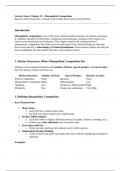
Lecture Notes: Chapter 13 – Monopolistic Competition
Based on Microeconomics: Canada in the Global Environment (11th Edition)
Introduction
Monopolistic competition is one of the most common market structures in modern economies.
It combines elements of both perfect competition and monopoly, making it more realistic for
many service-based and retail industries. This chapter explores the characteristics of
monopolistic competition, how firms set price and output in the short and long run, and why
firms invest heavily in advertising and brand development. These features impact not only the
firm's profitability but also market efficiency and consumer choice.
1. Market Structures: Where Monopolistic Competition Fits
Markets can be categorized based on the number of firms, type of product, and ease of entry.
The four primary market structures are:
Market Structure Number of Firms Type of Product Barriers to Entry
Perfect Competition Many Identical None
Monopolistic Competition Many Differentiated Low
Oligopoly Few Identical or Differentiated High
Monopoly One Unique (no substitutes) Very High
2. Defining Monopolistic Competition
Key Characteristics
1. Many Firms
o Each firm has a small market share.
o No firm can control market price significantly.
2. Product Differentiation
o Each firm offers a slightly different product (in quality, features, branding, etc.).
o Products are close substitutes, but not perfect ones.
3. Free Entry and Exit
o Firms can enter and leave the industry easily in the long run.
4. Independent Decision Making
o Firms set their own prices and output decisions without considering competitors’
reactions.
Examples:
, Coffee shops
Hair salons
Clothing brands
Restaurants
Each firm competes on price, product quality, location, design, and marketing.
3. Price and Output Decisions in the Short Run
In the short run, firms in monopolistic competition behave like monopolies due to product
differentiation—they face a downward-sloping demand curve and have some price-setting
power.
Revenue Concepts
Total Revenue (TR) = Price × Quantity
Average Revenue (AR) = Price
Marginal Revenue (MR): Change in TR from selling one more unit
o MR < Price because lowering the price increases quantity sold but reduces
revenue on all units
Profit Maximization Rule
The firm maximizes profit where:
Then the firm uses its demand curve to determine the price at that output.
Graph Description – Short-Run Equilibrium
X-axis: Quantity of output
Y-axis: Price and cost
Demand curve (D): Downward sloping
MR curve: Below the demand curve
MC curve: U-shaped
ATC curve: U-shaped
Profit is the rectangle between price and ATC, from 0 to Q
Possible Outcomes:
Based on Microeconomics: Canada in the Global Environment (11th Edition)
Introduction
Monopolistic competition is one of the most common market structures in modern economies.
It combines elements of both perfect competition and monopoly, making it more realistic for
many service-based and retail industries. This chapter explores the characteristics of
monopolistic competition, how firms set price and output in the short and long run, and why
firms invest heavily in advertising and brand development. These features impact not only the
firm's profitability but also market efficiency and consumer choice.
1. Market Structures: Where Monopolistic Competition Fits
Markets can be categorized based on the number of firms, type of product, and ease of entry.
The four primary market structures are:
Market Structure Number of Firms Type of Product Barriers to Entry
Perfect Competition Many Identical None
Monopolistic Competition Many Differentiated Low
Oligopoly Few Identical or Differentiated High
Monopoly One Unique (no substitutes) Very High
2. Defining Monopolistic Competition
Key Characteristics
1. Many Firms
o Each firm has a small market share.
o No firm can control market price significantly.
2. Product Differentiation
o Each firm offers a slightly different product (in quality, features, branding, etc.).
o Products are close substitutes, but not perfect ones.
3. Free Entry and Exit
o Firms can enter and leave the industry easily in the long run.
4. Independent Decision Making
o Firms set their own prices and output decisions without considering competitors’
reactions.
Examples:
, Coffee shops
Hair salons
Clothing brands
Restaurants
Each firm competes on price, product quality, location, design, and marketing.
3. Price and Output Decisions in the Short Run
In the short run, firms in monopolistic competition behave like monopolies due to product
differentiation—they face a downward-sloping demand curve and have some price-setting
power.
Revenue Concepts
Total Revenue (TR) = Price × Quantity
Average Revenue (AR) = Price
Marginal Revenue (MR): Change in TR from selling one more unit
o MR < Price because lowering the price increases quantity sold but reduces
revenue on all units
Profit Maximization Rule
The firm maximizes profit where:
Then the firm uses its demand curve to determine the price at that output.
Graph Description – Short-Run Equilibrium
X-axis: Quantity of output
Y-axis: Price and cost
Demand curve (D): Downward sloping
MR curve: Below the demand curve
MC curve: U-shaped
ATC curve: U-shaped
Profit is the rectangle between price and ATC, from 0 to Q
Possible Outcomes: