Stages of group formation
Social categorisation
Social identification
Social comparison Ingroup and outgroup. Minimal group experiment.
Who proposed, what is the theory explaining
Social identity theory
Credibility; Minimal group study
Conclusion: helps to understand
it also explains how groups discriminate even
how groups memberships
when the outgroup is not a threat to the
ingroup and even when they are not influences a persons self
incompletion. esteem supported by minimal
group experiment
Neglects individual differences
Objection: minimal group experiment Difference: RCT is supported by robbers cave
lacks ecological validity.it cannot be study and SIT is supported by minimal group
generalised with adult behaviour. study Cannot be generalised to adult behaviour.
Demand characteristics, critised RCT is realistic and explains how limited
because adolescent boys are resources lead to competition and prejudice SIT
naturally competitive explains how irrational thing lead to prejudice.
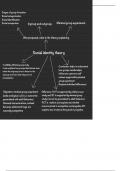
Social categorisation
Social identification
Social comparison Ingroup and outgroup. Minimal group experiment.
Who proposed, what is the theory explaining
Social identity theory
Credibility; Minimal group study
Conclusion: helps to understand
it also explains how groups discriminate even
how groups memberships
when the outgroup is not a threat to the
ingroup and even when they are not influences a persons self
incompletion. esteem supported by minimal
group experiment
Neglects individual differences
Objection: minimal group experiment Difference: RCT is supported by robbers cave
lacks ecological validity.it cannot be study and SIT is supported by minimal group
generalised with adult behaviour. study Cannot be generalised to adult behaviour.
Demand characteristics, critised RCT is realistic and explains how limited
because adolescent boys are resources lead to competition and prejudice SIT
naturally competitive explains how irrational thing lead to prejudice.