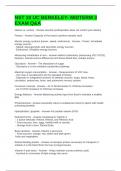
NST 10 UC BERKELEY- MIDTERM 3
EXAM Q&A
Nature vs. nurture - Answer-Genetic predisposition does not control your destiny
Fitness - Answer-Capacity of the body to perform aerobic work
Muscle energy systems (power, speed, endurance) - Answer-- Power: Immediate
energy sources
- Speed: Glycogenolytic and Glycolytic energy sources
- Endurance: Oxidative energy sources
Measuring metabolism in vivo - Answer-indirect calorimetry (measuring VO2 VCO2),
biopsies, arterial-venous differences and tissue blood flow, isotope tracers
Glycolysis - Answer-- The dissolution of sugar
- Glycolysis is a non-oxidative (anaerobic) pathway
Maximal oxygen consumption - Answer-- Measurement of VO2 max
- Vo2 max is considered to be the standard of fitness
- Depends on integrated functions of skeletal muscles, lungs, blood, heart,
circulation, endocrines, brain, and autonomic nervous system.
Crossover concept - Answer-- As % fat decreases % VO2max increases
- As % CHO increases % VO2max increases
Energy Balance - Answer-Balancing activity input from food to maintain a healthy
BMI
Phytochemical - Answer-Generally refers to substances found in plants with health
promoting benefits
Hydrophobic/ Lipophilic - Answer-Fat soluble vitamin (FSV)
Retinoid Forms - Answer-Contained in Vitamin A
- 3 active retinoids: Retinol, Retinal, and Retinoic Acid
* Food sources: liver, eggs, fortified milk or cereals
- Storage form in liver: Retinyl Ester
Beta-carotene - Answer-Vitamin A precursor
- Food sources: orange, red, yellow and dark green
fruits and vegetables.
Retinol-binding-protein - Answer-A transport protein necessary for transport of
Vitamin A in the blood from the liver to target tissues
Vitamin A and vision - Answer-- Helps maintain cornea (retinoic acid)
- Involved in conversion of light energy into nerve
EXAM Q&A
Nature vs. nurture - Answer-Genetic predisposition does not control your destiny
Fitness - Answer-Capacity of the body to perform aerobic work
Muscle energy systems (power, speed, endurance) - Answer-- Power: Immediate
energy sources
- Speed: Glycogenolytic and Glycolytic energy sources
- Endurance: Oxidative energy sources
Measuring metabolism in vivo - Answer-indirect calorimetry (measuring VO2 VCO2),
biopsies, arterial-venous differences and tissue blood flow, isotope tracers
Glycolysis - Answer-- The dissolution of sugar
- Glycolysis is a non-oxidative (anaerobic) pathway
Maximal oxygen consumption - Answer-- Measurement of VO2 max
- Vo2 max is considered to be the standard of fitness
- Depends on integrated functions of skeletal muscles, lungs, blood, heart,
circulation, endocrines, brain, and autonomic nervous system.
Crossover concept - Answer-- As % fat decreases % VO2max increases
- As % CHO increases % VO2max increases
Energy Balance - Answer-Balancing activity input from food to maintain a healthy
BMI
Phytochemical - Answer-Generally refers to substances found in plants with health
promoting benefits
Hydrophobic/ Lipophilic - Answer-Fat soluble vitamin (FSV)
Retinoid Forms - Answer-Contained in Vitamin A
- 3 active retinoids: Retinol, Retinal, and Retinoic Acid
* Food sources: liver, eggs, fortified milk or cereals
- Storage form in liver: Retinyl Ester
Beta-carotene - Answer-Vitamin A precursor
- Food sources: orange, red, yellow and dark green
fruits and vegetables.
Retinol-binding-protein - Answer-A transport protein necessary for transport of
Vitamin A in the blood from the liver to target tissues
Vitamin A and vision - Answer-- Helps maintain cornea (retinoic acid)
- Involved in conversion of light energy into nerve