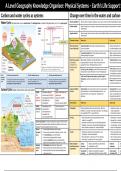
A Level Geography Knowledge Organiser: Physical Systems – Earth’s Life Support S
Carbon and water cycles as systems Change over time in the water and carbon c
Water Cycle (the global water cycle is a closed system. The drainage basin is a subset of the global water cycle - it is an open system) Dynamic equilibrium When a system can adapt to changes (e.g. to an input or a store) so that through feedback a balance
Positive feedback When a change (e.g. to an input or a store) causes further changes in the system which can make th
Global initial change)
water
cycle Negative feedback When a change causes the system to alter so that equilibrium (balance) is recovered and the system
initial change)
Timescale of change Water cycle Carbon cycle
Short-term: diurnal Evapotranspiration: falls at night as temperatures decrease, Daytime: photosynthesis > r
(over a 24hr period) increases in daytime from the atmosphere to plan
Convectional rainfall: tends to fall in afternoon/early evening Night: respiration continues
following heating of the ground dark) = carbon flows from pl
Short-term: seasonal UK: insolation 5x higher in June than December > high Tropical rainforest: growing
(controlled by evapotranspiration in summer > flows of water from soil to flow of carbon from atmosp
variations in the atmosphere. Stores + discharges lowest in summer.
Drainage intensity of solar
S.E Asia (e.g. India, Vietnam): receive 80-90% of annual rainfall Arctic tundra: growing seaso
basin cycle radiation)
during monsoon season (May-Sept) > stores + discharges peak from atmosphere to biosphe
In N hemisphere, ecosystem
Cloud ELR (Environmental Lapse Rate) DALR (Dry adiabatic lapse rate) SALR (saturated adiabatic lapse rate) 2ppm during the growing se
formation
Arctic tundra & high mountain regions (e.g. River Ganges in
and lapse The change in temperature with increasing height The change in temperature of a dry parcel of air rising The change in temperature with increasing height Himalayas): snowmelt in spring/early summer > increased river
flows Oceans: NPP from phytoplan
rates through the atmosphere at any given place or time: when no condensation occurs: when condensation occurs, releasing latent heat:
Approximately 6.5 degrees Celsius/km Approximately 10 degrees Celsius/km Approximately 7 degrees Celsius/km sea surface temperature, su
Carbon Cycle (Global: closed system, local: open system) FAST SLOW
Long-term (millions
of years)
Glacial periods: more water stored on land as ice sheets, glaciers,
and in permafrost > less water flowing between stores > sea
Glacial periods: lower sea te
absorbed by the oceans (it d
STORES Atmosphere (600) 6yrs Rocks (60-100 million) 150
levels fell c.100m. Loss of ecosystems > biosphere store water). Less atmospheric CO
(Gt) Surface oceans (700) 25yrs million years
decreases. reduced greenhouse effect >
Residence Living organisms (560) 18yrs Deep oceans (38,000) as tundra replaced temperat
time in yrs Soils (2300) 10yrs 1250yrs
Phytoplankton Sea floor sediments (6000) Human Impact Water cycle Carbon cycle
FLOWS/ Photosynthesis (120) Volcanic activity (0.1)
PROCESSES Respiration (60) Chemical Weathering (0.2) Urbanisation More impermeable surfaces (concrete/tarmac) > little or no • Vegetation removed > red
(Gt/year) Decomposition (60) infiltration > increased run-off volume and speed > river discharge carbon sequestration.
rises rapidly after PPN > increased flood risk • Construction, transport, h
Combustion (10)
Ocean sequestration (90) Farming • Water abstracted from surface/groundwater stores for • Deforestation = reduced b
irrigation > increased ETN. • Exposed soils > accelerate
Carbon sequestration: the capture and long-term storage of carbon from the • Interception and ETN by crops is less than forest/grassland CO2 released into atmosp
atmosphere. Photosynthesis and the formation of sedimentary rock are two • Ploughing > increased run-off (especially if following slope) • Crop harvesting > remove
examples. The oceans sequester carbon in two ways: • Heavy machinery compacts soils > reduced infiltration • Impact of farming depend
Physical • Carbon dioxide absorbed by surface waters
(inorganic) • Ocean currents transfer this to the poles. It cools + sinks Forestry • Planting more dense than natural woodland > more • Mature trees (200 tonnes
pump • This downwelling occurs in North Atlantic interception > increased transpiration • Soils under forests can sto
• Carbon remains at great depth for centuries • More interception > reduced run-off + river discharge • Rate of carbon capture slo
• Eventually upwelling takes place and carbon dioxide • Clear felling > very high run-off = shorter lag times • Commercial forestry fells
diffuses into the atmosphere (off coast of Peru + Chile)
Water extraction/ Surface Reduces channel flow (e.g. River Kennet Fossil fuel 85%
Biological • Phytoplankton photosynthesise, fixing carbon Fossil fuels & carbon extraction reduced flows by 10%) combustion CO2
(organic) • Marine organisms die and carbon builds up on sea floor sequestration
pump • Shells accumulate on sea floor and eventually form new Groundwater Reduces water table level in aquifers + Carbon capture Sep
carbonaceous rocks extraction artesian basins (fell 90m in London in 1800s) and storage (CCS) (bu
Carbon and water cycles as systems Change over time in the water and carbon c
Water Cycle (the global water cycle is a closed system. The drainage basin is a subset of the global water cycle - it is an open system) Dynamic equilibrium When a system can adapt to changes (e.g. to an input or a store) so that through feedback a balance
Positive feedback When a change (e.g. to an input or a store) causes further changes in the system which can make th
Global initial change)
water
cycle Negative feedback When a change causes the system to alter so that equilibrium (balance) is recovered and the system
initial change)
Timescale of change Water cycle Carbon cycle
Short-term: diurnal Evapotranspiration: falls at night as temperatures decrease, Daytime: photosynthesis > r
(over a 24hr period) increases in daytime from the atmosphere to plan
Convectional rainfall: tends to fall in afternoon/early evening Night: respiration continues
following heating of the ground dark) = carbon flows from pl
Short-term: seasonal UK: insolation 5x higher in June than December > high Tropical rainforest: growing
(controlled by evapotranspiration in summer > flows of water from soil to flow of carbon from atmosp
variations in the atmosphere. Stores + discharges lowest in summer.
Drainage intensity of solar
S.E Asia (e.g. India, Vietnam): receive 80-90% of annual rainfall Arctic tundra: growing seaso
basin cycle radiation)
during monsoon season (May-Sept) > stores + discharges peak from atmosphere to biosphe
In N hemisphere, ecosystem
Cloud ELR (Environmental Lapse Rate) DALR (Dry adiabatic lapse rate) SALR (saturated adiabatic lapse rate) 2ppm during the growing se
formation
Arctic tundra & high mountain regions (e.g. River Ganges in
and lapse The change in temperature with increasing height The change in temperature of a dry parcel of air rising The change in temperature with increasing height Himalayas): snowmelt in spring/early summer > increased river
flows Oceans: NPP from phytoplan
rates through the atmosphere at any given place or time: when no condensation occurs: when condensation occurs, releasing latent heat:
Approximately 6.5 degrees Celsius/km Approximately 10 degrees Celsius/km Approximately 7 degrees Celsius/km sea surface temperature, su
Carbon Cycle (Global: closed system, local: open system) FAST SLOW
Long-term (millions
of years)
Glacial periods: more water stored on land as ice sheets, glaciers,
and in permafrost > less water flowing between stores > sea
Glacial periods: lower sea te
absorbed by the oceans (it d
STORES Atmosphere (600) 6yrs Rocks (60-100 million) 150
levels fell c.100m. Loss of ecosystems > biosphere store water). Less atmospheric CO
(Gt) Surface oceans (700) 25yrs million years
decreases. reduced greenhouse effect >
Residence Living organisms (560) 18yrs Deep oceans (38,000) as tundra replaced temperat
time in yrs Soils (2300) 10yrs 1250yrs
Phytoplankton Sea floor sediments (6000) Human Impact Water cycle Carbon cycle
FLOWS/ Photosynthesis (120) Volcanic activity (0.1)
PROCESSES Respiration (60) Chemical Weathering (0.2) Urbanisation More impermeable surfaces (concrete/tarmac) > little or no • Vegetation removed > red
(Gt/year) Decomposition (60) infiltration > increased run-off volume and speed > river discharge carbon sequestration.
rises rapidly after PPN > increased flood risk • Construction, transport, h
Combustion (10)
Ocean sequestration (90) Farming • Water abstracted from surface/groundwater stores for • Deforestation = reduced b
irrigation > increased ETN. • Exposed soils > accelerate
Carbon sequestration: the capture and long-term storage of carbon from the • Interception and ETN by crops is less than forest/grassland CO2 released into atmosp
atmosphere. Photosynthesis and the formation of sedimentary rock are two • Ploughing > increased run-off (especially if following slope) • Crop harvesting > remove
examples. The oceans sequester carbon in two ways: • Heavy machinery compacts soils > reduced infiltration • Impact of farming depend
Physical • Carbon dioxide absorbed by surface waters
(inorganic) • Ocean currents transfer this to the poles. It cools + sinks Forestry • Planting more dense than natural woodland > more • Mature trees (200 tonnes
pump • This downwelling occurs in North Atlantic interception > increased transpiration • Soils under forests can sto
• Carbon remains at great depth for centuries • More interception > reduced run-off + river discharge • Rate of carbon capture slo
• Eventually upwelling takes place and carbon dioxide • Clear felling > very high run-off = shorter lag times • Commercial forestry fells
diffuses into the atmosphere (off coast of Peru + Chile)
Water extraction/ Surface Reduces channel flow (e.g. River Kennet Fossil fuel 85%
Biological • Phytoplankton photosynthesise, fixing carbon Fossil fuels & carbon extraction reduced flows by 10%) combustion CO2
(organic) • Marine organisms die and carbon builds up on sea floor sequestration
pump • Shells accumulate on sea floor and eventually form new Groundwater Reduces water table level in aquifers + Carbon capture Sep
carbonaceous rocks extraction artesian basins (fell 90m in London in 1800s) and storage (CCS) (bu