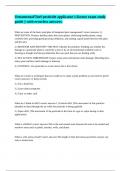
AIDA-181-Assignment 1 – Ch 5 Data-
Driven Decision Making well answered
to pass graded A+
1. Data-driven decision making is an organizational process that involves:
a) Gathering and analyzing relevant data
b) Evaluating results based on intuition
c) Ignoring internal data sources
d) Relying solely on external data - correct answer ✔✔a) Gathering and analyzing relevant data
2. Data science is an interdisciplinary field that deals with:
a) Only structured data from internal sources
b) Techniques to process very large amounts of data
c) Gathering data from a single source
d) Analyzing only historical data - correct answer ✔✔b) Techniques to process very large
amounts of data
3. In risk management and insurance, data-driven decision making:
a) Has been replaced by human analysis of data
b) Improves business results in various ways
c) Relies solely on intuition and gut feeling
d) Is not applicable due to lack of data sources - correct answer ✔✔b) Improves business results
in various ways
4. The two basic approaches to data-driven decision making are:
,a) Predictive and preventive
b) Descriptive and preventive
c) Predictive and descriptive
d) Reactive and preventive - correct answer ✔✔c) Predictive and descriptive
5. The descriptive approach to data-driven decision making is used for:
a) One-time-only business problems
b) Recurring business problems
c) Solving predictive modeling challenges
d) Handling external data sources - correct answer ✔✔a) One-time-only business problems
6. Predictive approaches in data-driven decision making are used for:
a) Solving specific, one-time problems
b) Recurring business problems
c) Analyzing data for the first time
d) Handling external data sources - correct answer ✔✔b) Recurring business problems
7. Data engineering and data processing technology allow insurers to manage:
a) Only small amounts of data
b) Data that is too large for most conventional systems
c) Only structured data
d) Historical data from previous years - correct answer ✔✔b) Data that is too large for most
conventional systems
8. Data-driven decision making can be applied to achieve:
a) Less efficient business processes
,b) A competitive disadvantage
c) A competitive advantage
d) A decrease in the volume of data - correct answer ✔✔c) A competitive advantage
9. Which type of data can insurers organize according to multiple characteristics, such as
telematics data?
a) Structured data only
b) External data only
c) Unstructured data only
d) New and large volumes of data - correct answer ✔✔d) New and large volumes of data
10. Data-driven decision making can help insurers automate decision making to improve:
a) Accuracy and efficiency
b) Accuracy and intuition
c) Intuition and efficiency
d) Data gathering and analysis - correct answer ✔✔a) Accuracy and efficiency
11. An insurer wants to identify the characteristics of insureds likely to make fraudulent claims.
What approach would they use?
a) Descriptive approach
b) Predictive approach
c) Reactive approach
d) Intuitive approach - correct answer ✔✔b) Predictive approach
12. Data mining claims adjusters' notes is an example of using what method to analyze data for
predicting claim severity?
a) Text mining
, b) Telematics
c) Internet of Things (IoT)
d) Machine learning - correct answer ✔✔a) Text mining
13. The primary goal of data-driven decision making is to:
a) Rely on intuition for important decisions
b) Automate all decision-making processes
c) Improve business results using data analysis
d) Ignore external data sources - correct answer ✔✔c) Improve business results using data
analysis
14. Data science involves processing data from:
a) Limited sources to ensure accuracy
b) A variety of sources to provide knowledge
c) Only internal data to maintain confidentiality
d) Non-relevant sources to reduce complexity - correct answer ✔✔b) A variety of sources to
provide knowledge
15. Data-driven decision making is:
a) A new concept with limited applications
b) An outdated approach to decision making
c) An organizational process for analyzing data
d) Only applicable to the finance industry - correct answer ✔✔c) An organizational process for
analyzing data
16. The Internet of Things (IoT) refers to:
a) A network of connected computers only
Driven Decision Making well answered
to pass graded A+
1. Data-driven decision making is an organizational process that involves:
a) Gathering and analyzing relevant data
b) Evaluating results based on intuition
c) Ignoring internal data sources
d) Relying solely on external data - correct answer ✔✔a) Gathering and analyzing relevant data
2. Data science is an interdisciplinary field that deals with:
a) Only structured data from internal sources
b) Techniques to process very large amounts of data
c) Gathering data from a single source
d) Analyzing only historical data - correct answer ✔✔b) Techniques to process very large
amounts of data
3. In risk management and insurance, data-driven decision making:
a) Has been replaced by human analysis of data
b) Improves business results in various ways
c) Relies solely on intuition and gut feeling
d) Is not applicable due to lack of data sources - correct answer ✔✔b) Improves business results
in various ways
4. The two basic approaches to data-driven decision making are:
,a) Predictive and preventive
b) Descriptive and preventive
c) Predictive and descriptive
d) Reactive and preventive - correct answer ✔✔c) Predictive and descriptive
5. The descriptive approach to data-driven decision making is used for:
a) One-time-only business problems
b) Recurring business problems
c) Solving predictive modeling challenges
d) Handling external data sources - correct answer ✔✔a) One-time-only business problems
6. Predictive approaches in data-driven decision making are used for:
a) Solving specific, one-time problems
b) Recurring business problems
c) Analyzing data for the first time
d) Handling external data sources - correct answer ✔✔b) Recurring business problems
7. Data engineering and data processing technology allow insurers to manage:
a) Only small amounts of data
b) Data that is too large for most conventional systems
c) Only structured data
d) Historical data from previous years - correct answer ✔✔b) Data that is too large for most
conventional systems
8. Data-driven decision making can be applied to achieve:
a) Less efficient business processes
,b) A competitive disadvantage
c) A competitive advantage
d) A decrease in the volume of data - correct answer ✔✔c) A competitive advantage
9. Which type of data can insurers organize according to multiple characteristics, such as
telematics data?
a) Structured data only
b) External data only
c) Unstructured data only
d) New and large volumes of data - correct answer ✔✔d) New and large volumes of data
10. Data-driven decision making can help insurers automate decision making to improve:
a) Accuracy and efficiency
b) Accuracy and intuition
c) Intuition and efficiency
d) Data gathering and analysis - correct answer ✔✔a) Accuracy and efficiency
11. An insurer wants to identify the characteristics of insureds likely to make fraudulent claims.
What approach would they use?
a) Descriptive approach
b) Predictive approach
c) Reactive approach
d) Intuitive approach - correct answer ✔✔b) Predictive approach
12. Data mining claims adjusters' notes is an example of using what method to analyze data for
predicting claim severity?
a) Text mining
, b) Telematics
c) Internet of Things (IoT)
d) Machine learning - correct answer ✔✔a) Text mining
13. The primary goal of data-driven decision making is to:
a) Rely on intuition for important decisions
b) Automate all decision-making processes
c) Improve business results using data analysis
d) Ignore external data sources - correct answer ✔✔c) Improve business results using data
analysis
14. Data science involves processing data from:
a) Limited sources to ensure accuracy
b) A variety of sources to provide knowledge
c) Only internal data to maintain confidentiality
d) Non-relevant sources to reduce complexity - correct answer ✔✔b) A variety of sources to
provide knowledge
15. Data-driven decision making is:
a) A new concept with limited applications
b) An outdated approach to decision making
c) An organizational process for analyzing data
d) Only applicable to the finance industry - correct answer ✔✔c) An organizational process for
analyzing data
16. The Internet of Things (IoT) refers to:
a) A network of connected computers only