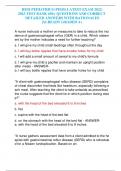
Advanced Pharmacology Exam 1 Test With d d d d d d
Verified Solutions d
Once you graduate from an NP program, in order to prescribe you'll need: -
d d d d d d d d d d d d d d
d d d d d d d d d d d -Advanced nurse prescriber license d d d
-DEA # d
What is the purpose of a DEA #? -
d d d d d d d d d
d d d d d d d d d d d Needed to prescribed scheduled drugs
d d d d
Rules for prescribing Schedule II drugs: -
d d d d d d d
d d d d d d d d d d d -Written script needed d d
-1 month supply only
d d d d
-No refills d
What is the PDMP? - d d d d d
d d d d d d d d d d d Prescription Drug Monitoring Program d d d
Used to effectively track patient's controlled substance uses across different health facilities (in the
d d d d d d d d d d d d d d
same state) d
What are clinical practice guidelines? -
d d d d d d
Recommendations that are intended to optimize patient care that are informed by a
d d d d d d d d d d d d d d d d d d d d d d d d
systematic review of the evidence and an assessment of the benefits/harms of alternative care
d d d d d d d d d d d d d d
practices
Ex: sepsis, CAP
d d
Common causes of medication errors: -
d d d d d d
d d d d d d d d d d d -Illegible writing d
-Drug names that sound alike
d d d d
1|Page
,-Medications that look alike d d d
-Administering a drug with the wrong route d d d d d d
What is pharmacokinetics? What are its 4 categories? -
d d d d d d d d d
d d d d d d d d d d d What the body does to the drug
d d d d d d
1. Absorption
d
2. Metabolism
d
3. Distribution
d
4. Excretion
d
Quickest route of absorption? Slowest? -
d d d d d d
d d d d d d d d d d d IV = quickest
d d d
IM = slowest
d d
What is the most common way drugs pass through cell membranes? -
d d d d d d d d d d d d
d d d d d d d d d d d Passive diffusion d
What characteristics of a drug allow it to pass most quickly through cell membranes (usually
d d d d d d d d d d d d d d d
through passive diffusion)? -d d d d
d d d d d d d d d d d Small, uncharged (unionized), lipid soluble--pass through membrane without any energy
d d d d d d d d d
What does it mean when a drug is ionized? -
d d d d d d d d d d
It means that the drug is stuck in the compartment it was ionized in and has to be moved to
d d d d d d d d d d d d d d d d d d d d d d d d d d d d d d
d the next compartment (cannot be absorbed into the bloodstream)
d d d d d d d d
Where do weak acids absorb? -
d d d d d d
d d d d d d d d d d d Stomach
Where do weak bases absorb? -
d d d d d d
d d d d d d d d d d d Small intestine d
2|Page
,pH of stomach: -
d d d d
d d d d d d d d d d d 2-4
pH of small intestine: -
d d d d d
d d d d d d d d d d d 6-7
pH of large intestine: -
d d d d d
d d d d d d d d d d d 6-7
pH of bloodstream: -
d d d d
d d d d d d d d d d d 7.35-7.45
pH of bladder: -
d d d d
d d d d d d d d d d d 5-8
pH of breastmilk: -
d d d d
d d d d d d d d d d d 7.1
Where will a drug absorb if it is a weak base that ionizes at a pH of 4 and lower? -
d d d d d d d d d d d d d d d d d d d d d
In the small intestine (since the stomach has a pH of 2-4, so the drug will become ionized
d d d d d d d d d d d d d d d d d d d d d d d d d d d d d
and move to the small intestine where it will be able to absorb into the bloodstream)
d d d d d d d d d d d d d d d
How can we manipulate the urine pH in cases of overdose? -
d d d d d d d d d d d d
d d d d d d d d d d d Drugs that are weak acids (aspirin) can be trapped and excreted through the urine.
d d d d d d d d d d d d d d
We raise pH of the urine (with sodium bicarb) to force the drug to ionize and allow it to be
d d d d d d d d d d d d d d d d d d d d
excreted, not reabsorbed through the bloodstream.
d d d d d
What is distribution? - d d d d
d d d d d d d d d d d How a drug will be transported to the tissues it needs to go to in order for it to exert its
d d d d d d d d d d d d d d d d d d d d d
effects
3|Page
, Drug factors related to distribution: -
d d d d d d
d d d d d d d d d d d -Lipid solubility d d
-Molecular size d
-Degree of ionization d d d
-Duration of action d d
-Cellular binding d
-Therapeutic effects d d
-Toxic effects d
(lipid soluble, small, and non-ionized drugs will distribute more quickly)
d d d d d d d d d
Body factors related to distribution: -
d d d d d d
d d d d d d d d d d d -Vascularity (poor perfusion, disruption of blood flow due to trauma--difficulty distributing)
d d d d d d d d d d
-Blood barriers (blood-brain-barrier can be problematic if we need to get drugs to the brain--will
d d d d d d d d d d d d d d d
need very high dosing since only a small amount of the drug will get through)
d d d d d d d d d d d d d d
-Transport mechanisms d d
-Plasma binding proteins d d d
-Disease states d
-Volume of distribution d d
-Drug interactions d
What is the key plasma protein involved with protein binding for medications? -
d d d d d d d d d d d d d
d d d d d d d d d d d Albumin
Why do we monitor albumin? -
d d d d d d
Indicative of nutritional status and how well protein-bound drugs will be transported to their
d d d d d d d d d d d d d d d d d d d d d d d d
d target locations d
What happens to the therapeutic effect of a drug when the patient is elderly and has very low
d d d d d d d d d d d d d d d d d d
levels of albumin? - d d d d
The drug does not bind to the protein (albumin) as much as expected, so there is a lot of
d d d d d d d d d d d d d d d d d d d d d d d d d d d d d d
free drug floating in the plasma; high risk for drug toxicity
d d d d d d d d d d
4|Page
Verified Solutions d
Once you graduate from an NP program, in order to prescribe you'll need: -
d d d d d d d d d d d d d d
d d d d d d d d d d d -Advanced nurse prescriber license d d d
-DEA # d
What is the purpose of a DEA #? -
d d d d d d d d d
d d d d d d d d d d d Needed to prescribed scheduled drugs
d d d d
Rules for prescribing Schedule II drugs: -
d d d d d d d
d d d d d d d d d d d -Written script needed d d
-1 month supply only
d d d d
-No refills d
What is the PDMP? - d d d d d
d d d d d d d d d d d Prescription Drug Monitoring Program d d d
Used to effectively track patient's controlled substance uses across different health facilities (in the
d d d d d d d d d d d d d d
same state) d
What are clinical practice guidelines? -
d d d d d d
Recommendations that are intended to optimize patient care that are informed by a
d d d d d d d d d d d d d d d d d d d d d d d d
systematic review of the evidence and an assessment of the benefits/harms of alternative care
d d d d d d d d d d d d d d
practices
Ex: sepsis, CAP
d d
Common causes of medication errors: -
d d d d d d
d d d d d d d d d d d -Illegible writing d
-Drug names that sound alike
d d d d
1|Page
,-Medications that look alike d d d
-Administering a drug with the wrong route d d d d d d
What is pharmacokinetics? What are its 4 categories? -
d d d d d d d d d
d d d d d d d d d d d What the body does to the drug
d d d d d d
1. Absorption
d
2. Metabolism
d
3. Distribution
d
4. Excretion
d
Quickest route of absorption? Slowest? -
d d d d d d
d d d d d d d d d d d IV = quickest
d d d
IM = slowest
d d
What is the most common way drugs pass through cell membranes? -
d d d d d d d d d d d d
d d d d d d d d d d d Passive diffusion d
What characteristics of a drug allow it to pass most quickly through cell membranes (usually
d d d d d d d d d d d d d d d
through passive diffusion)? -d d d d
d d d d d d d d d d d Small, uncharged (unionized), lipid soluble--pass through membrane without any energy
d d d d d d d d d
What does it mean when a drug is ionized? -
d d d d d d d d d d
It means that the drug is stuck in the compartment it was ionized in and has to be moved to
d d d d d d d d d d d d d d d d d d d d d d d d d d d d d d
d the next compartment (cannot be absorbed into the bloodstream)
d d d d d d d d
Where do weak acids absorb? -
d d d d d d
d d d d d d d d d d d Stomach
Where do weak bases absorb? -
d d d d d d
d d d d d d d d d d d Small intestine d
2|Page
,pH of stomach: -
d d d d
d d d d d d d d d d d 2-4
pH of small intestine: -
d d d d d
d d d d d d d d d d d 6-7
pH of large intestine: -
d d d d d
d d d d d d d d d d d 6-7
pH of bloodstream: -
d d d d
d d d d d d d d d d d 7.35-7.45
pH of bladder: -
d d d d
d d d d d d d d d d d 5-8
pH of breastmilk: -
d d d d
d d d d d d d d d d d 7.1
Where will a drug absorb if it is a weak base that ionizes at a pH of 4 and lower? -
d d d d d d d d d d d d d d d d d d d d d
In the small intestine (since the stomach has a pH of 2-4, so the drug will become ionized
d d d d d d d d d d d d d d d d d d d d d d d d d d d d d
and move to the small intestine where it will be able to absorb into the bloodstream)
d d d d d d d d d d d d d d d
How can we manipulate the urine pH in cases of overdose? -
d d d d d d d d d d d d
d d d d d d d d d d d Drugs that are weak acids (aspirin) can be trapped and excreted through the urine.
d d d d d d d d d d d d d d
We raise pH of the urine (with sodium bicarb) to force the drug to ionize and allow it to be
d d d d d d d d d d d d d d d d d d d d
excreted, not reabsorbed through the bloodstream.
d d d d d
What is distribution? - d d d d
d d d d d d d d d d d How a drug will be transported to the tissues it needs to go to in order for it to exert its
d d d d d d d d d d d d d d d d d d d d d
effects
3|Page
, Drug factors related to distribution: -
d d d d d d
d d d d d d d d d d d -Lipid solubility d d
-Molecular size d
-Degree of ionization d d d
-Duration of action d d
-Cellular binding d
-Therapeutic effects d d
-Toxic effects d
(lipid soluble, small, and non-ionized drugs will distribute more quickly)
d d d d d d d d d
Body factors related to distribution: -
d d d d d d
d d d d d d d d d d d -Vascularity (poor perfusion, disruption of blood flow due to trauma--difficulty distributing)
d d d d d d d d d d
-Blood barriers (blood-brain-barrier can be problematic if we need to get drugs to the brain--will
d d d d d d d d d d d d d d d
need very high dosing since only a small amount of the drug will get through)
d d d d d d d d d d d d d d
-Transport mechanisms d d
-Plasma binding proteins d d d
-Disease states d
-Volume of distribution d d
-Drug interactions d
What is the key plasma protein involved with protein binding for medications? -
d d d d d d d d d d d d d
d d d d d d d d d d d Albumin
Why do we monitor albumin? -
d d d d d d
Indicative of nutritional status and how well protein-bound drugs will be transported to their
d d d d d d d d d d d d d d d d d d d d d d d d
d target locations d
What happens to the therapeutic effect of a drug when the patient is elderly and has very low
d d d d d d d d d d d d d d d d d d
levels of albumin? - d d d d
The drug does not bind to the protein (albumin) as much as expected, so there is a lot of
d d d d d d d d d d d d d d d d d d d d d d d d d d d d d d
free drug floating in the plasma; high risk for drug toxicity
d d d d d d d d d d
4|Page