Organisation – Animals
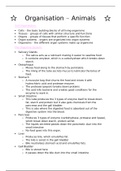
Cell Organisation:
Cells – the basic building blocks of all living organisms
Tissues – groups of cells with similar structure and functions
Organs – groups of tissues that perform a specific function
Organ systems – organs are organized into organ systems
Organisms – the different organ systems make up organisms
The Digestive System:
Salivary Glands
o The saliva acts as a lubricant making it easier to swallow food.
o It contains amylase, which is a carbohydrase which breaks down
starch.
Oesophagus
o Moves food along to the stomach by peristalsis.
o The lining of the tube secrets mucus to lubricate the bolus of
food.
Stomach
o A muscular bag that churns the food and mixes it with
hydrochloric acid and protease enzyme.
o The protease (pepsin) breaks down proteins
o The acid kills bacteria and creates good conditions for the
enzyme to work in.
Small Intestine
o This tube produces the 3 types of enzyme itself to break down
fat, starch and protein but it also gets chemicals from the
pancreas and the gall bladder.
o This is also where the digested food is absorbed out of the
digestive system into the blood.
Pancreas
o Produces 3 types of enzyme (carbohydrase, protease and lipase),
which break down starch, protein ad fat.
o The liquids secreted passes down the pancreatic duct into the
small intestine
o No food goes into this organ.
Liver
o Produces bile, which emulsifies fat.
o The bile is sored in the gall bladder
o Bile neutralises stomach acid and emulsifies fats.
Gall Bladder
o Bile is stored here
o It passes down the bile duct into the small intestine
Cell Organisation:
Cells – the basic building blocks of all living organisms
Tissues – groups of cells with similar structure and functions
Organs – groups of tissues that perform a specific function
Organ systems – organs are organized into organ systems
Organisms – the different organ systems make up organisms
The Digestive System:
Salivary Glands
o The saliva acts as a lubricant making it easier to swallow food.
o It contains amylase, which is a carbohydrase which breaks down
starch.
Oesophagus
o Moves food along to the stomach by peristalsis.
o The lining of the tube secrets mucus to lubricate the bolus of
food.
Stomach
o A muscular bag that churns the food and mixes it with
hydrochloric acid and protease enzyme.
o The protease (pepsin) breaks down proteins
o The acid kills bacteria and creates good conditions for the
enzyme to work in.
Small Intestine
o This tube produces the 3 types of enzyme itself to break down
fat, starch and protein but it also gets chemicals from the
pancreas and the gall bladder.
o This is also where the digested food is absorbed out of the
digestive system into the blood.
Pancreas
o Produces 3 types of enzyme (carbohydrase, protease and lipase),
which break down starch, protein ad fat.
o The liquids secreted passes down the pancreatic duct into the
small intestine
o No food goes into this organ.
Liver
o Produces bile, which emulsifies fat.
o The bile is sored in the gall bladder
o Bile neutralises stomach acid and emulsifies fats.
Gall Bladder
o Bile is stored here
o It passes down the bile duct into the small intestine