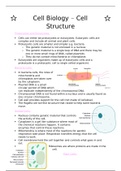
Cell Biology – Cell
Structure
Prokaryotes and Eukaryotes:
Cells can either be prokaryotes or eukaryotes. Eukaryotic cells are
complex and include all animal and plant cells.
Prokaryotic cells are smaller and simpler e.g. bacteria
o The genetic material is not enclosed in a nucleus
o The genetic material is a single loop of DNA and there may be
one or more small rings of DNA, called plasmids.
o They do not contain mitochondria or chloroplasts
Eukaryotes are organisms made up of eukaryotic cells and a
prokaryote is a prokaryotic cell (a single celled organism).
Bacteria Cells:
In bacteria cells, the roles of
mitochondria and
chloroplasts are taken over
by the cytoplasm.
Plasmid DNA is a small
circular section of DNA which
can replicate independently of the chromosomal DNA.
Chromosomal DNA is not found within a nucleus and is usually found as
one circular chromosome.
Cell wall provides support for the cell (not made of cellulose).
The flagella are tail-like structure that rotate to help some bacteria
move.
Animal Cells:
Nucleus contains genetic material that controls
the activity of the cell,
Cytoplasm is a gel like substance where most of
the chemical reactions happen. It contains
enzymes that control these reactions.
Mitochondria is where most of the reactions for aerobic
respiration take place. Respiration transfers energy that the cell
needs to work.
Cell membrane hold the cell together and controls what goes in and
out.
Ribosomes are where proteins are made in the
cell.
Plant Cells:
, Chloroplasts are needed to make their own food through
photosynthesis. They contain a green substance called chlorophyll
which absorbs the light needed for photosynthesis.
Cell wall made of cellulose supports the cell and strengthens it.
Permanent vacuole contains cell sap, a weak solution of sugar and
salts.
Cell Definitions:
Nucleus – Contains genes on chromosomes. Controls the activities
of the cell.
Cytoplasm – Where most of the chemical reactions (metabolism) of
the cell occur (including some parts of respirations). These reactions
are controlled by enzymes.
Cell Membrane – A selectively permeable barrier that controls the
movement of substances into and out of the cell.
Mitochondria – Where aerobic respiration occurs to release energy.
Ribosomes – The site of protein synthesis.
Cellulose Cell Wall – Provides strength and support for the cell.
Prevents it bursting due to osmosis.
Chloroplasts – The site of photosynthesis.
Permanent Vacuole – Contains cell sap (which may contain dissolved
substances). Important for keeping the cell rigid (turgid) and
providing support for the plant.
Cell Specialisation:
Sperm Cells – Sperm cells are found in the reproductive
system. The nucleus contains 1 set of genetic material
(haploid). The acrosome at the front contains enzymes to
digest its way into the egg. There are mitochondria
behind the nucleus to provide energy for movement. It has a
flagella tail that can move so it can swim to the egg. The sperm
cell is the male sex cell (gamete).
Nerve Cell - Nerve cells are found in the nervous system. Dendrites
allow this cell to synapse with many other nerve cells. The fatty
(myelin) sheath insulates the axon and speeds up the nervous
impulse. The nerve cell’s job is to send action potential (nerve
impulses) around the body to allow nervous coordination.
Muscle Cell – Muscle cells are found in your muscles.
Muscle is able to contract (get smaller). The muscle cells
contain many protein fibres that ratchet over each other
to make the muscle cell smaller. Muscles cause
movement. Causing movement requires a lot of energy.
Muscle cells will contain a lot of
mitochondria, so they can do a lot of respiration.
Structure
Prokaryotes and Eukaryotes:
Cells can either be prokaryotes or eukaryotes. Eukaryotic cells are
complex and include all animal and plant cells.
Prokaryotic cells are smaller and simpler e.g. bacteria
o The genetic material is not enclosed in a nucleus
o The genetic material is a single loop of DNA and there may be
one or more small rings of DNA, called plasmids.
o They do not contain mitochondria or chloroplasts
Eukaryotes are organisms made up of eukaryotic cells and a
prokaryote is a prokaryotic cell (a single celled organism).
Bacteria Cells:
In bacteria cells, the roles of
mitochondria and
chloroplasts are taken over
by the cytoplasm.
Plasmid DNA is a small
circular section of DNA which
can replicate independently of the chromosomal DNA.
Chromosomal DNA is not found within a nucleus and is usually found as
one circular chromosome.
Cell wall provides support for the cell (not made of cellulose).
The flagella are tail-like structure that rotate to help some bacteria
move.
Animal Cells:
Nucleus contains genetic material that controls
the activity of the cell,
Cytoplasm is a gel like substance where most of
the chemical reactions happen. It contains
enzymes that control these reactions.
Mitochondria is where most of the reactions for aerobic
respiration take place. Respiration transfers energy that the cell
needs to work.
Cell membrane hold the cell together and controls what goes in and
out.
Ribosomes are where proteins are made in the
cell.
Plant Cells:
, Chloroplasts are needed to make their own food through
photosynthesis. They contain a green substance called chlorophyll
which absorbs the light needed for photosynthesis.
Cell wall made of cellulose supports the cell and strengthens it.
Permanent vacuole contains cell sap, a weak solution of sugar and
salts.
Cell Definitions:
Nucleus – Contains genes on chromosomes. Controls the activities
of the cell.
Cytoplasm – Where most of the chemical reactions (metabolism) of
the cell occur (including some parts of respirations). These reactions
are controlled by enzymes.
Cell Membrane – A selectively permeable barrier that controls the
movement of substances into and out of the cell.
Mitochondria – Where aerobic respiration occurs to release energy.
Ribosomes – The site of protein synthesis.
Cellulose Cell Wall – Provides strength and support for the cell.
Prevents it bursting due to osmosis.
Chloroplasts – The site of photosynthesis.
Permanent Vacuole – Contains cell sap (which may contain dissolved
substances). Important for keeping the cell rigid (turgid) and
providing support for the plant.
Cell Specialisation:
Sperm Cells – Sperm cells are found in the reproductive
system. The nucleus contains 1 set of genetic material
(haploid). The acrosome at the front contains enzymes to
digest its way into the egg. There are mitochondria
behind the nucleus to provide energy for movement. It has a
flagella tail that can move so it can swim to the egg. The sperm
cell is the male sex cell (gamete).
Nerve Cell - Nerve cells are found in the nervous system. Dendrites
allow this cell to synapse with many other nerve cells. The fatty
(myelin) sheath insulates the axon and speeds up the nervous
impulse. The nerve cell’s job is to send action potential (nerve
impulses) around the body to allow nervous coordination.
Muscle Cell – Muscle cells are found in your muscles.
Muscle is able to contract (get smaller). The muscle cells
contain many protein fibres that ratchet over each other
to make the muscle cell smaller. Muscles cause
movement. Causing movement requires a lot of energy.
Muscle cells will contain a lot of
mitochondria, so they can do a lot of respiration.