DOWNLOAD THE Test Bank for Accounting for Business 3rd Edition Scott
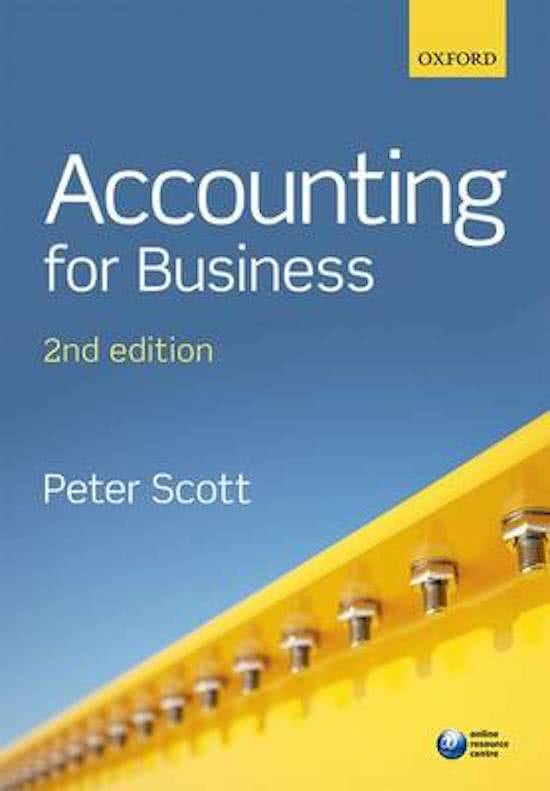
Scott: Accounting for Business, 3rd edition
Correct answers are marked with an asterisk (*).
Topic: Asset definition
Type: multiple choice question
Title: Chapter 02 - Question 01
01) Which one of the following statements is the IASB’s definition of an asset?
a. A right that has the potential to produce economic benefits.
Feedback: This is the IASB’s definition of an economic resource, not the IASB’s definition of
an asset.
Page reference: 32-35
b. A present obligation of the entity to transfer an economic resource as a result of past
events.
Feedback: This is the IASB’s definition of a liability not the IASB’s definition of an asset.
Page reference: 32-35, 40-43
*c. A present economic resource controlled by the entity as a result of past events.
Feedback: Well done. You have correctly identified the IASB’s definition of an asset.
Page reference: 32-35
d. A present economic resource that has the potential to produce economic benefits.
Feedback: The IASB defines an asset as “a present economic resource controlled by the
entity as a result of past events.” An economic resource is defined as “a right that has the
potential to produce economic benefits”. While the IASB definition of an asset includes the
words “a present economic resource”, it does not include the words “that has the potential to
produce economic benefits”. The essential asset defining elements of control and of a past
event are missing from this statement.
Page reference: 32-35
Type: multiple choice question
Title: Chapter 02 - Question 02
02) The International Accounting Standards Board’s Conceptual Framework for Financial
Reporting defines an asset as:
a. A resource not purchased for resale in the normal course of business, held for long-term
use in the business to produce goods or services.
Feedback: This is a description of non-current assets, not the IASB Conceptual Framework
definition of an asset.
Page reference: 32-35, 36-38
b. A present obligation of the entity to transfer an economic resource as a result of past
events.
Feedback: This is the IASB Conceptual Framework definition of a liability, not the IASB
Conceptual Framework definition of an asset.
Page reference: 32-35, 40-43
c. A short term resource that is constantly changing.
Feedback: This is a description of current assets, not the IASB Conceptual Framework
definition of an asset.
Page reference: 32-35, 38-39
*d. A present economic resource controlled by the entity as a result of past events.
Feedback: Well done. You have correctly remembered and identified the IASB Conceptual
Framework definition of an asset.
Page reference: 32-35
Type: multiple choice question
Title: Chapter 02 - Question 03
03) Which one of the following statements most accurately describes an asset?
a. Something an entity owes, the value of which can be faithfully represented.
© Peter Scott, 2019.
mynursytest.store
,DOWNLOAD THE Test Bank for Accounting for Business 3rd Edition Scott DOWNLOAD THE Test Bank for Accounting for Business 3rd Edition Scott
Scott: Accounting for Business, 3rd edition Scott: Accounting for Business, 3rd edition
Feedback: Certainly, the value of an asset must be capable of faithful representation before it be recognised or not. Is there a present economic resource controlled by the company as a
can be recognized on the statement of financial position. However, something that is owed by result of past events? Yes: the purchase of the plant and equipment gives the company
a business is a liability, not an asset. control of this resource. Is there potential to produce economic benefits (profit and cash) for
Page reference: 32-35, 40-43 the company from this resource? Yes: the new plant and equipment will be used to produce
b. Something an entity owes which will result in the transfer of cash. goods that can be sold at a price higher than their cost, resulting in both cash inflows and
Feedback: Assets represent rights that have the potential to produce economic benefits.: this profits. Can the value of the resource be measured in such a way that a faithful representation
means that cash will be received by the entity rather than being transferred from the entity. is achieved? Yes: the cost of the plant and equipment is the purchase price from the supplier.
Where there is a transfer of cash, this indicates a liability not an asset. Something that is In this case, all the conditions for recognising an asset have been met so this is not the
owed by a business is a liability not an asset. correct answer.
Page reference: 32-35, 40-43 Page reference: 32-35
*c. Something an entity controls which it uses to generate cash. b. Raw materials for use in production are bought by the company.
Feedback: The IASB defines an asset as “a present economic resource controlled by the Feedback: To find the situation in which an asset cannot be recognised on the statement of
entity as a result of past events” and goes on to define an economic resource as “a right that financial position, use the different parts of the asset definition to decide whether an asset can
has the potential to produce economic benefits”. An asset is therefore something controlled be recognised or not. Is there a present economic resource controlled by the company as a
by the organization (owned or leased) which is used to generate cash (economic benefits), so result of past events? Yes: the raw materials have been bought by the company which gives
this is a good description of an asset. the company control of those raw materials. Is there potential to produce economic benefits
Page reference: 32-35 (profit and cash) for the company from this resource? Yes: the raw materials will be used to
d. Something an entity owns for long term use within its business. produce goods which will be sold at a price higher than their cost, resulting in both cash
Feedback: This statement describes only non-current (long term) assets which are used inflows and profits. Can the value of the resource be measured in such a way that a faithful
within a business. Assets can be both current (short term assets) and non-current, so this is representation is achieved? Yes: the cost of the raw materials is the purchase price from the
only a partial description of the total class of assets. supplier. In this case, all the conditions for recognising an asset have been met so this is not
Page reference: 32-35, 36-38 the correct answer.
Page reference: 32-35
Type: multiple response question *c. A trade receivable that owes money to the company goes into liquidation with no likelihood
Title: Chapter 02 - Question 04 that it will be able to pay what is owed.
04) An asset can be recognised in an entity’s statement of financial position when: Please Feedback: To find the situation in which an asset cannot be recognised on the statement of
select all that apply. financial position, use the different parts of the asset definition to decide whether an asset can
Feedback: The International Accounting Standards Board’s Conceptual Framework for be recognised or not. Is there a present economic resource controlled by the company as a
Financial Reporting defines an asset as “a present economic resource controlled by the entity result of past events? Yes: goods were sold to a customer giving rise to the trade receivable
as a result of past events.“ An economic resource is a right that has the potential to produce which the company controls. Is there potential to produce economic benefits (profit and cash)
economic benefits.” ”. Therefore, an asset can be recognised when there is a past event from this resurce? No: no cash will be generated from this trade receivable and the failure of
giving rise to an economic resource controlled by the entity and when profit (economic the trade receivable to pay what is owed will result in a loss not a profit . Can the value of the
benefits) will be generated by that resource. The resource should generate economic benefits asset be measured in such a way that a faithful representation sis achieved? Yes: the trade
rather than resulting in a transfer of an economic resource. Where there is a transfer of an receivable would have been valued at the selling price of the goods. In this case no asset can
economic resource, this represents a liability, a present obligation of the entity to transfer an be recognised as the trade receivable does not satisfy all the criteria for recognising an asset
economic resource as a result of past events. In addition, the IASB Conceptual Framework so this is the correct answer.
only allows entities to recognise assets when their bvalue can be measured in such a way Page reference: 32-35
that a faithful representation is achieved. d. Cash that is not required to finance day to day trading operations is invested in a bank
Page reference: 32-35, 40-43 account paying a fixed rate of interest for a fixed term of three years.
*a. A past event gives rise to an economic resource controlled by the entity. Feedback: To find the situation in which an asset cannot be recognised on the statement of
*b. The value of the resource can be measured in such a way that a faithful representation is financial position, use the different parts of the asset definition to decide whether an asset can
achieved. be recognised or not. Is there a present economic resource controlled by the company as a
c. The resource will give rise to a transfer of economic resources. result of past events? Yes: the investment in the bank account is the past event and the bank
*d. Profit will be generated by the resource. will acknowledge receipt of the money paid in so the company controls the investment. Is
there potential to produce economic benefits (profit and cash) for the company from this
Type: multiple choice question resource? Yes: the investment will generate interest and a repayment of the amount invested
Title: Chapter 02 - Question 05 in three years’ time resulting in both cash inflows and profits. Can the value of the asset be
05) The International Accounting Standards Board’s Conceptual Framework for Financial measured in such a way that a faithful representation is achieved? Yes: the original amount
Reporting defines an asset as “a present economic resource controlled by the entity as a invested in the bank account. In this case, all the conditions for recognising an asset have
result of past events. An economic resource is a right that has the potential to produce been met so this is not the correct answer.
economic benefits.”. In addition, the IASB Cocneptual Framework only allows entities to Page reference: 32-35
recognise assets when their value can be measured in such a way that a faithful
representation is achieved. In which one of the following situations would a manufacturing Type: true-false
company not recognise an asset on its statement of financial position? Title: Chapter 02 - Question 06
a. A new piece of plant and equipment is purchased for use in the production process. 06) The International Accounting Standards Board’s Conceptual Framework for Financial
Feedback: To find the situation in which an asset cannot be recognised on the statement of Reporting defines an asset as “a present obligation of the entity to transfer an economic
financial position, use the different parts of the asset definition to decide whether an asset can resource as a result of past events.”
© Peter Scott, 2019. © Peter Scott, 2019.
mynursytest.store mynursytest.store
,DOWNLOAD THE Test Bank for Accounting for Business 3rd Edition Scott DOWNLOAD THE Test Bank for Accounting for Business 3rd Edition Scott
Scott: Accounting for Business, 3rd edition Scott: Accounting for Business, 3rd edition
a. True Feedback: This is the IASB’s definition of an economic resource, not the IASB’s definition of
Feedback: This is the IASB’s definition of a liability, not the IASB’s definition of an asset. The a liability. The IASB defines a liability as “a present obligation of the entity to transfer an
IASB defines an asset as “a present economic resource controlled by the entity as a result of economic resource as a result of past events.”
past events”. Page reference: 32-35, 40-43
Page reference: 32-35, 40-43 c. A present obligation of the entity as a result of past events.
*b. False Feedback: This is part of the IASB’s definition of a liability, but this statement misses out a
Feedback: You have correctly identified that this is not the IASB’s definition of an asset. This key part of the definition which is “the present obligation of the entity to transfer an economic
is the IASB’s definition of a liability. The IASB defines an asset as “a present economic resource as a result of past events.”
resource controlled by the entity as a result of past events”. Page reference: 40-43
Page reference: 32-35, 40-43 *d. A present obligation of the entity to transfer an economic resource as a result of past
events.
Type: multiple choice question Feedback: This is the IASB’s definition of a liability.
Title: Chapter 02 - Question 07 Page reference: 40-43
07) PhonesForUs has a stock of old smart phones bought three years ago from a supplier.
The phones have been counted up and it has been found that there are 100 of them. These Type: true-false
phones originally cost £50 each three years ago. However, no one has bought one of these Title: Chapter 02 - Question 09
phones in the past 18 months and much newer models with much greater levels of features 09) Liabilities can only be recognised in the statement of financial position if their value can be
and connectivity have rendered these phones out of date. The accountant has decided that measured in such a way that a faithful representation is achieved.
the phones can no longer be recognised as an asset in the statement of financial position of *a. True
PhonesForUs. What is the reason for the accountant’s decision? Feedback: Both assets and liabilities can only be recognized in the statement of financial
a. The cost of the phones cannot be measured in such a way that a faithful representation is position if their value can be measured in such a way that a faithful representation is
achieved. achieved. While the IASB allows entities to estimate the monetary value of assets and
Feedback: This cannot be the reason for the accountant’s decision as the cost of the mobile liabilities if a completely accurate valuation is not available, when the possible range of values
phones can be measured to achieve a faithful representation of their cost: 100 phones x £50 for an asset or liability is so wide or when measurement is based on very subjective
each = £5,000 total cost. measures, then the completeness, neutrality and freedom from error required for a faithful
Page reference: 32-35 representation cannot be achieved and no asset or liability is recognized in the statement of
*b. There is no potential to produce economic benefits for the entity. financial position.
Feedback: As the old smart phones have not been selling for the past 18 months and newer Page reference: 34, 41
and more desirable models are now available to consumers, it is most unlikely that any more b. False
of these old smart phones will be sold. Therefore, there is no potential to produce economic Feedback: Both assets and liabilities can only be recognized in the statement of financial
benefits for PhonesForUs in the form of cash and profits so these old smart phones can no position if their value can be measured in such a way that a faithful representation is
longer be recognized as an asset on the statement of financial position. achieved. While the IASB allows entities to estimate the monetary value of assets and
Page reference: 32-35 liabilities if a completely accurate valuation is not available, when the possible range of values
c. There is no past event giving rise to the asset. for an asset or liability is so wide or when measurement is based on very subjective
Feedback: This cannot be the reason for the accountant’s decision as the old smart phones measures, then the completeness, neutrality and freedom from error required for a faithful
were purchased from a supplier three years ago. This purchase was the past event that representation cannot be achieved and no asset or liability is recognized in the statement of
originally gave rise to the asset in the business. financial position.
Page reference: 32-35 Page reference: 34,41
d. The smart phones are not controlled by PhonesForUs
Feedback: This cannot be the reason for the accountant’s decision. The original purchase of Type: multiple choice question
the old smart phones from the supplier transferred ownership (and thus control) of these Title: Chapter 02 - Question 10
smart phones to PhonesForUs. 10) A liability can be described as:
Page reference: 32-35 a. Something an entity owes, the value of which just needs to be estimated.
Feedback: A liability is something that is owed by an organization. However, the IASB
requires the value of liabilities to be measured in such a way that they are faithfully
Topic: Liability definition
represented in the statement of financial position. The value of liabilities can be estimated
when no completely accurate valuation is available. However, where the possible range of
Type: multiple choice question estimated values for a liability (as well as for assets) is so wide or when measurement is
Title: Chapter 02 - Question 08 based on very subjective measures, then the completeness, neutrality and freedom from error
08) Which one of the following statements is the IASB’s definition of a liability? required for a faithful representation cannot be achieved and no liability (or asset) is
a. A present economic resource controlled by the entity as a result of past events. recognized in the statement of financial position. Therefore, it is not true to describe a liability
Feedback: This is the IASB’s definition of an asset, not the IASB’s definition of a liability. A as something an entity owes, the value of which just needs to be estimated.
liability is “a present obligation of the entity to transfer an economic resource as a result of Page reference: 40-43
past events.” *b. Something an entity owes which will result in the payment of cash by the entity.
Page reference: 32-35, 40-43 Feedback: The IASB defines a liability as “a present obligation of the entity to transfer an
b. A right that has the potential to produce economic benefits. economic resource as a result of past events.” Since the economic resource almost always
© Peter Scott, 2019. © Peter Scott, 2019.
mynursytest.store mynursytest.store
, DOWNLOAD THE Test Bank for Accounting for Business 3rd Edition Scott DOWNLOAD THE Test Bank for Accounting for Business 3rd Edition Scott
Scott: Accounting for Business, 3rd edition Scott: Accounting for Business, 3rd edition
transferred (paid) to settle a liability is cash, this is the correct description of what a liability Feedback: Liabilities are recognized when there is a present obligation to transfer an
represents. economic resource as a result of past events (International Accounting Standards Board,
Page reference: 40-43 Conceptual Framework for Financial Reporting). Therefore, when a transfer of an economic
c. Something an entity controls which it uses to generate cash. resource will take place, a liability will be recognized in the statement of financial position.
Feedback: This is the description of an asset, something owned or leased (both of which Page reference: 40-43
confer control, the right to use the economic resource within an organisation) by an entity that
results in the potential to produce economic benefits (cash). A liability is something owed by
an entity which will result in the transfer of cash (cash = an economic resource).
Page reference: 32-35, 40-43 Topic: Asset classification
d. Something an entity owns for long term use within its business.
Feedback: This statement describes non-current (long term) assets and is not a description
of a liability. Type: multiple choice question
Page reference: 36-38, 40-43 Title: Chapter 02 - Question 13
13) Which one of the following would be recognized as a non-current asset in the statement
Type: multiple response question of financial position of a mining company?
Title: Chapter 02 - Question 11 *a. A licence to mine land for minerals.
11) A liability can be recognised in an entity’s statement of financial position when: Please Feedback: A licence to mine land for minerals is an economic resource with the potential to
select all that apply. produce economic benefits (sales and cash) over periods of more than one financial year, so
Feedback: The International Accounting Standards Board’s Conceptual Framework for this licence would be recognized as a non-current asset in the statement of financial position
Financial Reporting defines a liability as “a present obligation of the entity to transfer an of a mining company.
economic resource as a result of past events”. Therefore, a liability can be recognised when Page reference: 36-38, 40
there is a past event giving rise to an obligation and when there is expected to be a transfer of b. A pile of ore ready for shipment.
an economic resource. A contractual or legal claim against an entity means that there has Feedback: Ore ready for shipment would be classified as inventory, a current asset that will
been a past event that will give rise to a transfer of an economic resource. However, when an be turned into cash (economic benefits) within the next 12 months, so this is not a non-current
obligation can be avoided no liability is recognised. asset of the company.
Page reference: 40-43 Page reference: 36-40
*a. There is a present obligation as a result of past events. c. A loan to the mining company which is due for repayment in 10 years’ time.
b. There is an expectation that the obligation can be avoided. Feedback: A loan to the mining company which is due for repayment in 10 years’ time is non-
*c. There is a contractual or legal claim against the entity. current but it is a non-current liability rather than a non-current asset. Liabilities are obligations
*d. There is expected to be a transfer of an economic resource. of the company to transfer economic resources rather than resources which have the
potential to produce economic benefits. Assets are present economic resources. Economic
Type: multiple choice question resources are rights which have the potential to produce economic benefits. Non-current
Title: Chapter 02 - Question 12 assets are rights which have the potential to produce these benefits over periods of more than
12) In which one of the following circumstances would an organization not recognise a one year.
liability on its statement of financial position? Page reference: 36-40, 43-45
*a. When the obligation cannot be measured, in such a way that a faithful representation is d. Money owed by the mining company’s customers.
achieved. Feedback: Money owed by the mining company’s customers would be classified as an asset.
Feedback: The International Accounting Standards Board requires obligations to be The company has an economic resource, a right which has the potential to produce economic
measured in such a way that a faithful representation of their value is presented on the benefits in the form of a cash payment from their customers. However, this money owed
statement of financial position. When such a faithful representation cannot be made, then a would be classified as a receivable, a current rather than a non-current asset as the economic
liability cannot be recognised on the statement of financial position. benefits of this asset will be realized within the next 12 months and not over accounting
Page reference: 40-43 periods exceeding one year.
b. When the obligation cannot be avoided. Page reference: 36-40
Feedback: When an obligation cannot be avoided, a liability must be recognised on the
statement of financial position. When an obligation can be avoided, then no liability can be Type: multiple choice question
recognized. An obligation that cannot be avoided is unavoidable, so a liability must be Title: Chapter 02 - Question 14
recognised. 14) Which one of the following would not be recognized as a non-current asset in the
Page reference: 40-43 statement of financial position of a professional football club?
c. When the entity has an obligation at the statement of financial position date. a. The contracts of players purchased from other football clubs.
Feedback: When an obligation exists at the statement of financial position date (a present Feedback: In order to recognize an asset, there must be a present economic resource
obligation), then a liability must be recognised on the statement of financial position. For an controlled by the entity as a result of past events (International Accounting Standards Board,
obligation to exist at the statement of financial position date there must have been a past Conceptual Framework for Financial Reporting). In addition, the IASB only allows the
event giving rise to the obligation, which will require recognition as a liability on the statement recognition of an asset when the value of that asset can be measured in such a way that a
of financial position. faithful representation is achieved. Here there is a resource (the players), controlled by the
Page reference: 40-43 entity (players are contracted to play exclusively for the club) as a result of a past event (the
d. When a transfer of an economic resource will take place. purchase of the contracts), the public will pay money to watch these players and the team (=
the potential to produce economic benefits) and the cost of the contracts can be measured by
© Peter Scott, 2019. © Peter Scott, 2019.
mynursytest.store mynursytest.store
Scott: Accounting for Business, 3rd edition
Correct answers are marked with an asterisk (*).
Topic: Asset definition
Type: multiple choice question
Title: Chapter 02 - Question 01
01) Which one of the following statements is the IASB’s definition of an asset?
a. A right that has the potential to produce economic benefits.
Feedback: This is the IASB’s definition of an economic resource, not the IASB’s definition of
an asset.
Page reference: 32-35
b. A present obligation of the entity to transfer an economic resource as a result of past
events.
Feedback: This is the IASB’s definition of a liability not the IASB’s definition of an asset.
Page reference: 32-35, 40-43
*c. A present economic resource controlled by the entity as a result of past events.
Feedback: Well done. You have correctly identified the IASB’s definition of an asset.
Page reference: 32-35
d. A present economic resource that has the potential to produce economic benefits.
Feedback: The IASB defines an asset as “a present economic resource controlled by the
entity as a result of past events.” An economic resource is defined as “a right that has the
potential to produce economic benefits”. While the IASB definition of an asset includes the
words “a present economic resource”, it does not include the words “that has the potential to
produce economic benefits”. The essential asset defining elements of control and of a past
event are missing from this statement.
Page reference: 32-35
Type: multiple choice question
Title: Chapter 02 - Question 02
02) The International Accounting Standards Board’s Conceptual Framework for Financial
Reporting defines an asset as:
a. A resource not purchased for resale in the normal course of business, held for long-term
use in the business to produce goods or services.
Feedback: This is a description of non-current assets, not the IASB Conceptual Framework
definition of an asset.
Page reference: 32-35, 36-38
b. A present obligation of the entity to transfer an economic resource as a result of past
events.
Feedback: This is the IASB Conceptual Framework definition of a liability, not the IASB
Conceptual Framework definition of an asset.
Page reference: 32-35, 40-43
c. A short term resource that is constantly changing.
Feedback: This is a description of current assets, not the IASB Conceptual Framework
definition of an asset.
Page reference: 32-35, 38-39
*d. A present economic resource controlled by the entity as a result of past events.
Feedback: Well done. You have correctly remembered and identified the IASB Conceptual
Framework definition of an asset.
Page reference: 32-35
Type: multiple choice question
Title: Chapter 02 - Question 03
03) Which one of the following statements most accurately describes an asset?
a. Something an entity owes, the value of which can be faithfully represented.
© Peter Scott, 2019.
mynursytest.store
,DOWNLOAD THE Test Bank for Accounting for Business 3rd Edition Scott DOWNLOAD THE Test Bank for Accounting for Business 3rd Edition Scott
Scott: Accounting for Business, 3rd edition Scott: Accounting for Business, 3rd edition
Feedback: Certainly, the value of an asset must be capable of faithful representation before it be recognised or not. Is there a present economic resource controlled by the company as a
can be recognized on the statement of financial position. However, something that is owed by result of past events? Yes: the purchase of the plant and equipment gives the company
a business is a liability, not an asset. control of this resource. Is there potential to produce economic benefits (profit and cash) for
Page reference: 32-35, 40-43 the company from this resource? Yes: the new plant and equipment will be used to produce
b. Something an entity owes which will result in the transfer of cash. goods that can be sold at a price higher than their cost, resulting in both cash inflows and
Feedback: Assets represent rights that have the potential to produce economic benefits.: this profits. Can the value of the resource be measured in such a way that a faithful representation
means that cash will be received by the entity rather than being transferred from the entity. is achieved? Yes: the cost of the plant and equipment is the purchase price from the supplier.
Where there is a transfer of cash, this indicates a liability not an asset. Something that is In this case, all the conditions for recognising an asset have been met so this is not the
owed by a business is a liability not an asset. correct answer.
Page reference: 32-35, 40-43 Page reference: 32-35
*c. Something an entity controls which it uses to generate cash. b. Raw materials for use in production are bought by the company.
Feedback: The IASB defines an asset as “a present economic resource controlled by the Feedback: To find the situation in which an asset cannot be recognised on the statement of
entity as a result of past events” and goes on to define an economic resource as “a right that financial position, use the different parts of the asset definition to decide whether an asset can
has the potential to produce economic benefits”. An asset is therefore something controlled be recognised or not. Is there a present economic resource controlled by the company as a
by the organization (owned or leased) which is used to generate cash (economic benefits), so result of past events? Yes: the raw materials have been bought by the company which gives
this is a good description of an asset. the company control of those raw materials. Is there potential to produce economic benefits
Page reference: 32-35 (profit and cash) for the company from this resource? Yes: the raw materials will be used to
d. Something an entity owns for long term use within its business. produce goods which will be sold at a price higher than their cost, resulting in both cash
Feedback: This statement describes only non-current (long term) assets which are used inflows and profits. Can the value of the resource be measured in such a way that a faithful
within a business. Assets can be both current (short term assets) and non-current, so this is representation is achieved? Yes: the cost of the raw materials is the purchase price from the
only a partial description of the total class of assets. supplier. In this case, all the conditions for recognising an asset have been met so this is not
Page reference: 32-35, 36-38 the correct answer.
Page reference: 32-35
Type: multiple response question *c. A trade receivable that owes money to the company goes into liquidation with no likelihood
Title: Chapter 02 - Question 04 that it will be able to pay what is owed.
04) An asset can be recognised in an entity’s statement of financial position when: Please Feedback: To find the situation in which an asset cannot be recognised on the statement of
select all that apply. financial position, use the different parts of the asset definition to decide whether an asset can
Feedback: The International Accounting Standards Board’s Conceptual Framework for be recognised or not. Is there a present economic resource controlled by the company as a
Financial Reporting defines an asset as “a present economic resource controlled by the entity result of past events? Yes: goods were sold to a customer giving rise to the trade receivable
as a result of past events.“ An economic resource is a right that has the potential to produce which the company controls. Is there potential to produce economic benefits (profit and cash)
economic benefits.” ”. Therefore, an asset can be recognised when there is a past event from this resurce? No: no cash will be generated from this trade receivable and the failure of
giving rise to an economic resource controlled by the entity and when profit (economic the trade receivable to pay what is owed will result in a loss not a profit . Can the value of the
benefits) will be generated by that resource. The resource should generate economic benefits asset be measured in such a way that a faithful representation sis achieved? Yes: the trade
rather than resulting in a transfer of an economic resource. Where there is a transfer of an receivable would have been valued at the selling price of the goods. In this case no asset can
economic resource, this represents a liability, a present obligation of the entity to transfer an be recognised as the trade receivable does not satisfy all the criteria for recognising an asset
economic resource as a result of past events. In addition, the IASB Conceptual Framework so this is the correct answer.
only allows entities to recognise assets when their bvalue can be measured in such a way Page reference: 32-35
that a faithful representation is achieved. d. Cash that is not required to finance day to day trading operations is invested in a bank
Page reference: 32-35, 40-43 account paying a fixed rate of interest for a fixed term of three years.
*a. A past event gives rise to an economic resource controlled by the entity. Feedback: To find the situation in which an asset cannot be recognised on the statement of
*b. The value of the resource can be measured in such a way that a faithful representation is financial position, use the different parts of the asset definition to decide whether an asset can
achieved. be recognised or not. Is there a present economic resource controlled by the company as a
c. The resource will give rise to a transfer of economic resources. result of past events? Yes: the investment in the bank account is the past event and the bank
*d. Profit will be generated by the resource. will acknowledge receipt of the money paid in so the company controls the investment. Is
there potential to produce economic benefits (profit and cash) for the company from this
Type: multiple choice question resource? Yes: the investment will generate interest and a repayment of the amount invested
Title: Chapter 02 - Question 05 in three years’ time resulting in both cash inflows and profits. Can the value of the asset be
05) The International Accounting Standards Board’s Conceptual Framework for Financial measured in such a way that a faithful representation is achieved? Yes: the original amount
Reporting defines an asset as “a present economic resource controlled by the entity as a invested in the bank account. In this case, all the conditions for recognising an asset have
result of past events. An economic resource is a right that has the potential to produce been met so this is not the correct answer.
economic benefits.”. In addition, the IASB Cocneptual Framework only allows entities to Page reference: 32-35
recognise assets when their value can be measured in such a way that a faithful
representation is achieved. In which one of the following situations would a manufacturing Type: true-false
company not recognise an asset on its statement of financial position? Title: Chapter 02 - Question 06
a. A new piece of plant and equipment is purchased for use in the production process. 06) The International Accounting Standards Board’s Conceptual Framework for Financial
Feedback: To find the situation in which an asset cannot be recognised on the statement of Reporting defines an asset as “a present obligation of the entity to transfer an economic
financial position, use the different parts of the asset definition to decide whether an asset can resource as a result of past events.”
© Peter Scott, 2019. © Peter Scott, 2019.
mynursytest.store mynursytest.store
,DOWNLOAD THE Test Bank for Accounting for Business 3rd Edition Scott DOWNLOAD THE Test Bank for Accounting for Business 3rd Edition Scott
Scott: Accounting for Business, 3rd edition Scott: Accounting for Business, 3rd edition
a. True Feedback: This is the IASB’s definition of an economic resource, not the IASB’s definition of
Feedback: This is the IASB’s definition of a liability, not the IASB’s definition of an asset. The a liability. The IASB defines a liability as “a present obligation of the entity to transfer an
IASB defines an asset as “a present economic resource controlled by the entity as a result of economic resource as a result of past events.”
past events”. Page reference: 32-35, 40-43
Page reference: 32-35, 40-43 c. A present obligation of the entity as a result of past events.
*b. False Feedback: This is part of the IASB’s definition of a liability, but this statement misses out a
Feedback: You have correctly identified that this is not the IASB’s definition of an asset. This key part of the definition which is “the present obligation of the entity to transfer an economic
is the IASB’s definition of a liability. The IASB defines an asset as “a present economic resource as a result of past events.”
resource controlled by the entity as a result of past events”. Page reference: 40-43
Page reference: 32-35, 40-43 *d. A present obligation of the entity to transfer an economic resource as a result of past
events.
Type: multiple choice question Feedback: This is the IASB’s definition of a liability.
Title: Chapter 02 - Question 07 Page reference: 40-43
07) PhonesForUs has a stock of old smart phones bought three years ago from a supplier.
The phones have been counted up and it has been found that there are 100 of them. These Type: true-false
phones originally cost £50 each three years ago. However, no one has bought one of these Title: Chapter 02 - Question 09
phones in the past 18 months and much newer models with much greater levels of features 09) Liabilities can only be recognised in the statement of financial position if their value can be
and connectivity have rendered these phones out of date. The accountant has decided that measured in such a way that a faithful representation is achieved.
the phones can no longer be recognised as an asset in the statement of financial position of *a. True
PhonesForUs. What is the reason for the accountant’s decision? Feedback: Both assets and liabilities can only be recognized in the statement of financial
a. The cost of the phones cannot be measured in such a way that a faithful representation is position if their value can be measured in such a way that a faithful representation is
achieved. achieved. While the IASB allows entities to estimate the monetary value of assets and
Feedback: This cannot be the reason for the accountant’s decision as the cost of the mobile liabilities if a completely accurate valuation is not available, when the possible range of values
phones can be measured to achieve a faithful representation of their cost: 100 phones x £50 for an asset or liability is so wide or when measurement is based on very subjective
each = £5,000 total cost. measures, then the completeness, neutrality and freedom from error required for a faithful
Page reference: 32-35 representation cannot be achieved and no asset or liability is recognized in the statement of
*b. There is no potential to produce economic benefits for the entity. financial position.
Feedback: As the old smart phones have not been selling for the past 18 months and newer Page reference: 34, 41
and more desirable models are now available to consumers, it is most unlikely that any more b. False
of these old smart phones will be sold. Therefore, there is no potential to produce economic Feedback: Both assets and liabilities can only be recognized in the statement of financial
benefits for PhonesForUs in the form of cash and profits so these old smart phones can no position if their value can be measured in such a way that a faithful representation is
longer be recognized as an asset on the statement of financial position. achieved. While the IASB allows entities to estimate the monetary value of assets and
Page reference: 32-35 liabilities if a completely accurate valuation is not available, when the possible range of values
c. There is no past event giving rise to the asset. for an asset or liability is so wide or when measurement is based on very subjective
Feedback: This cannot be the reason for the accountant’s decision as the old smart phones measures, then the completeness, neutrality and freedom from error required for a faithful
were purchased from a supplier three years ago. This purchase was the past event that representation cannot be achieved and no asset or liability is recognized in the statement of
originally gave rise to the asset in the business. financial position.
Page reference: 32-35 Page reference: 34,41
d. The smart phones are not controlled by PhonesForUs
Feedback: This cannot be the reason for the accountant’s decision. The original purchase of Type: multiple choice question
the old smart phones from the supplier transferred ownership (and thus control) of these Title: Chapter 02 - Question 10
smart phones to PhonesForUs. 10) A liability can be described as:
Page reference: 32-35 a. Something an entity owes, the value of which just needs to be estimated.
Feedback: A liability is something that is owed by an organization. However, the IASB
requires the value of liabilities to be measured in such a way that they are faithfully
Topic: Liability definition
represented in the statement of financial position. The value of liabilities can be estimated
when no completely accurate valuation is available. However, where the possible range of
Type: multiple choice question estimated values for a liability (as well as for assets) is so wide or when measurement is
Title: Chapter 02 - Question 08 based on very subjective measures, then the completeness, neutrality and freedom from error
08) Which one of the following statements is the IASB’s definition of a liability? required for a faithful representation cannot be achieved and no liability (or asset) is
a. A present economic resource controlled by the entity as a result of past events. recognized in the statement of financial position. Therefore, it is not true to describe a liability
Feedback: This is the IASB’s definition of an asset, not the IASB’s definition of a liability. A as something an entity owes, the value of which just needs to be estimated.
liability is “a present obligation of the entity to transfer an economic resource as a result of Page reference: 40-43
past events.” *b. Something an entity owes which will result in the payment of cash by the entity.
Page reference: 32-35, 40-43 Feedback: The IASB defines a liability as “a present obligation of the entity to transfer an
b. A right that has the potential to produce economic benefits. economic resource as a result of past events.” Since the economic resource almost always
© Peter Scott, 2019. © Peter Scott, 2019.
mynursytest.store mynursytest.store
, DOWNLOAD THE Test Bank for Accounting for Business 3rd Edition Scott DOWNLOAD THE Test Bank for Accounting for Business 3rd Edition Scott
Scott: Accounting for Business, 3rd edition Scott: Accounting for Business, 3rd edition
transferred (paid) to settle a liability is cash, this is the correct description of what a liability Feedback: Liabilities are recognized when there is a present obligation to transfer an
represents. economic resource as a result of past events (International Accounting Standards Board,
Page reference: 40-43 Conceptual Framework for Financial Reporting). Therefore, when a transfer of an economic
c. Something an entity controls which it uses to generate cash. resource will take place, a liability will be recognized in the statement of financial position.
Feedback: This is the description of an asset, something owned or leased (both of which Page reference: 40-43
confer control, the right to use the economic resource within an organisation) by an entity that
results in the potential to produce economic benefits (cash). A liability is something owed by
an entity which will result in the transfer of cash (cash = an economic resource).
Page reference: 32-35, 40-43 Topic: Asset classification
d. Something an entity owns for long term use within its business.
Feedback: This statement describes non-current (long term) assets and is not a description
of a liability. Type: multiple choice question
Page reference: 36-38, 40-43 Title: Chapter 02 - Question 13
13) Which one of the following would be recognized as a non-current asset in the statement
Type: multiple response question of financial position of a mining company?
Title: Chapter 02 - Question 11 *a. A licence to mine land for minerals.
11) A liability can be recognised in an entity’s statement of financial position when: Please Feedback: A licence to mine land for minerals is an economic resource with the potential to
select all that apply. produce economic benefits (sales and cash) over periods of more than one financial year, so
Feedback: The International Accounting Standards Board’s Conceptual Framework for this licence would be recognized as a non-current asset in the statement of financial position
Financial Reporting defines a liability as “a present obligation of the entity to transfer an of a mining company.
economic resource as a result of past events”. Therefore, a liability can be recognised when Page reference: 36-38, 40
there is a past event giving rise to an obligation and when there is expected to be a transfer of b. A pile of ore ready for shipment.
an economic resource. A contractual or legal claim against an entity means that there has Feedback: Ore ready for shipment would be classified as inventory, a current asset that will
been a past event that will give rise to a transfer of an economic resource. However, when an be turned into cash (economic benefits) within the next 12 months, so this is not a non-current
obligation can be avoided no liability is recognised. asset of the company.
Page reference: 40-43 Page reference: 36-40
*a. There is a present obligation as a result of past events. c. A loan to the mining company which is due for repayment in 10 years’ time.
b. There is an expectation that the obligation can be avoided. Feedback: A loan to the mining company which is due for repayment in 10 years’ time is non-
*c. There is a contractual or legal claim against the entity. current but it is a non-current liability rather than a non-current asset. Liabilities are obligations
*d. There is expected to be a transfer of an economic resource. of the company to transfer economic resources rather than resources which have the
potential to produce economic benefits. Assets are present economic resources. Economic
Type: multiple choice question resources are rights which have the potential to produce economic benefits. Non-current
Title: Chapter 02 - Question 12 assets are rights which have the potential to produce these benefits over periods of more than
12) In which one of the following circumstances would an organization not recognise a one year.
liability on its statement of financial position? Page reference: 36-40, 43-45
*a. When the obligation cannot be measured, in such a way that a faithful representation is d. Money owed by the mining company’s customers.
achieved. Feedback: Money owed by the mining company’s customers would be classified as an asset.
Feedback: The International Accounting Standards Board requires obligations to be The company has an economic resource, a right which has the potential to produce economic
measured in such a way that a faithful representation of their value is presented on the benefits in the form of a cash payment from their customers. However, this money owed
statement of financial position. When such a faithful representation cannot be made, then a would be classified as a receivable, a current rather than a non-current asset as the economic
liability cannot be recognised on the statement of financial position. benefits of this asset will be realized within the next 12 months and not over accounting
Page reference: 40-43 periods exceeding one year.
b. When the obligation cannot be avoided. Page reference: 36-40
Feedback: When an obligation cannot be avoided, a liability must be recognised on the
statement of financial position. When an obligation can be avoided, then no liability can be Type: multiple choice question
recognized. An obligation that cannot be avoided is unavoidable, so a liability must be Title: Chapter 02 - Question 14
recognised. 14) Which one of the following would not be recognized as a non-current asset in the
Page reference: 40-43 statement of financial position of a professional football club?
c. When the entity has an obligation at the statement of financial position date. a. The contracts of players purchased from other football clubs.
Feedback: When an obligation exists at the statement of financial position date (a present Feedback: In order to recognize an asset, there must be a present economic resource
obligation), then a liability must be recognised on the statement of financial position. For an controlled by the entity as a result of past events (International Accounting Standards Board,
obligation to exist at the statement of financial position date there must have been a past Conceptual Framework for Financial Reporting). In addition, the IASB only allows the
event giving rise to the obligation, which will require recognition as a liability on the statement recognition of an asset when the value of that asset can be measured in such a way that a
of financial position. faithful representation is achieved. Here there is a resource (the players), controlled by the
Page reference: 40-43 entity (players are contracted to play exclusively for the club) as a result of a past event (the
d. When a transfer of an economic resource will take place. purchase of the contracts), the public will pay money to watch these players and the team (=
the potential to produce economic benefits) and the cost of the contracts can be measured by
© Peter Scott, 2019. © Peter Scott, 2019.
mynursytest.store mynursytest.store