Introduction to Developmental Theories
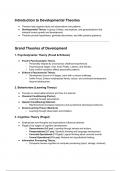
● Theories help organize facts and observations into patterns.
● Developmental Theory: A group of ideas, assumptions, and generalizations that
interpret human growth and development.
● Theories provide hypotheses, generate discoveries, and offer practical guidance.
Grand Theories of Development
1. Psychodynamic Theory (Freud & Erikson)
● Freud’s Psychoanalytic Theory:
○ Personality shaped by unconscious childhood experiences.
○ Psychosexual stages: Oral, Anal, Phallic, Latency, and Genital.
○ Early conflict resolution affects personality patterns.
● Erikson’s Psychosocial Theory:
○ Development occurs in 8 stages, each with a unique challenge.
○ Unlike Freud, Erikson emphasized family, culture, and continued development
beyond adolescence.
2. Behaviorism (Learning Theory)
● Focuses on observable behavior and how it is learned.
● Classical Conditioning (Pavlov):
○ Learning through associations.
● Operant Conditioning (Skinner):
○ Reinforcement (increases behavior) and punishment (decreases behavior).
● Social Learning Theory (Bandura):
○ Learning through observation and imitation.
3. Cognitive Theory (Piaget)
● Emphasizes how thoughts and expectations influence behavior.
● Piaget’s four stages of cognitive development:
○ Sensorimotor (0-2 yrs): Learning through senses and actions.
○ Preoperational (2-7 yrs): Symbolic thinking and language development.
○ Concrete Operational (7-11 yrs): Logical thinking about concrete events.
○ Formal Operational (12+ yrs): Abstract and hypothetical thinking.
● Information Processing Theory:
○ Compares human cognition to computer processing (input, storage, retrieval).
● Theories help organize facts and observations into patterns.
● Developmental Theory: A group of ideas, assumptions, and generalizations that
interpret human growth and development.
● Theories provide hypotheses, generate discoveries, and offer practical guidance.
Grand Theories of Development
1. Psychodynamic Theory (Freud & Erikson)
● Freud’s Psychoanalytic Theory:
○ Personality shaped by unconscious childhood experiences.
○ Psychosexual stages: Oral, Anal, Phallic, Latency, and Genital.
○ Early conflict resolution affects personality patterns.
● Erikson’s Psychosocial Theory:
○ Development occurs in 8 stages, each with a unique challenge.
○ Unlike Freud, Erikson emphasized family, culture, and continued development
beyond adolescence.
2. Behaviorism (Learning Theory)
● Focuses on observable behavior and how it is learned.
● Classical Conditioning (Pavlov):
○ Learning through associations.
● Operant Conditioning (Skinner):
○ Reinforcement (increases behavior) and punishment (decreases behavior).
● Social Learning Theory (Bandura):
○ Learning through observation and imitation.
3. Cognitive Theory (Piaget)
● Emphasizes how thoughts and expectations influence behavior.
● Piaget’s four stages of cognitive development:
○ Sensorimotor (0-2 yrs): Learning through senses and actions.
○ Preoperational (2-7 yrs): Symbolic thinking and language development.
○ Concrete Operational (7-11 yrs): Logical thinking about concrete events.
○ Formal Operational (12+ yrs): Abstract and hypothetical thinking.
● Information Processing Theory:
○ Compares human cognition to computer processing (input, storage, retrieval).