STRATEGIC DECISION-MAKING
Strategic decisions
We make decisions all day:
- Some need additional information
- We ask advice for some decisions
- Some are made on the basis of pre-existing heuristics
- We try to narrow down the number of alternatives
Organizations are also confronted with decision situations
The key challenge to any decision is the reduction of uncertainty
What are strategic decisions? – Example & discussion
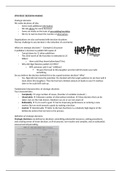
A publisher’s decision to publish 500 copies of
- Turned down by 12 other publishers
- The 2016 worth of the franchise is estimated at 25
billion!
o How could they know beforehand? Not.
- Why did Nigel Newton publish it (1996)?
o Will customers pick it up? (children)
He gave the book to this daughter and she told this book was really
something.
Do you believe the decision behind this to be a good business decision? Why?
- Yes, Nigel did not know the potential. He checked with the target audience to see how well it
went down (his daughter). Then he first had a limited amount of books to see if it worked,
later on he could still scale up.
Fundamental characteristics of strategic decisions
Four characteristics:
- Complexity Large number of issues, (Number of variables involved. )
- Uncertainty Unknown number of alternatives/solutions Many decision that can be
taken, but are the risks known. Solutions we are or are not aware of.
- Rationality Try to reach a goal Can be improving performance or entering a new
market. But we work towards a goals by making a decision.
- Control Intentionality Refer to the fact that there is a relatively high degree of the
deliberate actions that we have to the process.
Definition of strategic decisions
Strategic decisions are defined as decisions committing substantial resources, setting precedents,
and creating waves of lesser decision; as ill-structured, non-routine and complex; and as substantial,
unusual and all-pervading.
,Definition of strategic decision-making process
The Strategic decision-making process by which a strategic decision is made and implemented and
the factors which affect it, i.e. the process that leads to the choice of goals and means and the way in
which means are effectively deployed (Elbanna, 2006)
- Formulation and implementation of the decision.
Key assumptions of SDM
Departure of SDM thinking, research & theorizing:
So, why spend more time and resources on these decision and
processes?
- The more rational you are the more likely you will have a
good performance following a strategic decision. More
rational is collecting and analyzing more information.
- Resource shows that there are many aspects that can
limit or counter this relationship.
Reasons for this lie in a myriad of factors, amongst which analytical and organizational complexity.
To deal with this:
- Professionals develop tools based on decision analysis and/or evidence-based approaches
- Researchers identify the factors that increase or decrease the quality of strategic decisions
from a multidisciplinary viewpoint
o Economics, psychologist etc.
Key assumptions of SDM
SDM: What’s the fuzz all about?
- Assumptions underlying the SDM process-effectiveness relationship
Practitioners Use the correct procedures and tools to prevent decision failure and achieve
decision success.
+
Researchers Use the evidence generated by research to understand decision failure and decision
success
= NOT necessarily
Brilliant decision making!
,Key questions for the course
1. How can we understand variation and heterogeneity of the effects of context on SDM
processes?
2. How can we understand variation and heterogeneity of the effects of context and SDM
processes on outcomes?
Preliminary categorical answers to questions:
- Antecedents The causes why processes look like they do
- Process dynamics Interaction and interdependency between people and teams in
organizations.
- Constraining and enabling factors What happens during processes that hinder the process
or how can we design a process that helps us make better decisions.
More elaborately:
- The way decision making processes unfold is subject to decision-situational factors Not
every situation is suited for an approach rooted in information gathering and analysis in
relation to goals.
- In addition, the (collaborative) interactions between participants in the SDM process and the
dynamics of the process can unfold in different ways leading to different decisions.
Introducing the integrative framework of strategic decisions
1. The introductory text
2. The integrative framework for studying strategic decision (in a nutshell)
3. Basics in strategic management (self-study)
1. The introductory text
What do you need to learn from the introduction text:
- After reading it, do you know / understand the:
o Definitions of constituent components?
o Definitions of context factors, process characteristics, outcomes?
o Purpose of the framework?
o Logic behind the framework?
o How to read of the framework?
If not, engage us in the session or through the discussion board!
2. What is the integrative framework of SDs?
- Set of constituent parts with the links between them
- The analytical scheme to study SDs
- Integration of (sets of) factors from a multi-theoretic perspective
Why do we need it?
- An analytical review scheme is necessary for systematically discerning patterns from a widely
differing set of studies and evaluating the contributions of a given body of research and to
guide future research.
The integrative framework for SDs (Constituent components)
,
Strategic decisions
We make decisions all day:
- Some need additional information
- We ask advice for some decisions
- Some are made on the basis of pre-existing heuristics
- We try to narrow down the number of alternatives
Organizations are also confronted with decision situations
The key challenge to any decision is the reduction of uncertainty
What are strategic decisions? – Example & discussion
A publisher’s decision to publish 500 copies of
- Turned down by 12 other publishers
- The 2016 worth of the franchise is estimated at 25
billion!
o How could they know beforehand? Not.
- Why did Nigel Newton publish it (1996)?
o Will customers pick it up? (children)
He gave the book to this daughter and she told this book was really
something.
Do you believe the decision behind this to be a good business decision? Why?
- Yes, Nigel did not know the potential. He checked with the target audience to see how well it
went down (his daughter). Then he first had a limited amount of books to see if it worked,
later on he could still scale up.
Fundamental characteristics of strategic decisions
Four characteristics:
- Complexity Large number of issues, (Number of variables involved. )
- Uncertainty Unknown number of alternatives/solutions Many decision that can be
taken, but are the risks known. Solutions we are or are not aware of.
- Rationality Try to reach a goal Can be improving performance or entering a new
market. But we work towards a goals by making a decision.
- Control Intentionality Refer to the fact that there is a relatively high degree of the
deliberate actions that we have to the process.
Definition of strategic decisions
Strategic decisions are defined as decisions committing substantial resources, setting precedents,
and creating waves of lesser decision; as ill-structured, non-routine and complex; and as substantial,
unusual and all-pervading.
,Definition of strategic decision-making process
The Strategic decision-making process by which a strategic decision is made and implemented and
the factors which affect it, i.e. the process that leads to the choice of goals and means and the way in
which means are effectively deployed (Elbanna, 2006)
- Formulation and implementation of the decision.
Key assumptions of SDM
Departure of SDM thinking, research & theorizing:
So, why spend more time and resources on these decision and
processes?
- The more rational you are the more likely you will have a
good performance following a strategic decision. More
rational is collecting and analyzing more information.
- Resource shows that there are many aspects that can
limit or counter this relationship.
Reasons for this lie in a myriad of factors, amongst which analytical and organizational complexity.
To deal with this:
- Professionals develop tools based on decision analysis and/or evidence-based approaches
- Researchers identify the factors that increase or decrease the quality of strategic decisions
from a multidisciplinary viewpoint
o Economics, psychologist etc.
Key assumptions of SDM
SDM: What’s the fuzz all about?
- Assumptions underlying the SDM process-effectiveness relationship
Practitioners Use the correct procedures and tools to prevent decision failure and achieve
decision success.
+
Researchers Use the evidence generated by research to understand decision failure and decision
success
= NOT necessarily
Brilliant decision making!
,Key questions for the course
1. How can we understand variation and heterogeneity of the effects of context on SDM
processes?
2. How can we understand variation and heterogeneity of the effects of context and SDM
processes on outcomes?
Preliminary categorical answers to questions:
- Antecedents The causes why processes look like they do
- Process dynamics Interaction and interdependency between people and teams in
organizations.
- Constraining and enabling factors What happens during processes that hinder the process
or how can we design a process that helps us make better decisions.
More elaborately:
- The way decision making processes unfold is subject to decision-situational factors Not
every situation is suited for an approach rooted in information gathering and analysis in
relation to goals.
- In addition, the (collaborative) interactions between participants in the SDM process and the
dynamics of the process can unfold in different ways leading to different decisions.
Introducing the integrative framework of strategic decisions
1. The introductory text
2. The integrative framework for studying strategic decision (in a nutshell)
3. Basics in strategic management (self-study)
1. The introductory text
What do you need to learn from the introduction text:
- After reading it, do you know / understand the:
o Definitions of constituent components?
o Definitions of context factors, process characteristics, outcomes?
o Purpose of the framework?
o Logic behind the framework?
o How to read of the framework?
If not, engage us in the session or through the discussion board!
2. What is the integrative framework of SDs?
- Set of constituent parts with the links between them
- The analytical scheme to study SDs
- Integration of (sets of) factors from a multi-theoretic perspective
Why do we need it?
- An analytical review scheme is necessary for systematically discerning patterns from a widely
differing set of studies and evaluating the contributions of a given body of research and to
guide future research.
The integrative framework for SDs (Constituent components)
,