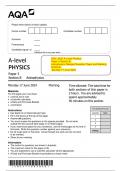
Please write clearly in block capitals.
Centre number Candidate number
Surname
Forename(s)
Candidate signatu re
I declare this is my own work.
A-level
2024_AQA A-Level Physics
Paper 3 Section B
Astrophysics (Merged Question Paper and Marking
PHYSICS Scheme)
Monday 17 June 2024
Paper 3
Section B Astrophysics
Monday 17 June 2024 Morning Time allowed: The total time for
Materials
both sections of this paper is
For this paper you must have: 2 hours. You are advised to
a pencil and a ruler spend approximately
a scientific calculator
a Data and Formulae Booklet 50 minutes on this section.
a protractor.
For Examiner’s Use
Instructions
Use black ink or black ball-point pen. Question Mark
Fill in the boxes at the top of this page. 1
Answer all questions.
2
You must answer the questions in the spaces provided. Do not write
outside the box around each page or on blank pages. 3
If you need extra space for your answer(s), use the lined pages at the end of 4
this book. Write the question number against your answer(s).
TOTAL
Do all rough work in this book. Cross through any work you do not want
to be marked.
Show all your working.
Information
The marks for questions are shown in brackets.
The maximum mark for this paper is 35.
You are expected to use a scientific calculator where appropriate.
A Data and Formulae Booklet is provided as a loose insert.
,7408/3BA
A-Level Physics: Paper 3 Section B – Astrophysics: Exam Preview Sections
Section B of Paper 3 focuses on Astrophysics, exploring the key concepts of
the universe, from stars and galaxies to cosmology. You'll be tested on your
understanding of astrophysical theories, observational techniques, and the
ability to apply physics concepts to astronomical phenomena.
1. Stellar Formation and Evolution:
Stellar Lifecycles: Understand the life stages of stars, from nebulae to
main-sequence stars, red giants, white dwarfs, and supernovae.
o Learn the difference between low- and high-mass star evolution.
o Understand nuclear fusion processes and how they power
stars.
o For high-mass stars, understand the concept of supernovae,
the formation of neutron stars and black holes.
Hertzsprung-Russell (H-R) Diagram: Be familiar with how the H-R
diagram is used to classify stars by their luminosity and temperature,
and understand how stars evolve across the diagram.
2. Black Holes:
Formation of Black Holes: Understand the concept of gravitational
collapse and how it leads to the formation of a black hole when a
massive star runs out of fuel.
Event Horizon: Know the properties of a black hole’s event horizon,
where not even light can escape.
Singularity: Understand the concept of singularity, the point of infinite
density at the center of a black hole.
Detection of Black Holes: Learn how black holes are detected
indirectly through their effect on nearby matter, such as by observing X-
ray emissions from accretion disks.
3. The Big Bang Theory and Cosmology:
4. Dark Matter and Dark Energy:
5. Observational Techniques:
Telescopes: Be familiar with the different types of telescopes (optical,
radio, infrared, X-ray, etc.), and how each detects different wavelengths
of electromagnetic radiation to observe objects in space.
Parallax and Distance Measurement: Know how stellar parallax is
used to measure the distance to nearby stars and how to calculate
distances in space.
6. Key Concepts to Revise:
Stellar evolution: Review the stages in the life cycle of stars, from
nebula to supernova or white dwarf, and the processes that occur at
each stage.
Black holes: Be able to explain the properties and formation of black
holes and how they can be detected.
Cosmology: Understand the evidence for the Big Bang, the expansion
of the universe, and the concepts of dark matter and dark energy.
Telescopes and observation: Review the various methods used to
study distant astronomical objects and the information that can be
derived from these observations. IB/M/Jun24/E6
, 2
Do not write
outside the
Section B box
Answer all questions in this section.
0 1 A student uses a refracting telescope in normal adjustment to make
observations of Jupiter.
The telescope has an angular magnification of 75
0 1
. 1 The eyepiece has a focal length of 22 mm.
Determine the distance between the eyepiece and the objective lens.
[2 marks]
distance = m
0 1 . 2 When viewed through the telescope, the image of Jupiter subtends an angle
of 1.7 × 10⁻² rad.
Calculate, in km, the distance between the Earth and Jupiter.
mean radius of Jupiter = 7.0 × 10⁴ km
[2 marks]
distance = km
IB/M/Jun24/7408/3BA
, 3
Do not write
outside the
The student places a cap over one end of the telescope. The cap has a circular hole box
in its centre.
Figure 1 shows the end of the telescope, the objective lens and the cap.
Figure 1
0 1
. 3 State and explain the effect that the addition of the cap has on the chromatic
aberration caused by the lens.
[3 marks]
0 1 . 4 Explain two other effects that the addition of the cap has on the image of Jupiter.
[4 marks]
1
2
11
IB/M/Jun24/7408/3BA
,4
Do not write
outside the
Turn over ► box
IB/M/Jun24/7408/3BA
, 5
Do not write
outside the
0 2 The apparent change in position of a nearby star relative to distant stars is due to an box
effect known as parallax.
Figure 2 shows how parallax arises. As the Earth moves from point P to point Q, an
observer on the Earth sees the position of a nearby star S change in relation to distant
stars.
Figure 2
Angle A is the parallax angle. This angle can be used to determine the distance to a
nearby star, provided that the relative motion between the star and the Sun is
negligible between observations.
0 2
. 1 The distance from the Sun to S is 79 ly.
The Earth takes 6 months to move from point P to point Q.
Calculate, in degrees, angle A.
[2 marks]
A= °
IB/M/Jun24/7408/3BA
, 6
Do not write
outside the
0 2 . 2 Parallax is used to determine the distance to a different star. Observations of the star box
produce the following data:
distance determined using parallax = 0.40 pc
apparent magnitude = 13.5
absolute magnitude = 16.7
An astronomer suggests that the star moved significantly relative to the Sun between
the two parallax observations.
Discuss whether this suggestion is valid.
[4 marks]
6
Turn over ►
IB/M/Jun24/7408/3BA
, 7
Do not write
outside the
0 3 . 1 Figure 3 shows the variation of intensity with wavelength for a star. box
Figure 3
Show that Figure 3 is consistent with a black-body temperature of about 6.0 × 10³ K.
[2 marks]
0 3
. 2 The radius of the star is 9.6 × 10⁶ m.
Calculate the power output of the star.
[2 marks]
power output = W
IB/M/Jun24/7408/3BA
, 8
Do not write
outside the
0 3 . 3 Which row gives the type and spectral class of the star? box
Tick () one box.
[1 mark]
Type of star Spectral class
white dwarf F
main sequence G
red giant K
main sequence F
red giant G
white dwarf K
0 3 . 4 The light from the star passes through an interstellar dust cloud before reaching Earth.
The reduction in intensity when light passes through a dust cloud is assumed to be
inversely proportional to the wavelength of the light.
An astronomer on the Earth estimates the black-body temperature of the star.
Discuss the effect that the dust cloud has on this estimate.
[2 marks]
7
Turn over ►
IB/M/Jun24/7408/3BA
Centre number Candidate number
Surname
Forename(s)
Candidate signatu re
I declare this is my own work.
A-level
2024_AQA A-Level Physics
Paper 3 Section B
Astrophysics (Merged Question Paper and Marking
PHYSICS Scheme)
Monday 17 June 2024
Paper 3
Section B Astrophysics
Monday 17 June 2024 Morning Time allowed: The total time for
Materials
both sections of this paper is
For this paper you must have: 2 hours. You are advised to
a pencil and a ruler spend approximately
a scientific calculator
a Data and Formulae Booklet 50 minutes on this section.
a protractor.
For Examiner’s Use
Instructions
Use black ink or black ball-point pen. Question Mark
Fill in the boxes at the top of this page. 1
Answer all questions.
2
You must answer the questions in the spaces provided. Do not write
outside the box around each page or on blank pages. 3
If you need extra space for your answer(s), use the lined pages at the end of 4
this book. Write the question number against your answer(s).
TOTAL
Do all rough work in this book. Cross through any work you do not want
to be marked.
Show all your working.
Information
The marks for questions are shown in brackets.
The maximum mark for this paper is 35.
You are expected to use a scientific calculator where appropriate.
A Data and Formulae Booklet is provided as a loose insert.
,7408/3BA
A-Level Physics: Paper 3 Section B – Astrophysics: Exam Preview Sections
Section B of Paper 3 focuses on Astrophysics, exploring the key concepts of
the universe, from stars and galaxies to cosmology. You'll be tested on your
understanding of astrophysical theories, observational techniques, and the
ability to apply physics concepts to astronomical phenomena.
1. Stellar Formation and Evolution:
Stellar Lifecycles: Understand the life stages of stars, from nebulae to
main-sequence stars, red giants, white dwarfs, and supernovae.
o Learn the difference between low- and high-mass star evolution.
o Understand nuclear fusion processes and how they power
stars.
o For high-mass stars, understand the concept of supernovae,
the formation of neutron stars and black holes.
Hertzsprung-Russell (H-R) Diagram: Be familiar with how the H-R
diagram is used to classify stars by their luminosity and temperature,
and understand how stars evolve across the diagram.
2. Black Holes:
Formation of Black Holes: Understand the concept of gravitational
collapse and how it leads to the formation of a black hole when a
massive star runs out of fuel.
Event Horizon: Know the properties of a black hole’s event horizon,
where not even light can escape.
Singularity: Understand the concept of singularity, the point of infinite
density at the center of a black hole.
Detection of Black Holes: Learn how black holes are detected
indirectly through their effect on nearby matter, such as by observing X-
ray emissions from accretion disks.
3. The Big Bang Theory and Cosmology:
4. Dark Matter and Dark Energy:
5. Observational Techniques:
Telescopes: Be familiar with the different types of telescopes (optical,
radio, infrared, X-ray, etc.), and how each detects different wavelengths
of electromagnetic radiation to observe objects in space.
Parallax and Distance Measurement: Know how stellar parallax is
used to measure the distance to nearby stars and how to calculate
distances in space.
6. Key Concepts to Revise:
Stellar evolution: Review the stages in the life cycle of stars, from
nebula to supernova or white dwarf, and the processes that occur at
each stage.
Black holes: Be able to explain the properties and formation of black
holes and how they can be detected.
Cosmology: Understand the evidence for the Big Bang, the expansion
of the universe, and the concepts of dark matter and dark energy.
Telescopes and observation: Review the various methods used to
study distant astronomical objects and the information that can be
derived from these observations. IB/M/Jun24/E6
, 2
Do not write
outside the
Section B box
Answer all questions in this section.
0 1 A student uses a refracting telescope in normal adjustment to make
observations of Jupiter.
The telescope has an angular magnification of 75
0 1
. 1 The eyepiece has a focal length of 22 mm.
Determine the distance between the eyepiece and the objective lens.
[2 marks]
distance = m
0 1 . 2 When viewed through the telescope, the image of Jupiter subtends an angle
of 1.7 × 10⁻² rad.
Calculate, in km, the distance between the Earth and Jupiter.
mean radius of Jupiter = 7.0 × 10⁴ km
[2 marks]
distance = km
IB/M/Jun24/7408/3BA
, 3
Do not write
outside the
The student places a cap over one end of the telescope. The cap has a circular hole box
in its centre.
Figure 1 shows the end of the telescope, the objective lens and the cap.
Figure 1
0 1
. 3 State and explain the effect that the addition of the cap has on the chromatic
aberration caused by the lens.
[3 marks]
0 1 . 4 Explain two other effects that the addition of the cap has on the image of Jupiter.
[4 marks]
1
2
11
IB/M/Jun24/7408/3BA
,4
Do not write
outside the
Turn over ► box
IB/M/Jun24/7408/3BA
, 5
Do not write
outside the
0 2 The apparent change in position of a nearby star relative to distant stars is due to an box
effect known as parallax.
Figure 2 shows how parallax arises. As the Earth moves from point P to point Q, an
observer on the Earth sees the position of a nearby star S change in relation to distant
stars.
Figure 2
Angle A is the parallax angle. This angle can be used to determine the distance to a
nearby star, provided that the relative motion between the star and the Sun is
negligible between observations.
0 2
. 1 The distance from the Sun to S is 79 ly.
The Earth takes 6 months to move from point P to point Q.
Calculate, in degrees, angle A.
[2 marks]
A= °
IB/M/Jun24/7408/3BA
, 6
Do not write
outside the
0 2 . 2 Parallax is used to determine the distance to a different star. Observations of the star box
produce the following data:
distance determined using parallax = 0.40 pc
apparent magnitude = 13.5
absolute magnitude = 16.7
An astronomer suggests that the star moved significantly relative to the Sun between
the two parallax observations.
Discuss whether this suggestion is valid.
[4 marks]
6
Turn over ►
IB/M/Jun24/7408/3BA
, 7
Do not write
outside the
0 3 . 1 Figure 3 shows the variation of intensity with wavelength for a star. box
Figure 3
Show that Figure 3 is consistent with a black-body temperature of about 6.0 × 10³ K.
[2 marks]
0 3
. 2 The radius of the star is 9.6 × 10⁶ m.
Calculate the power output of the star.
[2 marks]
power output = W
IB/M/Jun24/7408/3BA
, 8
Do not write
outside the
0 3 . 3 Which row gives the type and spectral class of the star? box
Tick () one box.
[1 mark]
Type of star Spectral class
white dwarf F
main sequence G
red giant K
main sequence F
red giant G
white dwarf K
0 3 . 4 The light from the star passes through an interstellar dust cloud before reaching Earth.
The reduction in intensity when light passes through a dust cloud is assumed to be
inversely proportional to the wavelength of the light.
An astronomer on the Earth estimates the black-body temperature of the star.
Discuss the effect that the dust cloud has on this estimate.
[2 marks]
7
Turn over ►
IB/M/Jun24/7408/3BA