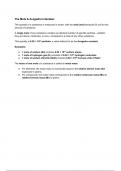
The Mole & Avogadro’s Number
The quantity of a substance is measured in moles, with the mole (mol) being the SI unit for the
amount of substance.
A single mole of any substance contains an identical number of specific particles—whether
they are atoms, molecules, or ions—compared to a mole of any other substance.
This quantity is 6.02 × 10²³ particles, a value referred to as the Avogadro constant.
Examples:
● 1 mole of sodium (Na) contains 6.02 × 10²³ sodium atoms.
● 1 mole of hydrogen gas (H₂) consists of 6.02 × 10²³ hydrogen molecules.
● 1 mole of sodium chloride (NaCl) includes 6.02 × 10²³ formula units of NaCl.
The mass of one mole of a substance is called its molar mass.
● For elements, the molar mass is numerically equal to the relative atomic mass (Ar)
expressed in grams.
● For compounds, the molar mass corresponds to the relative molecular mass (Mr) or
relative formula mass (Mr) in grams.
The quantity of a substance is measured in moles, with the mole (mol) being the SI unit for the
amount of substance.
A single mole of any substance contains an identical number of specific particles—whether
they are atoms, molecules, or ions—compared to a mole of any other substance.
This quantity is 6.02 × 10²³ particles, a value referred to as the Avogadro constant.
Examples:
● 1 mole of sodium (Na) contains 6.02 × 10²³ sodium atoms.
● 1 mole of hydrogen gas (H₂) consists of 6.02 × 10²³ hydrogen molecules.
● 1 mole of sodium chloride (NaCl) includes 6.02 × 10²³ formula units of NaCl.
The mass of one mole of a substance is called its molar mass.
● For elements, the molar mass is numerically equal to the relative atomic mass (Ar)
expressed in grams.
● For compounds, the molar mass corresponds to the relative molecular mass (Mr) or
relative formula mass (Mr) in grams.