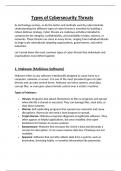
Types of Cybersecurity Threats
As technology evolves, so do the tactics and methods used by cybercriminals.
Understanding the different types of cyber threats is essential for building a
robust defense strategy. Cyber threats are malicious activities intended to
compromise the integrity, confidentiality, and availability of data, systems, or
networks. These threats can come in many forms, ranging from individual attacks
to large-scale cyberattacks targeting organizations, governments, and entire
industries.
Let's break down the most common types of cyber threats that individuals and
organizations must defend against:
1. Malware (Malicious Software)
Malware refers to any software intentionally designed to cause harm to a
computer, network, or server. It is one of the most prevalent types of cyber
threats and can take several forms. Malware can infect systems, steal data,
corrupt files, or even give cybercriminals control over a victim's machine.
Types of Malware:
Viruses: Programs that attach themselves to files or programs and spread
when the file is shared or executed. They can damage files, steal data, or
slow down systems.
Worms: Self-replicating programs that spread over networks and cause
disruptions. Worms do not need a host program to spread.
Trojan Horses: Malicious programs disguised as legitimate software. They
often appear as helpful applications, but once installed, they open
backdoors for hackers to access systems.
Ransomware: Malware that encrypts the victim’s data and demands a
ransom for decryption. It can cause massive data loss if backups are not
available.
Spyware: Software that secretly collects data from a system, such as
keystrokes, browsing habits, or sensitive information like passwords.
, Adware: Software that displays unwanted advertisements. While typically
less harmful, adware can be disruptive and invasive, often collecting data
about the user’s habits.
2. Phishing Attacks
Phishing is a type of social engineering attack where cybercriminals trick
individuals into revealing sensitive information such as usernames, passwords, or
financial details by posing as legitimate entities. These attacks typically occur via
email, but they can also be carried out through phone calls or fake websites.
Types of Phishing:
Spear Phishing: Targeted phishing attacks aimed at specific individuals or
organizations. The attacker customizes the message to appear more
legitimate, increasing the likelihood of success.
Whaling: A specific type of spear phishing targeting high-profile individuals,
such as executives, CEOs, or other senior leaders, to gain access to
confidential company information.
Vishing (Voice Phishing): Phishing conducted through phone calls or voice
messages where attackers impersonate legitimate organizations to request
sensitive information.
Smishing (SMS Phishing): Phishing conducted via text messages.
Cybercriminals send text messages that contain fraudulent links or requests
for personal information.
3. Denial of Service (DoS) and Distributed Denial of Service
(DDoS) Attacks
Denial of Service (DoS) attacks aim to make a service, network, or system
unavailable by overwhelming it with a flood of traffic, rendering it incapable of
responding to legitimate requests. In a Distributed Denial of Service (DDoS)
attack, multiple systems are used to carry out the attack, making it more difficult
to stop and trace the source.
As technology evolves, so do the tactics and methods used by cybercriminals.
Understanding the different types of cyber threats is essential for building a
robust defense strategy. Cyber threats are malicious activities intended to
compromise the integrity, confidentiality, and availability of data, systems, or
networks. These threats can come in many forms, ranging from individual attacks
to large-scale cyberattacks targeting organizations, governments, and entire
industries.
Let's break down the most common types of cyber threats that individuals and
organizations must defend against:
1. Malware (Malicious Software)
Malware refers to any software intentionally designed to cause harm to a
computer, network, or server. It is one of the most prevalent types of cyber
threats and can take several forms. Malware can infect systems, steal data,
corrupt files, or even give cybercriminals control over a victim's machine.
Types of Malware:
Viruses: Programs that attach themselves to files or programs and spread
when the file is shared or executed. They can damage files, steal data, or
slow down systems.
Worms: Self-replicating programs that spread over networks and cause
disruptions. Worms do not need a host program to spread.
Trojan Horses: Malicious programs disguised as legitimate software. They
often appear as helpful applications, but once installed, they open
backdoors for hackers to access systems.
Ransomware: Malware that encrypts the victim’s data and demands a
ransom for decryption. It can cause massive data loss if backups are not
available.
Spyware: Software that secretly collects data from a system, such as
keystrokes, browsing habits, or sensitive information like passwords.
, Adware: Software that displays unwanted advertisements. While typically
less harmful, adware can be disruptive and invasive, often collecting data
about the user’s habits.
2. Phishing Attacks
Phishing is a type of social engineering attack where cybercriminals trick
individuals into revealing sensitive information such as usernames, passwords, or
financial details by posing as legitimate entities. These attacks typically occur via
email, but they can also be carried out through phone calls or fake websites.
Types of Phishing:
Spear Phishing: Targeted phishing attacks aimed at specific individuals or
organizations. The attacker customizes the message to appear more
legitimate, increasing the likelihood of success.
Whaling: A specific type of spear phishing targeting high-profile individuals,
such as executives, CEOs, or other senior leaders, to gain access to
confidential company information.
Vishing (Voice Phishing): Phishing conducted through phone calls or voice
messages where attackers impersonate legitimate organizations to request
sensitive information.
Smishing (SMS Phishing): Phishing conducted via text messages.
Cybercriminals send text messages that contain fraudulent links or requests
for personal information.
3. Denial of Service (DoS) and Distributed Denial of Service
(DDoS) Attacks
Denial of Service (DoS) attacks aim to make a service, network, or system
unavailable by overwhelming it with a flood of traffic, rendering it incapable of
responding to legitimate requests. In a Distributed Denial of Service (DDoS)
attack, multiple systems are used to carry out the attack, making it more difficult
to stop and trace the source.