
IAL Psychology: paper 2
- how many snacks and soft drinks were consumed in a week
- how may days alcohol was drunk in the last month
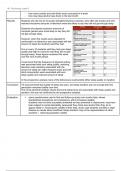
Results: Students who did not do muscular strength/endurance exercise, who often ate snacks and who
watched excessive amounts of television were less likely to say they did not get enough sleep.
Students who played excessive amounts of
computer games were more likely to say they did
not get enough sleep.
However, when the results were adjusted for
confounders no behaviour was associated with the
amount of sleep the students said they had.
Five in every 10 students said they had poor sleep
quality and eight in every ten said they did not get
enough sleep, these figures remained the same
over the nine-month period.
It was found that the frequency of physical activity
was associated with poor sleep quality; watching
television was positively associated with the
amount of sleep per night; frequent snack and soft
drink consumption were associated with poor
sleep quality and reduced amount of sleep.
In the prospective analysis none of the behaviours could predict either sleep quality or duration.
Conclusion: If it was perceived that quality of sleep was poor, and sleep duration was not enough that this
perception remained stable over time.
The cross-sectional analysis shows that some behaviours are associated with sleep quality and
duration, this was not confirmed by the prospective analysis.
Evaluation: + same questionnaire used in first and follow-up study nine months later: shows
standardized procedures and consistency, which increases reliable.
- students may not have accurately answered as they answered in classrooms: may have
been subject to social desirability (answered they drank less alcohol than they do to
appear better) = reducing the validity of their data, study used students enrolled in night
classes so results about insufficient sleep duration may not be representative of other
students = reducing population validity
, IAL Psychology: paper 2
2. Learning theories and development
- Effects of environment in the shaping of behaviour
- Believe humans are born with a blank stale and our learning/ experiences make us into who we are
- Nurture viewed as far more important than genetic influences
2.1 Classical conditioning
Ivan Petrovich Pavlov
- Stimulus: something in our environment triggering a response (reaction)
- Reacting to stimuli is a natural tendency: unconditioned responses (UCR)
↳things producing this reaction as called unconditioned stimuli
- When a natural stimulus (something that normally doesn't affect us) is paired with a UCS over a
period of time they become associated: learning by doing
↳ NS becomes a conditioned stimulus (CS) as it produces same reaction UCS used to = CR
Unconditioned stimulus/ UCS: works by itself, produce UCR
Unconditioned response/ UCR: natural reaction to stimuli (UCS)
Neutral stimulus/ NS: does nothing until paired with UCS
Conditioned stimulus/ CS: substitute stimulus triggering same reaction UCS used to
Conditioned response/ CR: learned reaction to CS
- Extinction → CS gradually lose their association with original UCS over time and revert back to a NS
(can take a long time)
- Spontaneous recovery → once association is formed; never truly forgotten, CR can reappear even
after extinction
- Stimulus generalisation → stimuli similar to CS will produce CR; learned by association = continue
making associations
- Distribution → respond to a specific stimulus and not to other similar stimuli ??
Evaluation
+ explains the acquisition of involuntary behaviours, supported lab research
- Generalized from animal learning to humans, focus solely on nurture without nature, ignored cognitions
(personality, willpower, and motivation)
2.2 Operant conditioning
- Voluntary behaviour can be learned: notice consequences of our actions
↳ consequences affects our behaviour next time we experience the same situation
- Behaviour is based on A-B-C: antecedents - behaviour- consequences
↳ to change behaviour, you must change the A (what has already happened) or C: C is much easier
- how many snacks and soft drinks were consumed in a week
- how may days alcohol was drunk in the last month
Results: Students who did not do muscular strength/endurance exercise, who often ate snacks and who
watched excessive amounts of television were less likely to say they did not get enough sleep.
Students who played excessive amounts of
computer games were more likely to say they did
not get enough sleep.
However, when the results were adjusted for
confounders no behaviour was associated with the
amount of sleep the students said they had.
Five in every 10 students said they had poor sleep
quality and eight in every ten said they did not get
enough sleep, these figures remained the same
over the nine-month period.
It was found that the frequency of physical activity
was associated with poor sleep quality; watching
television was positively associated with the
amount of sleep per night; frequent snack and soft
drink consumption were associated with poor
sleep quality and reduced amount of sleep.
In the prospective analysis none of the behaviours could predict either sleep quality or duration.
Conclusion: If it was perceived that quality of sleep was poor, and sleep duration was not enough that this
perception remained stable over time.
The cross-sectional analysis shows that some behaviours are associated with sleep quality and
duration, this was not confirmed by the prospective analysis.
Evaluation: + same questionnaire used in first and follow-up study nine months later: shows
standardized procedures and consistency, which increases reliable.
- students may not have accurately answered as they answered in classrooms: may have
been subject to social desirability (answered they drank less alcohol than they do to
appear better) = reducing the validity of their data, study used students enrolled in night
classes so results about insufficient sleep duration may not be representative of other
students = reducing population validity
, IAL Psychology: paper 2
2. Learning theories and development
- Effects of environment in the shaping of behaviour
- Believe humans are born with a blank stale and our learning/ experiences make us into who we are
- Nurture viewed as far more important than genetic influences
2.1 Classical conditioning
Ivan Petrovich Pavlov
- Stimulus: something in our environment triggering a response (reaction)
- Reacting to stimuli is a natural tendency: unconditioned responses (UCR)
↳things producing this reaction as called unconditioned stimuli
- When a natural stimulus (something that normally doesn't affect us) is paired with a UCS over a
period of time they become associated: learning by doing
↳ NS becomes a conditioned stimulus (CS) as it produces same reaction UCS used to = CR
Unconditioned stimulus/ UCS: works by itself, produce UCR
Unconditioned response/ UCR: natural reaction to stimuli (UCS)
Neutral stimulus/ NS: does nothing until paired with UCS
Conditioned stimulus/ CS: substitute stimulus triggering same reaction UCS used to
Conditioned response/ CR: learned reaction to CS
- Extinction → CS gradually lose their association with original UCS over time and revert back to a NS
(can take a long time)
- Spontaneous recovery → once association is formed; never truly forgotten, CR can reappear even
after extinction
- Stimulus generalisation → stimuli similar to CS will produce CR; learned by association = continue
making associations
- Distribution → respond to a specific stimulus and not to other similar stimuli ??
Evaluation
+ explains the acquisition of involuntary behaviours, supported lab research
- Generalized from animal learning to humans, focus solely on nurture without nature, ignored cognitions
(personality, willpower, and motivation)
2.2 Operant conditioning
- Voluntary behaviour can be learned: notice consequences of our actions
↳ consequences affects our behaviour next time we experience the same situation
- Behaviour is based on A-B-C: antecedents - behaviour- consequences
↳ to change behaviour, you must change the A (what has already happened) or C: C is much easier


