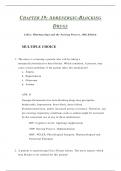
C HAPTER 19: A DRENERGIC -B LOCKING
D RUGS
Lilley: Pharmacology and the Nursing Process, 10th Edition
MULTIPLE CHOICE
1. The nurse is screening a patient who will be taking a
nonspecific/nonselective beta blocker. Which condition, if present, may
cause serious problems if the patient takes this medication?
a. Angina
b. Hypertension
c. Glaucoma
d. Asthma
ANS: D
Nonspecific/nonselective beta -blocking drugs may precipitate
bradycardia, hypotension, heart block, heart failure,
bronchoconstriction, and/or increased airway resistance. Therefore, any
pre-existing respiratory conditions such a s asthma might be worsened
by the concurrent use of any of these medications.
DIF: Cognitive Level: Appl ying (Application)
TOP: Nursing Process: Implementation
MSC: NC LEX: Physiological Integrit y: Pharmacological and
Parenteral Therapies
2. A patient is experiencing Class II heart failure. The nurse expects which
beta blocker to be ordered for this patient?
, a. Atenolol
b. Carvedilol
c. Labetalol
d. Esmolol
ANS: B
Not all beta blockers are used for the treatment of heart failure.
Carvedilol is currently used in the treat ment of heart failure. The other
drugs listed are not indicated for the treatment of heart failure.
DIF: Cognitive Level: Understanding (Comprehension)
TOP: Nursing Process: Planning
MSC: NC LEX: Physiological Integrit y: Pharmacological and
Parenteral Therapies
3. During a teaching session about self -monitoring while taking a beta
blocker at home, the nurse has taught the patient to take his apical pulse
dail y for 1 minute. If the pulse rate decreases to less than 60 beats/min,
the nurse will instruct the pati ent to do which of these?
a. Notify his prescriber.
b. Reduce the dose of his beta blocker by half.
c. Continue the medication because this is an expected effect.
d. Skip the medication dose that day, and check his pulse again the
next day.
ANS: A
Cardiac depression can occur with beta blockers; instruct the patient to
contact his prescriber if his pulse rate decreases to less than 60
beats/min. The medication dose may need to be changed, but it is not
appropriate for the nurse to change the dosage. The other options are
incorrect.
D RUGS
Lilley: Pharmacology and the Nursing Process, 10th Edition
MULTIPLE CHOICE
1. The nurse is screening a patient who will be taking a
nonspecific/nonselective beta blocker. Which condition, if present, may
cause serious problems if the patient takes this medication?
a. Angina
b. Hypertension
c. Glaucoma
d. Asthma
ANS: D
Nonspecific/nonselective beta -blocking drugs may precipitate
bradycardia, hypotension, heart block, heart failure,
bronchoconstriction, and/or increased airway resistance. Therefore, any
pre-existing respiratory conditions such a s asthma might be worsened
by the concurrent use of any of these medications.
DIF: Cognitive Level: Appl ying (Application)
TOP: Nursing Process: Implementation
MSC: NC LEX: Physiological Integrit y: Pharmacological and
Parenteral Therapies
2. A patient is experiencing Class II heart failure. The nurse expects which
beta blocker to be ordered for this patient?
, a. Atenolol
b. Carvedilol
c. Labetalol
d. Esmolol
ANS: B
Not all beta blockers are used for the treatment of heart failure.
Carvedilol is currently used in the treat ment of heart failure. The other
drugs listed are not indicated for the treatment of heart failure.
DIF: Cognitive Level: Understanding (Comprehension)
TOP: Nursing Process: Planning
MSC: NC LEX: Physiological Integrit y: Pharmacological and
Parenteral Therapies
3. During a teaching session about self -monitoring while taking a beta
blocker at home, the nurse has taught the patient to take his apical pulse
dail y for 1 minute. If the pulse rate decreases to less than 60 beats/min,
the nurse will instruct the pati ent to do which of these?
a. Notify his prescriber.
b. Reduce the dose of his beta blocker by half.
c. Continue the medication because this is an expected effect.
d. Skip the medication dose that day, and check his pulse again the
next day.
ANS: A
Cardiac depression can occur with beta blockers; instruct the patient to
contact his prescriber if his pulse rate decreases to less than 60
beats/min. The medication dose may need to be changed, but it is not
appropriate for the nurse to change the dosage. The other options are
incorrect.