
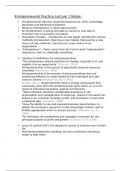
Entrepreneurial Practice Lecture 1 Notes:
Entrepreneurial learning: Acquiring experiences, skills, knowledge,
attributes and behavioural patterns
Being an entrepreneur is about taking action
An entrepreneur is willing and able to convert a new idea or
invention into a successful innovation
Innovation includes – Introduction of new goods, Introduction of new
methods of production, Opening a new market, Discovering a new
source of raw materials, Carrying out a new source of an
organisation
“Entrepreneur” – likely comes from the French word “entreprendre”
meaning to start or undertake something
Citations of definitions for entrepreneurship:
- ‘The entrepreneur always searches for change, responds to it, and
exploits it as an opportunity.’ (Drucker, 2014)
- Entrepreneurship is the pursuit of opportunity beyond resources
controlled (Stevenson, 1990)
- Entrepreneurship is the process of doing something new and
something different to create wealth for the individual and add
value to society (Proposed by Kao (1993))
- Kuratko (2011) researched that there is energy and passion that
continually arise from the entrepreneurial spirit within us. It is the
result of individual innovation, passion and tenacity
- “Takes initiative, assumes considerable autonomy in the
organisation and management of resources, shares in the asset risk,
shares in an uncertain monetary profit, and innovates in more than
a marginal way” (Harwood, 1982)
- “Have the ability to see and evaluate business opportunities; to
gather the necessary resources to take advantage of them; and to
initiate appropriate action to ensure success” (Meredith, er. Al,
1982)
- “An individual who establishes and manages a business for the
principal purpose of profit and growth” (Carland, er. Al. 1984)
Locus of control (LOC): the degree of control of a person over his/her
life
Risk-taking propensity: handling risk and uncertainty and being
ready to bear them
Entrepreneurial learning: Acquiring experiences, skills, knowledge,
attributes and behavioural patterns
Being an entrepreneur is about taking action
An entrepreneur is willing and able to convert a new idea or
invention into a successful innovation
Innovation includes – Introduction of new goods, Introduction of new
methods of production, Opening a new market, Discovering a new
source of raw materials, Carrying out a new source of an
organisation
“Entrepreneur” – likely comes from the French word “entreprendre”
meaning to start or undertake something
Citations of definitions for entrepreneurship:
- ‘The entrepreneur always searches for change, responds to it, and
exploits it as an opportunity.’ (Drucker, 2014)
- Entrepreneurship is the pursuit of opportunity beyond resources
controlled (Stevenson, 1990)
- Entrepreneurship is the process of doing something new and
something different to create wealth for the individual and add
value to society (Proposed by Kao (1993))
- Kuratko (2011) researched that there is energy and passion that
continually arise from the entrepreneurial spirit within us. It is the
result of individual innovation, passion and tenacity
- “Takes initiative, assumes considerable autonomy in the
organisation and management of resources, shares in the asset risk,
shares in an uncertain monetary profit, and innovates in more than
a marginal way” (Harwood, 1982)
- “Have the ability to see and evaluate business opportunities; to
gather the necessary resources to take advantage of them; and to
initiate appropriate action to ensure success” (Meredith, er. Al,
1982)
- “An individual who establishes and manages a business for the
principal purpose of profit and growth” (Carland, er. Al. 1984)
Locus of control (LOC): the degree of control of a person over his/her
life
Risk-taking propensity: handling risk and uncertainty and being
ready to bear them


