

Unit 14b: Aromatic ring chemistry for designer chemicals
Introduction:
F or my assignment, we will explore the structure and properties of benzene, a highly
important and widely used aromatic hydrocarbon. We will examine the sp2 hybridization of
carbon in benzene, along with the sigma and pi bonding that contributes to its stability and
unique properties. We will also investigate the evidence supporting the accepted structure
of benzene, which disproves the originally suggested Kekulé structure. Additionally, we will
discuss the chemical properties of benzene, phenol, and methylbenzene, and their
importance in industrial reactions.
Furthermore, we will compare the mechanisms for several important substitution and
addition reactions of benzene, including the Friedel-Crafts reaction, the sulfonation of
benzene, the chlorination of benzene, and the hydrogenation of benzene. We will examine
the similarities and differences between these mechanisms and their practical applications.
Finally, we will analyse the effects of monosubstituents such as -OH, -Cl, -NO2, and -CH3 on
the position(s) of incoming species during further substitution reactions on the benzene
ring. We will also discuss the nomenclature of substituted benzene compounds and how
they are named based on the functional groups present and their position on the benzene
ring.
The Benzene Ring Structure
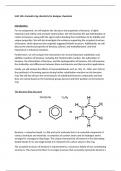
Benzene, a colourless liquid, is a flat and cyclic molecule that is an essential component of
various chemicals and materials. It comprises six carbon atoms and six hydrogen atoms
arranged in a hexagonal ring shape. The unique characteristic of benzene is the alternating
double bonds (C=C) and single bonds (C-C) between the carbon atoms in the ring.
The accepted structure of benzene is represented by a resonance hybrid of two contributing
structures. This means that there is no single structure that accurately represents benzene's
,actual configuration. Instead, the molecule's true nature is a blend of these two structures.
Each carbon atom in the benzene ring is sp2 hybridized with one unhybridized p orbital.
This molecular configuration, known as delocalized pi electron bonding, explains benzene's
unique properties. The electrons in the unhybridized p orbitals are delocalized throughout
the entire ring structure, making the carbon-carbon bonds stronger and shorter than
expected for a double bond. This characteristic also accounts for the high stability of the
benzene molecule and the lack of reactivity compared to other unsaturated hydrocarbons.
Benzene's resonance hybrid structure, along with its unique delocalized pi electron bonding,
results in a molecule that is essential to the production of various materials, including
plastics, synthetic fibres, and rubber. It is crucial to understand benzene's structure to
determine its chemical properties and how it interacts with other substances.
Hybridisation
(Menuhin, Y. (2022). Aromatic Compound Handbook, p.2.)
The covalent bonding in benzene arises from the sharing of electrons between adjacent
atoms, which generates a cloud of electron density above and below the plane of the
molecule. This electron cloud, in turn, creates a delocalized pi-electron system that enables
benzene to display aromaticity - a term that describes the peculiar stability and reactivity of
aromatic compounds.
To understand the molecular structure of benzene in more detail, we must delve into the
hybridization of its constituent carbon atoms. In benzene, the carbon atoms undergo sp2
hybridization, which involves the combination of one s orbital and two of the three available
p orbitals to form three equivalent sp2 hybrid orbitals. These hybrid orbitals are oriented in
a trigonal planar arrangement around each carbon atom, resulting in a symmetrical and
stable molecular geometry.
The remaining p orbital on each carbon atom remains unhybridized and perpendicular to
the plane of the molecule, forming a pi-bonding network that enables the delocalization of
pi-electrons throughout the entire ring structure. This unique electron distribution gives rise
to the characteristic aromaticity of benzene and is responsible for its distinct chemical and
physical properties.
,(chemguide.co.uk)
Molecular Orbitals of Benzene
The sp2 hybrid orbitals of each carbon atom in benzene overlap with the sp2 hybrid orbitals
of adjacent carbon atoms, forming sigma (σ) bonds. The sp2 hybrid orbitals are directed
towards the corners of an equilateral triangle, with a bond angle of 120 degrees. The
carbon-hydrogen bond is formed by the overlap of the 1s orbital of hydrogen with the
unhybridized p orbital of the carbon atom.
, (zigya.com)
The overlap of the unhybridized p orbitals of adjacent carbon atoms results in the formation
of a ring of six delocalized pi (π) electrons above and below the plane of the molecule. These
π electrons are able to freely move along the ring, creating a phenomenon known as
aromaticity, which is responsible for the stability and unique properties of benzene. The
remaining p orbital on each carbon atom is oriented perpendicular to the plane of the
molecule, and it contributes to the delocalized π electron system.
(zigya.com)
Introduction:
F or my assignment, we will explore the structure and properties of benzene, a highly
important and widely used aromatic hydrocarbon. We will examine the sp2 hybridization of
carbon in benzene, along with the sigma and pi bonding that contributes to its stability and
unique properties. We will also investigate the evidence supporting the accepted structure
of benzene, which disproves the originally suggested Kekulé structure. Additionally, we will
discuss the chemical properties of benzene, phenol, and methylbenzene, and their
importance in industrial reactions.
Furthermore, we will compare the mechanisms for several important substitution and
addition reactions of benzene, including the Friedel-Crafts reaction, the sulfonation of
benzene, the chlorination of benzene, and the hydrogenation of benzene. We will examine
the similarities and differences between these mechanisms and their practical applications.
Finally, we will analyse the effects of monosubstituents such as -OH, -Cl, -NO2, and -CH3 on
the position(s) of incoming species during further substitution reactions on the benzene
ring. We will also discuss the nomenclature of substituted benzene compounds and how
they are named based on the functional groups present and their position on the benzene
ring.
The Benzene Ring Structure
Benzene, a colourless liquid, is a flat and cyclic molecule that is an essential component of
various chemicals and materials. It comprises six carbon atoms and six hydrogen atoms
arranged in a hexagonal ring shape. The unique characteristic of benzene is the alternating
double bonds (C=C) and single bonds (C-C) between the carbon atoms in the ring.
The accepted structure of benzene is represented by a resonance hybrid of two contributing
structures. This means that there is no single structure that accurately represents benzene's
,actual configuration. Instead, the molecule's true nature is a blend of these two structures.
Each carbon atom in the benzene ring is sp2 hybridized with one unhybridized p orbital.
This molecular configuration, known as delocalized pi electron bonding, explains benzene's
unique properties. The electrons in the unhybridized p orbitals are delocalized throughout
the entire ring structure, making the carbon-carbon bonds stronger and shorter than
expected for a double bond. This characteristic also accounts for the high stability of the
benzene molecule and the lack of reactivity compared to other unsaturated hydrocarbons.
Benzene's resonance hybrid structure, along with its unique delocalized pi electron bonding,
results in a molecule that is essential to the production of various materials, including
plastics, synthetic fibres, and rubber. It is crucial to understand benzene's structure to
determine its chemical properties and how it interacts with other substances.
Hybridisation
(Menuhin, Y. (2022). Aromatic Compound Handbook, p.2.)
The covalent bonding in benzene arises from the sharing of electrons between adjacent
atoms, which generates a cloud of electron density above and below the plane of the
molecule. This electron cloud, in turn, creates a delocalized pi-electron system that enables
benzene to display aromaticity - a term that describes the peculiar stability and reactivity of
aromatic compounds.
To understand the molecular structure of benzene in more detail, we must delve into the
hybridization of its constituent carbon atoms. In benzene, the carbon atoms undergo sp2
hybridization, which involves the combination of one s orbital and two of the three available
p orbitals to form three equivalent sp2 hybrid orbitals. These hybrid orbitals are oriented in
a trigonal planar arrangement around each carbon atom, resulting in a symmetrical and
stable molecular geometry.
The remaining p orbital on each carbon atom remains unhybridized and perpendicular to
the plane of the molecule, forming a pi-bonding network that enables the delocalization of
pi-electrons throughout the entire ring structure. This unique electron distribution gives rise
to the characteristic aromaticity of benzene and is responsible for its distinct chemical and
physical properties.
,(chemguide.co.uk)
Molecular Orbitals of Benzene
The sp2 hybrid orbitals of each carbon atom in benzene overlap with the sp2 hybrid orbitals
of adjacent carbon atoms, forming sigma (σ) bonds. The sp2 hybrid orbitals are directed
towards the corners of an equilateral triangle, with a bond angle of 120 degrees. The
carbon-hydrogen bond is formed by the overlap of the 1s orbital of hydrogen with the
unhybridized p orbital of the carbon atom.
, (zigya.com)
The overlap of the unhybridized p orbitals of adjacent carbon atoms results in the formation
of a ring of six delocalized pi (π) electrons above and below the plane of the molecule. These
π electrons are able to freely move along the ring, creating a phenomenon known as
aromaticity, which is responsible for the stability and unique properties of benzene. The
remaining p orbital on each carbon atom is oriented perpendicular to the plane of the
molecule, and it contributes to the delocalized π electron system.
(zigya.com)


