
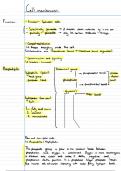
Cell membranes
Function : -
transport between cells
E Selectively permeable - it chooses which molecules in and out
-
go
S.I units
partially permeable >
only
let certain molecules through
- -
Compartmentalisation
-
↳ keeps inside the cell
everything
Imitochondria are membrane bound X membrane bound organelles)
and
signalling
-
Communication
↳ receptors -
hormones
Phospholipids
I
Chemical
hydrophilic (polar group
7
- Phosphoester bond Phospho
head diester
group
phosphate
phosphate head bond
>
-
phosphoester bond
glycero ↳
I
= ester bond
hydrophobic (non-polare
2
1
x
fatty acid chains
saturated
I monounsaturated
Polar and non-polar ends
↳ Amphiphilic/Amphiphatic
The phosphate is polar the covalent bonds between
group
as
phosphorous and Oxygen is unbalanced
.
Oxygen is more
electronegative
electrons closer and make it delta and
so are
negative
phosphorous delta positive . In a
phospholipid bilayer phosphate heads
bonds
face inwards and outwards
interacting
with water
forming hydrogen .
Function : -
transport between cells
E Selectively permeable - it chooses which molecules in and out
-
go
S.I units
partially permeable >
only
let certain molecules through
- -
Compartmentalisation
-
↳ keeps inside the cell
everything
Imitochondria are membrane bound X membrane bound organelles)
and
signalling
-
Communication
↳ receptors -
hormones
Phospholipids
I
Chemical
hydrophilic (polar group
7
- Phosphoester bond Phospho
head diester
group
phosphate
phosphate head bond
>
-
phosphoester bond
glycero ↳
I
= ester bond
hydrophobic (non-polare
2
1
x
fatty acid chains
saturated
I monounsaturated
Polar and non-polar ends
↳ Amphiphilic/Amphiphatic
The phosphate is polar the covalent bonds between
group
as
phosphorous and Oxygen is unbalanced
.
Oxygen is more
electronegative
electrons closer and make it delta and
so are
negative
phosphorous delta positive . In a
phospholipid bilayer phosphate heads
bonds
face inwards and outwards
interacting
with water
forming hydrogen .


