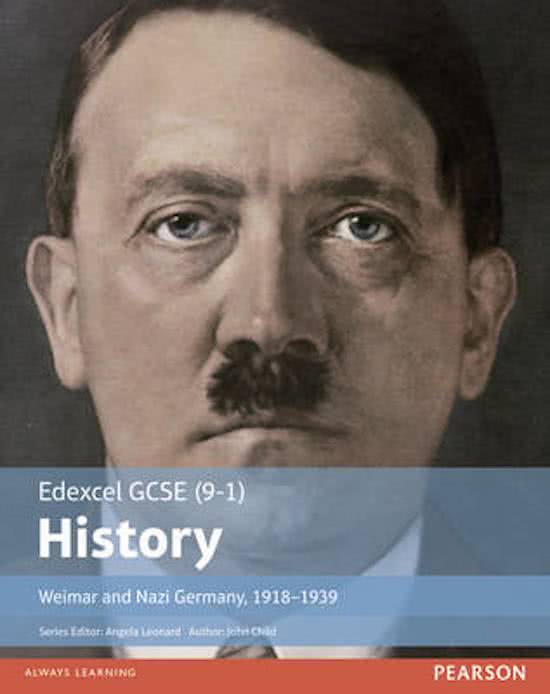
Nazi Germany
Germany 1919-1933: Weimar Republic
THE END OF WW1 - Nov 1918
● Germany was in a poor state:
→ Blockade = lack of food and supplies = starvation
→ Riots - many rebelled against Kaiser - he was abdicated in Oct 1918
● Biggest political party was the Social Democrats
→ its leader was Friedrich Ebert
→ Ebert and his gov. Signed the armistice & withdrew Germany from WW1 in Nov 1918
THE WEIMAR CONSTITUTION
● The Social Democrats won Jan 1919 elections - created the Weimar gov. & constitution
Rules included:
1. Everyone over age 20 could vote → people voted for MPs who would sit in the
Reichstag (which was the dominant house)
2. The Chancellor would be the head of Reichstag & be voted for every 4 years
3. There would be a President - chose Chancellor & controlled army - voted for every 7 yrs
4. Would use Proportional Representation - # of Reichstag seats would depend on % of
votes for the party
STRENGTHS & WEAKNESSES OF THE WEIMAR CONSTITUTION
Strengths:
● Very fair, especially the voting
● Allowed lots of people to have a say
● State governments would ensure local issues addressed
● Wouldn’t allow one person to take over - balance between President & Chancellor
● A poor Chancellor or President would only be around for a limited time
Weaknesses:
● Proportional representation meant that there lots of different parties in the Reichstag so it
would be difficult to reach agreements
● Article 48 could be abused and president could stop listening to Reichstag
→ Article 48 allowed the President, under certain circumstances, to take emergency
measures without asking the Reichstag
● State governments could pass laws that went against what Reichstag wanted
, Challenges to the Weimar Republic:
SPARTACIST REVOLUTION - Jan 1919
● Spartacists (led by Rosa Luxemburg & Karl Liebnecht) wanted a communist (left wing)
revolution bc Germany was suffering under the government
● They failed because the government used Freikorps (ex soldiers) to destroy them
KAPP PUTSCH - 1929
● Dr Wolfgang Kapp & Freikorps (right wing) want to return Kaiser to lead Germany & end
the Treaty of Versailles
● Workers in Berlin disagree and go on strike which defeats them
MUNICH PUTSCH - Nov 1923
● Right wing (nationalist/dictatorship) Nazi party revolution that was led by Adolf Hitler
● Easily crushed by army & police
Effects
● Hitler went to jail
● Failure caused Hitler to make changes in his tactics and come to power in more
constitutional means
● Effect on Germany - More Nazi organisations were created e.g. Hitler Youth
→ Nazi influence increased
TREATY OF VERSAILLES - June 1919
● Peace treaty Germany had to sign after WW1
→ they had no choice but to sign it bc if they didn’t the war would continue and Germany
would lose the war
Main terms:
● Blame - Germany had to accept responsibility for starting the war & causing all the
damage → war guilt clause
● Reparations - Germany had to pay 6.6 billion british for repair of the damage from war
● Armed forces - Germany army was reduced to 100,000 men + no tanks, submarines or
planes + Rhineland had to be demilitarised
● Territory - Germany lost 13% of land and 12.5% of its population + lost colonies
→ no empire + forbidden to join w. Austria
→ some of the land lost was industrial
Causes:
● Germans were outraged - called treaty ‘diktat’ (dictated peace)
● Accused gov. Of “stabbing them in the back”
● Began to look to other politicians e.g. Hitler
Germany 1919-1933: Weimar Republic
THE END OF WW1 - Nov 1918
● Germany was in a poor state:
→ Blockade = lack of food and supplies = starvation
→ Riots - many rebelled against Kaiser - he was abdicated in Oct 1918
● Biggest political party was the Social Democrats
→ its leader was Friedrich Ebert
→ Ebert and his gov. Signed the armistice & withdrew Germany from WW1 in Nov 1918
THE WEIMAR CONSTITUTION
● The Social Democrats won Jan 1919 elections - created the Weimar gov. & constitution
Rules included:
1. Everyone over age 20 could vote → people voted for MPs who would sit in the
Reichstag (which was the dominant house)
2. The Chancellor would be the head of Reichstag & be voted for every 4 years
3. There would be a President - chose Chancellor & controlled army - voted for every 7 yrs
4. Would use Proportional Representation - # of Reichstag seats would depend on % of
votes for the party
STRENGTHS & WEAKNESSES OF THE WEIMAR CONSTITUTION
Strengths:
● Very fair, especially the voting
● Allowed lots of people to have a say
● State governments would ensure local issues addressed
● Wouldn’t allow one person to take over - balance between President & Chancellor
● A poor Chancellor or President would only be around for a limited time
Weaknesses:
● Proportional representation meant that there lots of different parties in the Reichstag so it
would be difficult to reach agreements
● Article 48 could be abused and president could stop listening to Reichstag
→ Article 48 allowed the President, under certain circumstances, to take emergency
measures without asking the Reichstag
● State governments could pass laws that went against what Reichstag wanted
, Challenges to the Weimar Republic:
SPARTACIST REVOLUTION - Jan 1919
● Spartacists (led by Rosa Luxemburg & Karl Liebnecht) wanted a communist (left wing)
revolution bc Germany was suffering under the government
● They failed because the government used Freikorps (ex soldiers) to destroy them
KAPP PUTSCH - 1929
● Dr Wolfgang Kapp & Freikorps (right wing) want to return Kaiser to lead Germany & end
the Treaty of Versailles
● Workers in Berlin disagree and go on strike which defeats them
MUNICH PUTSCH - Nov 1923
● Right wing (nationalist/dictatorship) Nazi party revolution that was led by Adolf Hitler
● Easily crushed by army & police
Effects
● Hitler went to jail
● Failure caused Hitler to make changes in his tactics and come to power in more
constitutional means
● Effect on Germany - More Nazi organisations were created e.g. Hitler Youth
→ Nazi influence increased
TREATY OF VERSAILLES - June 1919
● Peace treaty Germany had to sign after WW1
→ they had no choice but to sign it bc if they didn’t the war would continue and Germany
would lose the war
Main terms:
● Blame - Germany had to accept responsibility for starting the war & causing all the
damage → war guilt clause
● Reparations - Germany had to pay 6.6 billion british for repair of the damage from war
● Armed forces - Germany army was reduced to 100,000 men + no tanks, submarines or
planes + Rhineland had to be demilitarised
● Territory - Germany lost 13% of land and 12.5% of its population + lost colonies
→ no empire + forbidden to join w. Austria
→ some of the land lost was industrial
Causes:
● Germans were outraged - called treaty ‘diktat’ (dictated peace)
● Accused gov. Of “stabbing them in the back”
● Began to look to other politicians e.g. Hitler