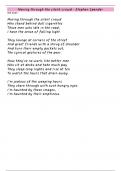
Moving through the silent crowd - Stephen Spender
IEB 2025
Moving through the silent crowd
Who stand behind dull cigarettes
Those men who idle in the road,
I have the sense of falling light.
They lounge at corners of the street
And greet friends with a shrug of shoulder
And turn their empty pockets out,
The cynical gestures of the poor.
Now they've no work, like better men
Who sit at desks and take much pay
They sleep long nights and rise at ten
To watch the hours that drain away.
I'm jealous of the weeping hours
They stare through with such hungry eyes.
I'm haunted by these images,
I'm haunted by their emptiness.
, - This opening line sets a somber tone, portraying an
atmosphere of quiet desolation.
- The adjective "silent" implies not just an absence of
noise but a lack of vitality or spirit among the crowd.
- The verb "moving" suggests the speaker’s physical
journey and hints at a metaphorical passage through
Moving through the silent life or society.
crowd - The phrase may symbolize detachment, as the speaker
observes from a distance rather than engages.
- The figure of speech here could be interpreted as
metonymy, where "silent crowd" represents the
marginalized and voiceless individuals in society.
- The lack of punctuation within the line emphasizes
continuity, mirroring the seamless flow of movement or
time.
- This line evokes a vivid image of passivity and
monotony.
- The "dull cigarettes" symbolize futility or unfulfilling
routines, as smoking is often associated with waiting or
idleness.
- The adjective "dull" reinforces the lack of energy or
Who stand behind dull enthusiasm in their lives.
cigarettes - The cigarettes themselves could act as a metaphor for
fleeting comfort or distraction from deeper despair.
- The line uses enjambment, continuing directly from the
previous line, which mirrors the seamless and ongoing
nature of the depicted despair.
- This line focuses on the physical and symbolic inaction
of "those men," whose idleness reflects not only
unemployment but also societal neglect.
- The choice of "idle" is significant, suggesting
Those men who idle in the purposelessness and a forced inertia due to
road, circumstances beyond their control.
- The road, often a symbol of journeys or progress,
becomes ironic here as it is merely a place to linger,
offering no forward movement.
- The phrase "those men" creates distance, implying that
the speaker observes them as outsiders.
- This line introduces a shift toward introspection. The
phrase "falling light" employs imagery and symbolism,
evoking a sense of decline, whether of time, hope, or
vitality.
I have the sense of falling - It could symbolize the end of the day, paralleling the
light. loss of opportunity or hope.
- The verb "falling" conveys an uncontrollable descent,
mirroring the helplessness felt by both the speaker and
the subjects.
- The figure of speech might be personification, as "light"
is imbued with an active quality.
IEB 2025
Moving through the silent crowd
Who stand behind dull cigarettes
Those men who idle in the road,
I have the sense of falling light.
They lounge at corners of the street
And greet friends with a shrug of shoulder
And turn their empty pockets out,
The cynical gestures of the poor.
Now they've no work, like better men
Who sit at desks and take much pay
They sleep long nights and rise at ten
To watch the hours that drain away.
I'm jealous of the weeping hours
They stare through with such hungry eyes.
I'm haunted by these images,
I'm haunted by their emptiness.
, - This opening line sets a somber tone, portraying an
atmosphere of quiet desolation.
- The adjective "silent" implies not just an absence of
noise but a lack of vitality or spirit among the crowd.
- The verb "moving" suggests the speaker’s physical
journey and hints at a metaphorical passage through
Moving through the silent life or society.
crowd - The phrase may symbolize detachment, as the speaker
observes from a distance rather than engages.
- The figure of speech here could be interpreted as
metonymy, where "silent crowd" represents the
marginalized and voiceless individuals in society.
- The lack of punctuation within the line emphasizes
continuity, mirroring the seamless flow of movement or
time.
- This line evokes a vivid image of passivity and
monotony.
- The "dull cigarettes" symbolize futility or unfulfilling
routines, as smoking is often associated with waiting or
idleness.
- The adjective "dull" reinforces the lack of energy or
Who stand behind dull enthusiasm in their lives.
cigarettes - The cigarettes themselves could act as a metaphor for
fleeting comfort or distraction from deeper despair.
- The line uses enjambment, continuing directly from the
previous line, which mirrors the seamless and ongoing
nature of the depicted despair.
- This line focuses on the physical and symbolic inaction
of "those men," whose idleness reflects not only
unemployment but also societal neglect.
- The choice of "idle" is significant, suggesting
Those men who idle in the purposelessness and a forced inertia due to
road, circumstances beyond their control.
- The road, often a symbol of journeys or progress,
becomes ironic here as it is merely a place to linger,
offering no forward movement.
- The phrase "those men" creates distance, implying that
the speaker observes them as outsiders.
- This line introduces a shift toward introspection. The
phrase "falling light" employs imagery and symbolism,
evoking a sense of decline, whether of time, hope, or
vitality.
I have the sense of falling - It could symbolize the end of the day, paralleling the
light. loss of opportunity or hope.
- The verb "falling" conveys an uncontrollable descent,
mirroring the helplessness felt by both the speaker and
the subjects.
- The figure of speech might be personification, as "light"
is imbued with an active quality.