

Unit 11 assignment 2
Structure and function of human chromosome
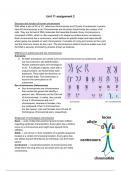
With either a pair of XX or XY, called sex chromosomes and 22 pairs of autosomes, humans
have 46 chromosomes in all. Chromosomes are structures found inside the nucleus of all
cells. They are formed of DNA molecules that resemble threads. Every chromosome is
composed of DNA, which is often supported in its shape by proteins known as histones.
Each chromosome has a centromere, which defines its specific shape and helps identify
where genes are located on each chromosome; it consists of a long arm known as the q arm
and the short arm known as the p arm. The chromosome's distinct structure makes sure that
the DNA is securely encircled by proteins known as histones.
Difference in autosomes and sex chromosomes
Autosome
● All other procedures are carried out by chromosomes known as autosomes, which
are not involved in sex determination.
Human autosome pairs are homologous
to 22. A multitude of genes, each with a
unique function, are found inside each
autosome. They make the decisions on
the somatic traits. The centromere is
found in the same place on all
autosomes.
Sex chromosome (heterosome)
● Sex chromosomes are chromosomes
that contain the genes that identify a
person's sex. Allosomes are the 23rd set
of chromosomes. In males, they consist
of one X chromosome and one Y
chromosome, whereas in females, they
are composed of two X chromosomes.
For this reason, men and females have 22 and 23
homologous chromosomal pairs, respectively.
Single pair of homologous chromosome
Gene → units of data that parents transmit to their children
regarding particular characteristics. Every gene has a distinct
locus on a chromosome and might have several forms
(alleles).
Allele → one of two or more variations of a genetic sequence
located at a certain chromosomal location. Every gene has
two alleles that are inherited by an individual, one from each
parent.
Centromere → Constricted sections of chromosomes that
divide them into long arms (q) and short arms (p) are called
centromeres..
, Sister chromatids → Sister chromatids are formed by the linkage of two exact copies of a
chromosome at a shared centromere during the process of DNA replication.
Locus → A locus is a location on a chromosome where a gene corresponding to a certain
characteristic is found in every individual within a species.
Homologous pair → Chromosomal pairs include genes for the same characteristics that are
situated at matching loci. These loci have similar length, staining pattern and centromere
position. The mother of the organism produces one homologous chromosome during
reproduction, whereas the father produces the other.
Non-homologous pair → Non-homologous chromosomes refer to chromosomes that have
distinct pairings.
Mitosis
Prophase
● The cell starts to deconstruct certain components and build others during the early
prophase, getting the chromosomes ready for division. The chromosomes start to
condense which results in the formation of the mitotic spindle. A spindle develops in
the place of the centrosomes when they split apart. The nucleolus has vanished. This
suggests that the nucleus is on the verge of breaking apart. In late prophase, the
formation of the mitotic spindle occurs and rearranges the chromosomes. The
nuclear membrane breaks down and releases the chromosomes. As the mitotic
spindle grows, some of the microtubules start to catch the chromosomes.
Telophase
● By the time a cell reaches telophase, when cytokinesis starts to restore its original
structural integrity, it has nearly completed its division. The mitotic spindle's
component parts are separated. Two new nuclei are produced by each pair of
chromosomes. Nuclear membranes and nucleoli reappear. The chromosomes
become less rigid and more thread-like. Cytokinesis and mitosis occur
Structure and function of human chromosome
With either a pair of XX or XY, called sex chromosomes and 22 pairs of autosomes, humans
have 46 chromosomes in all. Chromosomes are structures found inside the nucleus of all
cells. They are formed of DNA molecules that resemble threads. Every chromosome is
composed of DNA, which is often supported in its shape by proteins known as histones.
Each chromosome has a centromere, which defines its specific shape and helps identify
where genes are located on each chromosome; it consists of a long arm known as the q arm
and the short arm known as the p arm. The chromosome's distinct structure makes sure that
the DNA is securely encircled by proteins known as histones.
Difference in autosomes and sex chromosomes
Autosome
● All other procedures are carried out by chromosomes known as autosomes, which
are not involved in sex determination.
Human autosome pairs are homologous
to 22. A multitude of genes, each with a
unique function, are found inside each
autosome. They make the decisions on
the somatic traits. The centromere is
found in the same place on all
autosomes.
Sex chromosome (heterosome)
● Sex chromosomes are chromosomes
that contain the genes that identify a
person's sex. Allosomes are the 23rd set
of chromosomes. In males, they consist
of one X chromosome and one Y
chromosome, whereas in females, they
are composed of two X chromosomes.
For this reason, men and females have 22 and 23
homologous chromosomal pairs, respectively.
Single pair of homologous chromosome
Gene → units of data that parents transmit to their children
regarding particular characteristics. Every gene has a distinct
locus on a chromosome and might have several forms
(alleles).
Allele → one of two or more variations of a genetic sequence
located at a certain chromosomal location. Every gene has
two alleles that are inherited by an individual, one from each
parent.
Centromere → Constricted sections of chromosomes that
divide them into long arms (q) and short arms (p) are called
centromeres..
, Sister chromatids → Sister chromatids are formed by the linkage of two exact copies of a
chromosome at a shared centromere during the process of DNA replication.
Locus → A locus is a location on a chromosome where a gene corresponding to a certain
characteristic is found in every individual within a species.
Homologous pair → Chromosomal pairs include genes for the same characteristics that are
situated at matching loci. These loci have similar length, staining pattern and centromere
position. The mother of the organism produces one homologous chromosome during
reproduction, whereas the father produces the other.
Non-homologous pair → Non-homologous chromosomes refer to chromosomes that have
distinct pairings.
Mitosis
Prophase
● The cell starts to deconstruct certain components and build others during the early
prophase, getting the chromosomes ready for division. The chromosomes start to
condense which results in the formation of the mitotic spindle. A spindle develops in
the place of the centrosomes when they split apart. The nucleolus has vanished. This
suggests that the nucleus is on the verge of breaking apart. In late prophase, the
formation of the mitotic spindle occurs and rearranges the chromosomes. The
nuclear membrane breaks down and releases the chromosomes. As the mitotic
spindle grows, some of the microtubules start to catch the chromosomes.
Telophase
● By the time a cell reaches telophase, when cytokinesis starts to restore its original
structural integrity, it has nearly completed its division. The mitotic spindle's
component parts are separated. Two new nuclei are produced by each pair of
chromosomes. Nuclear membranes and nucleoli reappear. The chromosomes
become less rigid and more thread-like. Cytokinesis and mitosis occur


