UNIT 4 — MILESTONE 4
20/20
20/20 that's 100% RETAKE
20 questions were answered correctly.
1
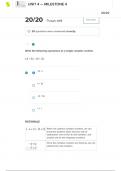
Write the following expression as a single complex number.
(‐4 + 3i) – (5 + 2i)
-9 + i
1 + 5i
-9 + 5i
1+i
RATIONALE
When we subtract complex numbers, we can
break the problem down into two sets of
subtraction: one set for all real numbers, and
another set for the imaginary numbers.
Once the complex numbers are lined up, we can
subtract the real numbers.
, -4 minus 5 is equal to -9. Next, subtract the
UNIT 4 — MILESTONE 4
imaginary numbers.
3i minus 2i is equal to i. Next, write the two parts 20/20
as a complex number in the form a + bi.
The expression (‐4 + 3i) – (5 + 2i) can be written
as a single complex number -9 + i.
CONCEPT
Add and Subtract Complex Numbers
Report an issue with this question
2
Consider the quadratic function .
What do we know about the graph of this quadratic equation,
based on its formula?
The vertex is (3,4) and it opens
downward.
The vertex is (3,4) and it opens
upward.
The vertex is (-3,-32) and it opens
upward.
, UNIT 4 — MILESTONE 4
The vertex is (-3,-32) and it opens
downward.
20/20
RATIONALE
Compare the given equation to the
general . The values of a
and b in particular give us useful
information about the graph.
The sign of a tells us if the parabola
opens upward or downward. If a is
positive, the parabola opens upward. If a
is negative, the parabola opens
downward.
In this case, since a is negative, we know
the parabola opens downward. Next, we
can use the values of a and b to find the
x-coordinate of the vertex.
The values a and b can be plugged into
this formula to give us the x-coordinate of
the vertex.
From the given equation, plug in -1 for a
and 6 for b. Simplify the denominator.
Take note of the sign in the numerator.
Evaluate the division to get the x-
coordinate of the vertex.
The x-coordinate of the vertex is x = 3. To
determine the y-coordinate of the vertex,
plug this x-value into the original
equation and solve for y.
Return to the original equation, but write
in the calculated x-coordinate, 3, for
every instance of x. Then, evaluate the
equation.
3 squared is 9. Next multiply this by the
coefficient, -1.
, -1 times 9 is -9. Next, evaluate 6 times 3.
UNIT 4 — MILESTONE 4
6 times 3 is 18. Finally, evaluate the
addition and subtraction.
20/20
This is the y-coordinate to the parabola's
vertex.
From the equation, we know that the
parabola's vertex is at (3,4) and opens
downward.
CONCEPT
Introduction to Parabolas
Report an issue with this question
3
Consider the quadratic inequality .
What is the solution set?
-8 ≤ x ≤ -6
x ≤ -8 or x ≥ -6
x ≤ 6 or x ≥ 8
6≤x≤8
RATIONALE
To solve a quadratic inequality, first
rewrite it as an equation set equal
to zero.
20/20
20/20 that's 100% RETAKE
20 questions were answered correctly.
1
Write the following expression as a single complex number.
(‐4 + 3i) – (5 + 2i)
-9 + i
1 + 5i
-9 + 5i
1+i
RATIONALE
When we subtract complex numbers, we can
break the problem down into two sets of
subtraction: one set for all real numbers, and
another set for the imaginary numbers.
Once the complex numbers are lined up, we can
subtract the real numbers.
, -4 minus 5 is equal to -9. Next, subtract the
UNIT 4 — MILESTONE 4
imaginary numbers.
3i minus 2i is equal to i. Next, write the two parts 20/20
as a complex number in the form a + bi.
The expression (‐4 + 3i) – (5 + 2i) can be written
as a single complex number -9 + i.
CONCEPT
Add and Subtract Complex Numbers
Report an issue with this question
2
Consider the quadratic function .
What do we know about the graph of this quadratic equation,
based on its formula?
The vertex is (3,4) and it opens
downward.
The vertex is (3,4) and it opens
upward.
The vertex is (-3,-32) and it opens
upward.
, UNIT 4 — MILESTONE 4
The vertex is (-3,-32) and it opens
downward.
20/20
RATIONALE
Compare the given equation to the
general . The values of a
and b in particular give us useful
information about the graph.
The sign of a tells us if the parabola
opens upward or downward. If a is
positive, the parabola opens upward. If a
is negative, the parabola opens
downward.
In this case, since a is negative, we know
the parabola opens downward. Next, we
can use the values of a and b to find the
x-coordinate of the vertex.
The values a and b can be plugged into
this formula to give us the x-coordinate of
the vertex.
From the given equation, plug in -1 for a
and 6 for b. Simplify the denominator.
Take note of the sign in the numerator.
Evaluate the division to get the x-
coordinate of the vertex.
The x-coordinate of the vertex is x = 3. To
determine the y-coordinate of the vertex,
plug this x-value into the original
equation and solve for y.
Return to the original equation, but write
in the calculated x-coordinate, 3, for
every instance of x. Then, evaluate the
equation.
3 squared is 9. Next multiply this by the
coefficient, -1.
, -1 times 9 is -9. Next, evaluate 6 times 3.
UNIT 4 — MILESTONE 4
6 times 3 is 18. Finally, evaluate the
addition and subtraction.
20/20
This is the y-coordinate to the parabola's
vertex.
From the equation, we know that the
parabola's vertex is at (3,4) and opens
downward.
CONCEPT
Introduction to Parabolas
Report an issue with this question
3
Consider the quadratic inequality .
What is the solution set?
-8 ≤ x ≤ -6
x ≤ -8 or x ≥ -6
x ≤ 6 or x ≥ 8
6≤x≤8
RATIONALE
To solve a quadratic inequality, first
rewrite it as an equation set equal
to zero.