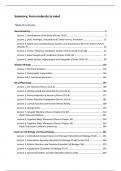
Summary, From molecule to mind
Table of Contents
NeuroAnatomy ................................................................................................................... 3
Lecture 1, Development of the Brain (Purves Ch22).............................................................. 3
Lecture 2, Skull, meninges, vasculature & Cranial nerves, brainstem ................................. 15
Lecture 3, Spinal Cord, Somatosensory Systems and Autonomous Nervous System (Purves
Ch9,10,17) ........................................................................................................................... 32
Lecture 4, Cortex, Thalamus and Motor Systems (Purves Ch16,17,27,28) .......................... 52
Lecture 5, Basal Ganglia and Cerebellum (Purves Ch18,19) ............................................... 71
Lecture 6, Limbic System, Hippocampus and Amygdala (Purves Ch30,31) ......................... 96
Synapse Biology ............................................................................................................. 116
Lecture 1, Chemical Synapses ........................................................................................... 116
Lecture 2, PostsynapSc organizaSon ................................................................................ 125
Lecture 4 & 5, FuncSonal Genomics .................................................................................. 142
NeuroPhysiology ............................................................................................................ 155
Lecture 1, Ion Channels (Purves Ch2-4) ............................................................................. 158
Lecture 2, ResSng membrane potenSal (Purves Ch2-4) .................................................... 168
Lecture 3, AcSve properSes of neurons (Purves Ch2-4) .................................................... 177
Lecture 4, AcSon PotenSal PropagaSon (Purves Ch2-4) ................................................... 181
Lecture 5, CorScal FuncSon and Human Mental Ability.................................................... 189
Lecture 6, OptogeneScs .................................................................................................... 197
Lecture 7, SynapSc PlasScity (Purves Chapter 8 & 30) ...................................................... 213
Paper Discussion Nabavi ............................................................................................... 221
Lecture 8, CogniSve Map/ Memories (Purves Chapter 30) ............................................... 230
Lecture 8, CogniSve Map/ Memories (Purves Chapter 30) ............................................... 230
Paper Discussion LiuNature (memory) .......................................................................... 240
Basics in Cell Biology and Neurobiology .......................................................................... 251
Lecture 1, Intracellular Compartments and Transport (EssenSal Cell Biology Ch15) ........ 251
Lecture 2, Intracellular Signaling (EssenSal Cell Biology Ch16/ Purves Ch7) ..................... 264
Lecture 3, Protein Structure and FuncSon (EssenSal Cell Biology Ch4) ............................. 279
Lecture 4, Cytoskeleton (EssenSal Cell Biology Ch17) ....................................................... 293
Lecture 5, Neurotransmi\ers and their Receptors (Purves Ch6) ....................................... 303
, Lecture 6, DNA and Chromosomes (EssenSal Cell Biology Ch5) ........................................ 315
Lecture 7, From DNA to Protein: How Cells Read the Genome (EssenSal Cell Biology Ch7)
.......................................................................................................................................... 323
Lecture 8, Synapses (Purves Ch5) ...................................................................................... 335
Lecture 9, Molecular Memory / SynapSc PlasScity (Purves Ch8) ...................................... 349
Methods and Models in Neuroscience ............................................................................ 358
Lecture 1, C. elegans ......................................................................................................... 359
Lecture 2, Yeast ................................................................................................................. 371
Lecture 3, Drosophila ........................................................................................................ 381
Lecture 4, Mouse ............................................................................................................... 388
,Methods and Models in Neuroscience
Invertebrate Model organisms
–Saccharomices cerevisiae (Baker’s yeast) Verhage
–CaenorhabdiAs elegans (the roundworm) Smit
–D. melanogaster (the fruit fly) Verhage
à specific behaviours
à simply build nervous system
àspecific features (E.g., drosophila: flying, big eyes; snail: large neurons)
Vertebrate organisms
- O]en studied for specific purposes
o Tote: adapAng skin colour
o Finch: singing and maAng research
o Zebrafish: transparent
o Rats: intricate behaviours (social)
o Mice: easy to do transgenic (genes and funcAon)
Genomes compared
à more dense packing of
genes in the genome.
The intervals in human genes
are much larger> more
possibility to regulate gene
expression.
, Lecture 1, C. elegans
Overview
• Introducing C. elegans
• Life cycle and anatomy
• The worm genome
• Transgenesis and RNA interference
• Examples of geneAc screens (including paper)
• Worms in space
What is C. elegans?
C. elegans is a nematode - a member of the phylum Nematoda:
• It is small, growing to about 1.5 mm in length, and lives in the soil
• in many parts of the world, where it survives by
• feeding on microbes such as bacteria.
• It is of no economic importance
• 1.5 mm length
• 959 cells, of which
• 302 neurons
à These numbers are not special, but it is special that we know these
numbers. In c.elegans all neurons are known and it is a fixed number.
First published descripAon of C.elegans (1900)
- Mouth> geneAc screens
- A lot of space in the worm is occupied by its reproducAon system (seen by the eggs)
What makes C. elegans a unique model organism?
• Small, easy to maintain (eats E. coli) (handy for maintaining the animal in the laboratory)
• Short generaAon Ame and self-ferAlizing
• Cell lineage is constant and completely mapped
• Transparent body: suitable for high-throughput screening methods
• Simple nervous system
• Sequenced genome & extensive molecular toolbox
• Genome database: hTp://www.wormbase.org
• Many research results are translatable to human processes
- Due to the fact that the nervous system of c. elegans also has synapses etc.
• Ethical
- There are no laws protecAng these animals
Table of Contents
NeuroAnatomy ................................................................................................................... 3
Lecture 1, Development of the Brain (Purves Ch22).............................................................. 3
Lecture 2, Skull, meninges, vasculature & Cranial nerves, brainstem ................................. 15
Lecture 3, Spinal Cord, Somatosensory Systems and Autonomous Nervous System (Purves
Ch9,10,17) ........................................................................................................................... 32
Lecture 4, Cortex, Thalamus and Motor Systems (Purves Ch16,17,27,28) .......................... 52
Lecture 5, Basal Ganglia and Cerebellum (Purves Ch18,19) ............................................... 71
Lecture 6, Limbic System, Hippocampus and Amygdala (Purves Ch30,31) ......................... 96
Synapse Biology ............................................................................................................. 116
Lecture 1, Chemical Synapses ........................................................................................... 116
Lecture 2, PostsynapSc organizaSon ................................................................................ 125
Lecture 4 & 5, FuncSonal Genomics .................................................................................. 142
NeuroPhysiology ............................................................................................................ 155
Lecture 1, Ion Channels (Purves Ch2-4) ............................................................................. 158
Lecture 2, ResSng membrane potenSal (Purves Ch2-4) .................................................... 168
Lecture 3, AcSve properSes of neurons (Purves Ch2-4) .................................................... 177
Lecture 4, AcSon PotenSal PropagaSon (Purves Ch2-4) ................................................... 181
Lecture 5, CorScal FuncSon and Human Mental Ability.................................................... 189
Lecture 6, OptogeneScs .................................................................................................... 197
Lecture 7, SynapSc PlasScity (Purves Chapter 8 & 30) ...................................................... 213
Paper Discussion Nabavi ............................................................................................... 221
Lecture 8, CogniSve Map/ Memories (Purves Chapter 30) ............................................... 230
Lecture 8, CogniSve Map/ Memories (Purves Chapter 30) ............................................... 230
Paper Discussion LiuNature (memory) .......................................................................... 240
Basics in Cell Biology and Neurobiology .......................................................................... 251
Lecture 1, Intracellular Compartments and Transport (EssenSal Cell Biology Ch15) ........ 251
Lecture 2, Intracellular Signaling (EssenSal Cell Biology Ch16/ Purves Ch7) ..................... 264
Lecture 3, Protein Structure and FuncSon (EssenSal Cell Biology Ch4) ............................. 279
Lecture 4, Cytoskeleton (EssenSal Cell Biology Ch17) ....................................................... 293
Lecture 5, Neurotransmi\ers and their Receptors (Purves Ch6) ....................................... 303
, Lecture 6, DNA and Chromosomes (EssenSal Cell Biology Ch5) ........................................ 315
Lecture 7, From DNA to Protein: How Cells Read the Genome (EssenSal Cell Biology Ch7)
.......................................................................................................................................... 323
Lecture 8, Synapses (Purves Ch5) ...................................................................................... 335
Lecture 9, Molecular Memory / SynapSc PlasScity (Purves Ch8) ...................................... 349
Methods and Models in Neuroscience ............................................................................ 358
Lecture 1, C. elegans ......................................................................................................... 359
Lecture 2, Yeast ................................................................................................................. 371
Lecture 3, Drosophila ........................................................................................................ 381
Lecture 4, Mouse ............................................................................................................... 388
,Methods and Models in Neuroscience
Invertebrate Model organisms
–Saccharomices cerevisiae (Baker’s yeast) Verhage
–CaenorhabdiAs elegans (the roundworm) Smit
–D. melanogaster (the fruit fly) Verhage
à specific behaviours
à simply build nervous system
àspecific features (E.g., drosophila: flying, big eyes; snail: large neurons)
Vertebrate organisms
- O]en studied for specific purposes
o Tote: adapAng skin colour
o Finch: singing and maAng research
o Zebrafish: transparent
o Rats: intricate behaviours (social)
o Mice: easy to do transgenic (genes and funcAon)
Genomes compared
à more dense packing of
genes in the genome.
The intervals in human genes
are much larger> more
possibility to regulate gene
expression.
, Lecture 1, C. elegans
Overview
• Introducing C. elegans
• Life cycle and anatomy
• The worm genome
• Transgenesis and RNA interference
• Examples of geneAc screens (including paper)
• Worms in space
What is C. elegans?
C. elegans is a nematode - a member of the phylum Nematoda:
• It is small, growing to about 1.5 mm in length, and lives in the soil
• in many parts of the world, where it survives by
• feeding on microbes such as bacteria.
• It is of no economic importance
• 1.5 mm length
• 959 cells, of which
• 302 neurons
à These numbers are not special, but it is special that we know these
numbers. In c.elegans all neurons are known and it is a fixed number.
First published descripAon of C.elegans (1900)
- Mouth> geneAc screens
- A lot of space in the worm is occupied by its reproducAon system (seen by the eggs)
What makes C. elegans a unique model organism?
• Small, easy to maintain (eats E. coli) (handy for maintaining the animal in the laboratory)
• Short generaAon Ame and self-ferAlizing
• Cell lineage is constant and completely mapped
• Transparent body: suitable for high-throughput screening methods
• Simple nervous system
• Sequenced genome & extensive molecular toolbox
• Genome database: hTp://www.wormbase.org
• Many research results are translatable to human processes
- Due to the fact that the nervous system of c. elegans also has synapses etc.
• Ethical
- There are no laws protecAng these animals