

6.4 The Organisation and
Specialisation of Cells
First review @November 13, 2023
Practise Q's Done
Levels of organisation in multicellular organisms
specialised cells —> tissues —> organs —> organ systems —> whole organism
specialised cells
different cells within multicellular organisms are specialised/ differentiated to carry
out a specific function
examples of specialised animal cells:
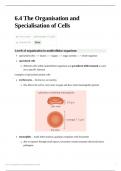
erythrocytes— biconcave, no nucleus
this allows the cell to carry more oxygen and have more haemoglobin present
neutrophils— multi-lobed nucleus, granular cytoplasm with lysosomes
able to squeeze through small spaces, lysosomes contain enzymes that break down
pathogens
6.4 The Organisation and Specialisation of Cells 1
, sperm cell— tail/ flagellum, many mitochondria, acrosome containing digestive
enzymes
movement, supply energy for movement, breaks down protective layer around egg
cell
examples of specialised plant cells:
palisade cells— chloroplasts, rectangular box shapes, thin cell walls
traps sunlight for photosynthesis, can be closely packed to form a layer, increases
rate of diffusion of CO2 into cell
6.4 The Organisation and Specialisation of Cells 2
Specialisation of Cells
First review @November 13, 2023
Practise Q's Done
Levels of organisation in multicellular organisms
specialised cells —> tissues —> organs —> organ systems —> whole organism
specialised cells
different cells within multicellular organisms are specialised/ differentiated to carry
out a specific function
examples of specialised animal cells:
erythrocytes— biconcave, no nucleus
this allows the cell to carry more oxygen and have more haemoglobin present
neutrophils— multi-lobed nucleus, granular cytoplasm with lysosomes
able to squeeze through small spaces, lysosomes contain enzymes that break down
pathogens
6.4 The Organisation and Specialisation of Cells 1
, sperm cell— tail/ flagellum, many mitochondria, acrosome containing digestive
enzymes
movement, supply energy for movement, breaks down protective layer around egg
cell
examples of specialised plant cells:
palisade cells— chloroplasts, rectangular box shapes, thin cell walls
traps sunlight for photosynthesis, can be closely packed to form a layer, increases
rate of diffusion of CO2 into cell
6.4 The Organisation and Specialisation of Cells 2


