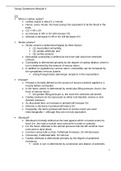
Summarized Notes of Weeks 1 to 10
"PEG-MPFP”
Price
o Aggregate Production Function
o Current and Financial Account
o Trade Balance
o Life time budget constraint - c2 = (1 + r) x (y1 – c1) +
y2
Economy and Trade
o GDP, Real GDP, GDP Deflator, CPI, GNI, HDI, Poverty
Rates and non-qualitative measures
o Cyclical and Countercyclical properties
Growth theories
o Malthusian
o Solow
o Fundamental causes of prosperity
o Theories of unemployment:
Search theory (frictional unemployment) –
looking for the right worker or work
Structural unemployment – due to wage
rigidities
o Money theory:
1. Real Business cycle
2. Keynesian theory
3. Monetary and Fiscal theory
Markets
o Credit Market
o Labour Market
o Foreign Exchange market
Net Exports graph
Productivity
o Labour productivity
Affected by human capital
Efficiency wages
o Capital productivity
o Fundamental causes of prosperity
Foreign Exchange
o Flexible, Fixed and Managed exchange rates
,Summarized Notes of Weeks 1 to 10
o Real and Nominal (e) exchange rates
Policies
o Monetary and Fiscal Policies
Government spending multiplier effect
EC1B5 Key Information and facts (Add YT Notes):
Week 1 (GDP and Price Levels):
Stock variable- refers to a quantity measured at a particular time
period.
Flow variable- quantity measured over a period of time.
GDP can be calculated in three different ways:
o Production = Expenditure = Income
Production-based accounting calculates each firm’s value
added. Meaning that the firm’s intermediatory purchases from
other firms are subtracted from the revenue.
Expenditure approach uses this formula:
Y=C+I+G+X–M
Buying of stocks or a house for example are not
investments, because it is considered as a change of
ownership. Investment is a good that is produced in that
time period (not a transfer of ownership).
Gov expenditure ex- Defence spending, infrastructure but
social security payments are usually not in this list.
Remember, the income based accounting not only sums the
income of labour but also the profits of a firm (for example,
Labours’ Income + Firm’s Profit)
o There are two types of GDP: Nominal GDP and Real GDP.
Nominal GDP: Calculated using current market prices
Real GDP: Calculated using a base year’s market prices but the
quantity of goods sold are from current year’s quantity. For
example, real GDP calculated in 2013 may use 2009’s market
prices as base year.
GDP usually does not take into account multiple factors:
o GDP doesn’t count negative externalities (ex- crime, pollution, etc).
o GDP doesn’t record illegal activities. For example, Mexico is
estimated to record revenues of $35B from drugs alone.
GDP Deflator – The price level of the overall economy
o (Nominal GDP / Real GDP ) x 100
o Can be thought of as the average price level of the economy
,Summarized Notes of Weeks 1 to 10
o For example, assume that the GDP deflator was 109% for a year.
This signifies that the price levels increased by 9% from the base
year to the current year.
Consumer Price Index (CPI) – The price level of a particular basket of
consumer goods and services.
Cost of consumer basket in current year x 100
_________________________________
Cost of consumer basket in base year
o CPI will be measuring the price level of a common basket of goods
that a consumer tends to buy.
o Importantly, the CPI includes goods such as Chinese laptops that
the GDP doesn’t consider.
o In essence, GDP deflator will consist of certain goods that the CPI
will not include but generally these isn’t a major difference between
the two.
o One disadvantage could be that overtime the basket of goods
change in general for consumers. Which means it’s no longer
efficient to calculate CPI between the same basket of goods
between different years.
Inflation rate – The percentage change in a price index.
Notes for exam questions (remember each week is connected):
GDP is affected by common household decisions:
o Mother deciding to stay at home rather than working, remember
that unpaid activities such as household work is not taken into
account.
o Choosing to eat in or even taking clothes to a dry cleaner rather
than doing that at home affect GDP.
Is GDP the best measure of welfare?
o GDP is likely the best measure of welfare. However, other
measures such as CPI, GDP per capita and Real GDP have their
advantages over Nominal GDP. Furthermore, GDP Deflator can be
a good measure of price level of a year.
o GDP leaves out illegal activities and household work from its
calculations which may paint an incomplete picture of the overall
economy.
o Happiness Index can be a better measure of welfare, this is
because GDP only accounts for quantitative measures.
o GNI is an alternative to GDP and could be argued is a better
measure of a country’s welfare, this is due to factor payments
, Summarized Notes of Weeks 1 to 10
and transfers from abroad which contribute to a country’s overall
wellbeing.
o Poverty rates and Human Development Index can also be used.
Week 2 (Productivity and Growth):
GDP per capita = GDP / Total Population
o This formula doesn’t take into consideration unemployment.
Making GDP Comparison across countries:
o 1. Convert GDP using the exchange rate
o 2. Convert GDP using PPP
PPP can be thought of as an exchange rate that is used to
compare standards of living.
Productivity – it is believed that countries have differed income due to
differences in productivity.
"PEG-MPFP”
Price
o Aggregate Production Function
o Current and Financial Account
o Trade Balance
o Life time budget constraint - c2 = (1 + r) x (y1 – c1) +
y2
Economy and Trade
o GDP, Real GDP, GDP Deflator, CPI, GNI, HDI, Poverty
Rates and non-qualitative measures
o Cyclical and Countercyclical properties
Growth theories
o Malthusian
o Solow
o Fundamental causes of prosperity
o Theories of unemployment:
Search theory (frictional unemployment) –
looking for the right worker or work
Structural unemployment – due to wage
rigidities
o Money theory:
1. Real Business cycle
2. Keynesian theory
3. Monetary and Fiscal theory
Markets
o Credit Market
o Labour Market
o Foreign Exchange market
Net Exports graph
Productivity
o Labour productivity
Affected by human capital
Efficiency wages
o Capital productivity
o Fundamental causes of prosperity
Foreign Exchange
o Flexible, Fixed and Managed exchange rates
,Summarized Notes of Weeks 1 to 10
o Real and Nominal (e) exchange rates
Policies
o Monetary and Fiscal Policies
Government spending multiplier effect
EC1B5 Key Information and facts (Add YT Notes):
Week 1 (GDP and Price Levels):
Stock variable- refers to a quantity measured at a particular time
period.
Flow variable- quantity measured over a period of time.
GDP can be calculated in three different ways:
o Production = Expenditure = Income
Production-based accounting calculates each firm’s value
added. Meaning that the firm’s intermediatory purchases from
other firms are subtracted from the revenue.
Expenditure approach uses this formula:
Y=C+I+G+X–M
Buying of stocks or a house for example are not
investments, because it is considered as a change of
ownership. Investment is a good that is produced in that
time period (not a transfer of ownership).
Gov expenditure ex- Defence spending, infrastructure but
social security payments are usually not in this list.
Remember, the income based accounting not only sums the
income of labour but also the profits of a firm (for example,
Labours’ Income + Firm’s Profit)
o There are two types of GDP: Nominal GDP and Real GDP.
Nominal GDP: Calculated using current market prices
Real GDP: Calculated using a base year’s market prices but the
quantity of goods sold are from current year’s quantity. For
example, real GDP calculated in 2013 may use 2009’s market
prices as base year.
GDP usually does not take into account multiple factors:
o GDP doesn’t count negative externalities (ex- crime, pollution, etc).
o GDP doesn’t record illegal activities. For example, Mexico is
estimated to record revenues of $35B from drugs alone.
GDP Deflator – The price level of the overall economy
o (Nominal GDP / Real GDP ) x 100
o Can be thought of as the average price level of the economy
,Summarized Notes of Weeks 1 to 10
o For example, assume that the GDP deflator was 109% for a year.
This signifies that the price levels increased by 9% from the base
year to the current year.
Consumer Price Index (CPI) – The price level of a particular basket of
consumer goods and services.
Cost of consumer basket in current year x 100
_________________________________
Cost of consumer basket in base year
o CPI will be measuring the price level of a common basket of goods
that a consumer tends to buy.
o Importantly, the CPI includes goods such as Chinese laptops that
the GDP doesn’t consider.
o In essence, GDP deflator will consist of certain goods that the CPI
will not include but generally these isn’t a major difference between
the two.
o One disadvantage could be that overtime the basket of goods
change in general for consumers. Which means it’s no longer
efficient to calculate CPI between the same basket of goods
between different years.
Inflation rate – The percentage change in a price index.
Notes for exam questions (remember each week is connected):
GDP is affected by common household decisions:
o Mother deciding to stay at home rather than working, remember
that unpaid activities such as household work is not taken into
account.
o Choosing to eat in or even taking clothes to a dry cleaner rather
than doing that at home affect GDP.
Is GDP the best measure of welfare?
o GDP is likely the best measure of welfare. However, other
measures such as CPI, GDP per capita and Real GDP have their
advantages over Nominal GDP. Furthermore, GDP Deflator can be
a good measure of price level of a year.
o GDP leaves out illegal activities and household work from its
calculations which may paint an incomplete picture of the overall
economy.
o Happiness Index can be a better measure of welfare, this is
because GDP only accounts for quantitative measures.
o GNI is an alternative to GDP and could be argued is a better
measure of a country’s welfare, this is due to factor payments
, Summarized Notes of Weeks 1 to 10
and transfers from abroad which contribute to a country’s overall
wellbeing.
o Poverty rates and Human Development Index can also be used.
Week 2 (Productivity and Growth):
GDP per capita = GDP / Total Population
o This formula doesn’t take into consideration unemployment.
Making GDP Comparison across countries:
o 1. Convert GDP using the exchange rate
o 2. Convert GDP using PPP
PPP can be thought of as an exchange rate that is used to
compare standards of living.
Productivity – it is believed that countries have differed income due to
differences in productivity.