Thermodynamics
Introduction:
It is a scientific discipline that was originally developed to better understand steam-engines,
which use heat to put things into motion, but in biochemistry, explains why we eat and what
all the energy is used for. It is always about a system. In the case of the steam-engine,
“system” referred to the engine, but in biochemistry, it may refer to an organism, molecule or
cell. It can sometimes define an imaginary system, for example a box containing four
particles that bump around vigorously. Another important term is environment, which refers
to everything outside the system. Thermodynamics provides us tools to investigate the
exchange of energy between a system and its environment. Another term is variables, more
specifically state variables, which describe everything that is constant at the moment in a
system (e.g. if the system is me sitting at a place, the state variables can be my attitude,
weight, how many molecules are in my body, but things like the path I took to get here do not
matter as they do not describe my state, but the process to get to the state). State variables are
divided into intensive variables and extensive variables. If you combine two systems, the
extensive variables add up, while the intensive variables average out/do not add up (e.g.
combining a coffee and water, the number of molecules is extensive as it adds up and
increases, while the amount of sugar averages out/dilutes therefore is intensive). There are
pairs of state variables (where one is intensive, while the other is extensive, but they are
linked), for example temperature (intensive) and energy (extensive) since the coffee and
water have two different temps, so they average out, and heat is a form of energy. Another
pair is pressure and volume. Basically, there should be exchange of extensive variables.
Another example is conc and no. molecules.
The First Law = energy is conserved
Internal energy (E) = molecular systems can have potential energy (in bonds) and kinetic
energy (vibrations, rotations etc) and nuclei energy. Energy can only be
converted from one form to another (it is conserved). The internal
energy can be used either to do work or to produce heat. If a system does
work, the energy content of the system decreases, if it produces heat, the internal energy (U)
increases. q = heat, w = work. If my system therefore, does work, the U decrease, and if there
is some heat being added to my system, U increases.
Work:
In steam engines, they operated at constant volume and fluctuating pressure (puff of steam),
but in biology, we work at a constant temperature and pressure, but fluctuating volume.
Therefore, volume work is 𝑊 = 𝑝 ∙ ∆𝑉, and internal energy is ∆𝑈 = 𝑞 − 𝑝 ∙ ∆𝑉. For constant
pressure q, we write this . qp is by definition ∆𝐻, so ∆𝐻 = ∆𝑈 + 𝑝∆𝑉, where ∆𝐻
is enthalpy change. Enthalpy change is the heat added to or
produced by the system at constant pressure. E.g. heat up water, there is a volume change and
a temperature change.
Forces on Molecules
A gas will expand in a vacuum, hot coffee becomes room temperature, so does a cold drink.
Why? You might think that due to a concentration or temperature gradient, but it is due to
probability. A state in which molecules are dispersed around is much more probable than a
state in which they are all confined to a specific spot. This is the second law of
, thermodynamics too (discussed later). Multiplicity (represented with W or a capital omega)
is the number of microscopic arrangements that have the same macroscopic appearance.
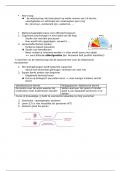
Q. What is the probability of finding the state 4:0?
The probability of finding particle (a) on the left is ½ , same goes for particle (b), (c) and (d),
therefore, it is ½* ½* ½* ½, so 1/16.
Q. What about the state 3:1?
There are 4 ways to get to this state (W of 4), and there are is ½* ½* ½*
½ ways to arrange the individuals particles, so it is going to be
4* ½* ½* ½* ½ = ¼ probability
Microscopic and Macroscopic Perspective:
From the microscopic perspective, every molecule is unique and is
cruising the spaces it can occupy: every microscopic state where every molecule is labelled
and traced, is equally probable. It is only when we consider the overall, macroscopic state,
that difference in multiplicity and thus probability arise. Compare it to throwing two dice: the
microscopic state (1,1) is equally likely as (3,4) or any other combination (the probability of
each being 1/36). The macroscopic state “2”, however, is only
achieved by one combination of dice (1,1), whereas the state “7”
has multiplicity of 6 {(1,6),(6,1),(2,5),(5,2),(3,4),(4,3)}. If you
throw unbiased dice often enough, you will see that you observe
“7” 6 times more often than “2”.
Also, as the number of particles increases, the steeper the peak
becomes and the closer to 0 the probability of getting an extreme
value becomes. So, the chance for equal division increases. and
the chance of finding all particles together becomes nearly zero.
The most probable state is called equilibrium.
Entropy and the Second Law:
Entropy is the thermodynamics name for probability, given the symbol S
The second law states that in a spontaneous reaction, the total entropy needs to increase. So,
if the entropy increases, the reaction will happen, if it does not increase, the reaction will not
happen. Coffee will cool down and volume will expand in a vacuum because it increases in
entropy for example.
S = kb ln(W) is the formula for entropy, where kb is the Boltzmann constant 1.38 × 10⁻²³ J K-1
Highly structured systems (such as all molecules localized in one place) have low multiplicity
and hence low entropy.
Exchange of Heat:
For the example of a coffee cooling again, the same story applies, as heat is a flow
of energy and this will occur if there is a probability drive, which in this case is defined as a
“temperature difference”. There is one important difference between macroscopic objects and
molecules: at the molecular level, energy is quantitized. It comes as defined packages of
fixed energy. Spectroscopy is based on this: photons of specific wavelength and hence energy
Introduction:
It is a scientific discipline that was originally developed to better understand steam-engines,
which use heat to put things into motion, but in biochemistry, explains why we eat and what
all the energy is used for. It is always about a system. In the case of the steam-engine,
“system” referred to the engine, but in biochemistry, it may refer to an organism, molecule or
cell. It can sometimes define an imaginary system, for example a box containing four
particles that bump around vigorously. Another important term is environment, which refers
to everything outside the system. Thermodynamics provides us tools to investigate the
exchange of energy between a system and its environment. Another term is variables, more
specifically state variables, which describe everything that is constant at the moment in a
system (e.g. if the system is me sitting at a place, the state variables can be my attitude,
weight, how many molecules are in my body, but things like the path I took to get here do not
matter as they do not describe my state, but the process to get to the state). State variables are
divided into intensive variables and extensive variables. If you combine two systems, the
extensive variables add up, while the intensive variables average out/do not add up (e.g.
combining a coffee and water, the number of molecules is extensive as it adds up and
increases, while the amount of sugar averages out/dilutes therefore is intensive). There are
pairs of state variables (where one is intensive, while the other is extensive, but they are
linked), for example temperature (intensive) and energy (extensive) since the coffee and
water have two different temps, so they average out, and heat is a form of energy. Another
pair is pressure and volume. Basically, there should be exchange of extensive variables.
Another example is conc and no. molecules.
The First Law = energy is conserved
Internal energy (E) = molecular systems can have potential energy (in bonds) and kinetic
energy (vibrations, rotations etc) and nuclei energy. Energy can only be
converted from one form to another (it is conserved). The internal
energy can be used either to do work or to produce heat. If a system does
work, the energy content of the system decreases, if it produces heat, the internal energy (U)
increases. q = heat, w = work. If my system therefore, does work, the U decrease, and if there
is some heat being added to my system, U increases.
Work:
In steam engines, they operated at constant volume and fluctuating pressure (puff of steam),
but in biology, we work at a constant temperature and pressure, but fluctuating volume.
Therefore, volume work is 𝑊 = 𝑝 ∙ ∆𝑉, and internal energy is ∆𝑈 = 𝑞 − 𝑝 ∙ ∆𝑉. For constant
pressure q, we write this . qp is by definition ∆𝐻, so ∆𝐻 = ∆𝑈 + 𝑝∆𝑉, where ∆𝐻
is enthalpy change. Enthalpy change is the heat added to or
produced by the system at constant pressure. E.g. heat up water, there is a volume change and
a temperature change.
Forces on Molecules
A gas will expand in a vacuum, hot coffee becomes room temperature, so does a cold drink.
Why? You might think that due to a concentration or temperature gradient, but it is due to
probability. A state in which molecules are dispersed around is much more probable than a
state in which they are all confined to a specific spot. This is the second law of
, thermodynamics too (discussed later). Multiplicity (represented with W or a capital omega)
is the number of microscopic arrangements that have the same macroscopic appearance.
Q. What is the probability of finding the state 4:0?
The probability of finding particle (a) on the left is ½ , same goes for particle (b), (c) and (d),
therefore, it is ½* ½* ½* ½, so 1/16.
Q. What about the state 3:1?
There are 4 ways to get to this state (W of 4), and there are is ½* ½* ½*
½ ways to arrange the individuals particles, so it is going to be
4* ½* ½* ½* ½ = ¼ probability
Microscopic and Macroscopic Perspective:
From the microscopic perspective, every molecule is unique and is
cruising the spaces it can occupy: every microscopic state where every molecule is labelled
and traced, is equally probable. It is only when we consider the overall, macroscopic state,
that difference in multiplicity and thus probability arise. Compare it to throwing two dice: the
microscopic state (1,1) is equally likely as (3,4) or any other combination (the probability of
each being 1/36). The macroscopic state “2”, however, is only
achieved by one combination of dice (1,1), whereas the state “7”
has multiplicity of 6 {(1,6),(6,1),(2,5),(5,2),(3,4),(4,3)}. If you
throw unbiased dice often enough, you will see that you observe
“7” 6 times more often than “2”.
Also, as the number of particles increases, the steeper the peak
becomes and the closer to 0 the probability of getting an extreme
value becomes. So, the chance for equal division increases. and
the chance of finding all particles together becomes nearly zero.
The most probable state is called equilibrium.
Entropy and the Second Law:
Entropy is the thermodynamics name for probability, given the symbol S
The second law states that in a spontaneous reaction, the total entropy needs to increase. So,
if the entropy increases, the reaction will happen, if it does not increase, the reaction will not
happen. Coffee will cool down and volume will expand in a vacuum because it increases in
entropy for example.
S = kb ln(W) is the formula for entropy, where kb is the Boltzmann constant 1.38 × 10⁻²³ J K-1
Highly structured systems (such as all molecules localized in one place) have low multiplicity
and hence low entropy.
Exchange of Heat:
For the example of a coffee cooling again, the same story applies, as heat is a flow
of energy and this will occur if there is a probability drive, which in this case is defined as a
“temperature difference”. There is one important difference between macroscopic objects and
molecules: at the molecular level, energy is quantitized. It comes as defined packages of
fixed energy. Spectroscopy is based on this: photons of specific wavelength and hence energy