

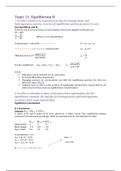
Topic 11: Equilibrium II
1. be able to deduce an expression for Kp, for homogeneous and
heterogeneous systems, in terms of equilibrium partial pressures in atm
Gas Equilibria and Kp
Pressure can be seen as a form of concentration (how close together molecules are):
PV = nRT
n P
= Where n/v is concentration.
V RT
Total pressure = sum of all partial pressures PT = pA + pB + pc
Partial pressure = mole fraction x total pressure pA = xA x PT
moles of A nA
Mole fraction of A= xA =
total moles nT
p C c p Dd
For the equilibrium: aA(g) + bB(g) ⇌ cC cC(g) + dD(g): Kp = a b
p A pB
RULES
Only gases can be included in a Kp expression
Kp is only affected by temperature
Changing pressure or concentration can shift the equilibrium position but does not
affect the value of Kp/Kc
Catalysts have no effect on the position of equilibrium and therefore cannot affect K p/Kc
either however they mean an equilibrium is reached faster
2. be able to calculate a value, with units where appropriate, for the
equilibrium constant (Kc and Kp) for homogeneous and heterogeneous
reactions, from experimental data
Equilibria Calculations
Kc Calculations
Example: N2(g) + 3H2(g) ⇌ cC 2NH3(g)
6 moles of H2 and 2 moles of N2 were placed in a 10dm3 vessel. The equilibrium mixture
contained 3.2 moles of ammonia gas. Write an expression for Kc and calculate its value.
N2(g) + 3H2(g) ⇌ cC 2NH3(g)
Initial moles 2 6 0
Mole change -1.6 -4.8 + 3.2
Equm moles 0.4 1.2 3.2
Concentration = n/v
CN2= 0.4/10 = 0.04 Units: ¿ ¿
CH2 = 1.2/10 = 0.12
CNH3 = 3.2/10 = 0.32 = mol-2dm6
Kc = ¿ ¿ = ¿ ¿ = 1481mol-2dm6
1. be able to deduce an expression for Kp, for homogeneous and
heterogeneous systems, in terms of equilibrium partial pressures in atm
Gas Equilibria and Kp
Pressure can be seen as a form of concentration (how close together molecules are):
PV = nRT
n P
= Where n/v is concentration.
V RT
Total pressure = sum of all partial pressures PT = pA + pB + pc
Partial pressure = mole fraction x total pressure pA = xA x PT
moles of A nA
Mole fraction of A= xA =
total moles nT
p C c p Dd
For the equilibrium: aA(g) + bB(g) ⇌ cC cC(g) + dD(g): Kp = a b
p A pB
RULES
Only gases can be included in a Kp expression
Kp is only affected by temperature
Changing pressure or concentration can shift the equilibrium position but does not
affect the value of Kp/Kc
Catalysts have no effect on the position of equilibrium and therefore cannot affect K p/Kc
either however they mean an equilibrium is reached faster
2. be able to calculate a value, with units where appropriate, for the
equilibrium constant (Kc and Kp) for homogeneous and heterogeneous
reactions, from experimental data
Equilibria Calculations
Kc Calculations
Example: N2(g) + 3H2(g) ⇌ cC 2NH3(g)
6 moles of H2 and 2 moles of N2 were placed in a 10dm3 vessel. The equilibrium mixture
contained 3.2 moles of ammonia gas. Write an expression for Kc and calculate its value.
N2(g) + 3H2(g) ⇌ cC 2NH3(g)
Initial moles 2 6 0
Mole change -1.6 -4.8 + 3.2
Equm moles 0.4 1.2 3.2
Concentration = n/v
CN2= 0.4/10 = 0.04 Units: ¿ ¿
CH2 = 1.2/10 = 0.12
CNH3 = 3.2/10 = 0.32 = mol-2dm6
Kc = ¿ ¿ = ¿ ¿ = 1481mol-2dm6


