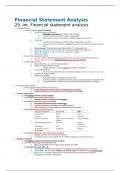
Financial Statement Analysis
29. Int. Financial statement analysis
1. Financial statement
1. Financial statement analysis framework -
a. State the objectives and context
i. Determine what questions the analysis seek to answer
ii. The form in which information’s need to be presented
iii. What resources and how much time are available to perform the analysis
b. Gather data
i. Acquire financial statements and other relevant data(industry, economy)
ii. Ask questions of the company’s management, suppliers, and customers, and visit company
sites.
c. Process the data : Make any appropriate adjustment to F/S - ratio, graphs, size
d. Analyze and interpret the data : Use the date to answer and decide recommendations
e. Report the conclusions or recommendations : Prepare for audience
f. Update the analysis
2. Roles of financial statement analysis
a. Financial reporting : showing their financial performances to investors about financial statement
b. Financial statement analysis is used by investors to make economic decisions
3. Financial statement (F/S)
a. Balance sheet(B/S) - statement of financial position
b. Statement of Comprehensive income
i. Reports all changes in equity except for shareholder transaction
c. Income statement(I/S)
i. I/S can be combined with OCI and presented as a single statement of comprehensive income
d. Statement of changes in equity
e. Statement of cashflows
i. Operating cash flows : Normal business of the firm
ii. Investing cash flows : Acquisition or sales of property, plant, equipment / investment in firms
iii. Financing cash flows : Issuance or retirement of debt and equity securities / dividends
2. Financial reporting objective
1. ISAB conceptual framework for financial reporting
a. Provide information which is useful for making decisions on investing
b. Provide consistency by narrowing the range of acceptable financial reports
3. Standard- setting bodies
1. They Establish financial reporting standards
2. Financial accounting standards board(FASB)
a. Generally accepted accounting principles(GAAP)
3. International accounting standard board(IASB)
a. International financial reporting standards(IFRS)
b. Detailing qualitative characteristics of financial statement
c. Provide information which is useful for making decisions on investing
4. Major difference between GAAP and IFRS
a.
5. International organization of securities commission(IOSCO)
a. Regulate more than 95% world financial markets
b. To protect investors / ensure market are fair, efficient, transparent / reduce systemic risk
4. Regulatory authorities
1. They Enforce compliance with financial reporting standards
2. Securities and exchange commission(SEC) - US
a. SEC Has responsibility of enforcing the sarbanes-oxley act of 2002
3. the Sarbanes-Oxley act of 2002 - US
a. Independence : Prohibit external audit from providing certain additional service to a company
b. Responsibility : The act requires company and external auditor to certify that F/S are presented fairly
c. Effectiveness : to include a statement about the effectiveness of internal controls of financial
reporting(external auditor confirmation)
,5. Footnotes, audit, analysis
1. Financial statement note(footnotes)
a. Disclosure that provide further detail about F/S
b. Information about Accounting method, assumptions, estimates
c. Additional information on primary information such as Business acquisition, employee benefit plan,
contingencies plan, legal actions
2. Management's discussion and analysis(MD&A)
a. Management discusses a variety of issues(IFRS Recommendation)
i. Management objectives and strategy
ii. past performance
iii. performance measure
iv. the company’s significant resources, risks, and relationships
b. MD&A must disclosure(SEC requirements)
i. Effects of inflation and changing price if material
ii. Impact of off-B/S obligations and contractual obligation
iii. Accounting policies that require significant judgement by management
iv. Forward-looking expenditure and divestitures
3. Standard auditor's opinion requirement
a. the auditor has performed an independent review.
b. Generally accepted auditing standards were followed, thus providing reasonable assurance that F/Ss
contain no material errors.
c. The auditor is satisfied that the statements were prepared in accordance with accepted accounting
principles and that the principles chosen and estimates made are reasonable.
4. Standard auditor's opinion
a. Unqualified opinion[clean, Unmodified) : Statements are free form material omissions and errors
b. Qualified opinion : If making any exceptions to the accounting principles
c. Adverse opinion : If not presented fairly or materially nonconforming with accounting standard
d. Disclaimer : Author is Unable to express an opinion
30. Analyzing Income Statement
1. Recognition
1. Revenue recognition
a. It is recognized at the time of the exchange(sales)
i. account receivable - payment will be done after goods transference
ii. Unearned revenue - payment is received prior to the transfer of the goods
b. IFRS vs GAAP
i. "collectability" vs "probability"
ii. Revenue = accrual accounting principle = IFRS = GAAP
c. Revenue should be recognized only when it is highly probable so they will not be reversed
d. For example, a firm may need to recognize a liability for a refund obligation if revenue from a sale cannot be
estimated reliably.
2. Expense recognition
a. Matching principle : expenses to generate revenue are recognized in the same period as the revenue
i. E.g., inventory sales , warranty
b. Not all expenses can be directly tied to revenue generation.
i. Period costs, such as administrative costs, are expensed in the period incurred.
c. An accounting policy that recognizes expenses later rather than sooner is seen as aggressive, while a policy that
recognizes expenses earlier is conservative.
i. If F/S were prepared on a cash basis, neither revenue nor expense recognition would be an issue.
2. Capitalization
1. What is capitalization
a. An expenditure that is expected to provide a future economic benefit is capitalized
b. If the future economic benefit is unlikely or highly uncertain, then expensed in the period incurred.
c. Once capitalized, subsequent related expenditures are also capitalized.
d. However, what merely sustain the usefulness of the asset are expensed when incurred(regular maintenance)
2. Capitalized interest
a. : When a firm constructs an asset for its own use or for resale, the interest is capitalized as a part of the asset’s
cost
i. to accurately measure the cost of the asset and better match the cost with the revenues
b. The treatment of capitalized interest is similar under GAAP and IFRS, but not under cash flow analysis
i. GAAP : CFO (Operating outflows)
ii. IFRS : CFO / CFF (Operating or financing outflow)
c. depreciation expense for use or COGS for sales
d. both capitalized and expensed interest should be used when calculating interest coverage ratios
3. Research and development cost
1. Research cost
, a. Costs which are aimed at the discovery of new scientific or technical knowledge and understanding
b. Under both IFRS and GAAP, research cost are expensed as incurred
2. Development cost
a. Cost used to translate research findings into a plan or design of a new product or process
b. Under IFRS, development cost can be capitalized as incurred
c. Under GAAP, development cost are expensed as incurred
d. Under GAAP, Costs incurred to develop software for sale can be capitalized after the product’s technological
feasibility has been established
4. Non-recurring items
1. What is nonrecurring item
a. unusual in nature or infrequent in occurrence
b. Gains or losses from the sale of assets or part of a business
c. Impairments, write-offs, write-downs and Restructuring costs
2. Discontinued operation
a. : management has decided to dispose of
i. measurement date : The date when the company develops a formal plan for disposing of an
operation
ii. phaseout period : the time between measurement period and actual disposal date
b. Any income or loss from discontinued operations is reported separately in I/S, net of tax
i. Any past I/S presented must be restated too
ii. Any expected gain on the disposal cannot be reported until the sale is completed.
c. Discontinued operations do not affect net income
5. Change in accounting policies and estimate
1. Changes in accounting policies
a. Unless it is impractical, changes in accounting policies require retrospective application.
b. Retrospective application: prior F/S must be restated, applying new policy, as well as future statements.
i. It enhances the comparability of F/S over time
c. Prospective application : prior F/S are not restated, and new policies are applied only to future F/S
d. Modified retrospective application : In the recent change to revenue recognition standards
i. : does not require restatement
ii. however, beginning values of affected accounts are adjusted for the cumulative effects of the
change.
2. Changes in accounting estimates
a. Changes in accounting estimates do not require the restatement of prior F/S
b. Analytical implications: Accounting estimate changes typically do not affect cash flow.
c. should review their impact on future operating results.
3. Prior-period adjustments
a. : A correction of an accounting error made in previous F/S
b. It requires retrospective application + disclosure of the adjustment and effect on
net income
6. Effect of stock dividends and stock splits
1. Capital structure
a. Simple capital structure : contains no potentially dilutive securities. : only basic
EPS.
b. Complex capital structure : contains potentially dilutive securities : Must report both
basic EPS and diluted EPS.
2. EPS
.÷¿
a. Basic EPS =¿− pref ¿
Σ Shares of stock
¿− pref .÷+others
b. Dilutive EPS =
Σ S h ares of stock
i. Others : dividends on convertible preferred stock + after-tax interest on
convertible debt
ii. Dilutive EPS would decrease EPS if exercised or converted to common stock.
iii. Stock options and warrants are dilutive only when exercise prices >
average market price
c. If convertible preferred stock is dilutive, the convertible preferred dividends must be
added to earnings available to common shareholders.
d. If convertible bonds are dilutive, the bonds’ after-tax interest expense is not
considered an interest expense for diluted EPS.
3. Antidilutive vs dilutive
preferred stock par value x ( % ) dividneds
a. Preferred stock=
preferred stock
29. Int. Financial statement analysis
1. Financial statement
1. Financial statement analysis framework -
a. State the objectives and context
i. Determine what questions the analysis seek to answer
ii. The form in which information’s need to be presented
iii. What resources and how much time are available to perform the analysis
b. Gather data
i. Acquire financial statements and other relevant data(industry, economy)
ii. Ask questions of the company’s management, suppliers, and customers, and visit company
sites.
c. Process the data : Make any appropriate adjustment to F/S - ratio, graphs, size
d. Analyze and interpret the data : Use the date to answer and decide recommendations
e. Report the conclusions or recommendations : Prepare for audience
f. Update the analysis
2. Roles of financial statement analysis
a. Financial reporting : showing their financial performances to investors about financial statement
b. Financial statement analysis is used by investors to make economic decisions
3. Financial statement (F/S)
a. Balance sheet(B/S) - statement of financial position
b. Statement of Comprehensive income
i. Reports all changes in equity except for shareholder transaction
c. Income statement(I/S)
i. I/S can be combined with OCI and presented as a single statement of comprehensive income
d. Statement of changes in equity
e. Statement of cashflows
i. Operating cash flows : Normal business of the firm
ii. Investing cash flows : Acquisition or sales of property, plant, equipment / investment in firms
iii. Financing cash flows : Issuance or retirement of debt and equity securities / dividends
2. Financial reporting objective
1. ISAB conceptual framework for financial reporting
a. Provide information which is useful for making decisions on investing
b. Provide consistency by narrowing the range of acceptable financial reports
3. Standard- setting bodies
1. They Establish financial reporting standards
2. Financial accounting standards board(FASB)
a. Generally accepted accounting principles(GAAP)
3. International accounting standard board(IASB)
a. International financial reporting standards(IFRS)
b. Detailing qualitative characteristics of financial statement
c. Provide information which is useful for making decisions on investing
4. Major difference between GAAP and IFRS
a.
5. International organization of securities commission(IOSCO)
a. Regulate more than 95% world financial markets
b. To protect investors / ensure market are fair, efficient, transparent / reduce systemic risk
4. Regulatory authorities
1. They Enforce compliance with financial reporting standards
2. Securities and exchange commission(SEC) - US
a. SEC Has responsibility of enforcing the sarbanes-oxley act of 2002
3. the Sarbanes-Oxley act of 2002 - US
a. Independence : Prohibit external audit from providing certain additional service to a company
b. Responsibility : The act requires company and external auditor to certify that F/S are presented fairly
c. Effectiveness : to include a statement about the effectiveness of internal controls of financial
reporting(external auditor confirmation)
,5. Footnotes, audit, analysis
1. Financial statement note(footnotes)
a. Disclosure that provide further detail about F/S
b. Information about Accounting method, assumptions, estimates
c. Additional information on primary information such as Business acquisition, employee benefit plan,
contingencies plan, legal actions
2. Management's discussion and analysis(MD&A)
a. Management discusses a variety of issues(IFRS Recommendation)
i. Management objectives and strategy
ii. past performance
iii. performance measure
iv. the company’s significant resources, risks, and relationships
b. MD&A must disclosure(SEC requirements)
i. Effects of inflation and changing price if material
ii. Impact of off-B/S obligations and contractual obligation
iii. Accounting policies that require significant judgement by management
iv. Forward-looking expenditure and divestitures
3. Standard auditor's opinion requirement
a. the auditor has performed an independent review.
b. Generally accepted auditing standards were followed, thus providing reasonable assurance that F/Ss
contain no material errors.
c. The auditor is satisfied that the statements were prepared in accordance with accepted accounting
principles and that the principles chosen and estimates made are reasonable.
4. Standard auditor's opinion
a. Unqualified opinion[clean, Unmodified) : Statements are free form material omissions and errors
b. Qualified opinion : If making any exceptions to the accounting principles
c. Adverse opinion : If not presented fairly or materially nonconforming with accounting standard
d. Disclaimer : Author is Unable to express an opinion
30. Analyzing Income Statement
1. Recognition
1. Revenue recognition
a. It is recognized at the time of the exchange(sales)
i. account receivable - payment will be done after goods transference
ii. Unearned revenue - payment is received prior to the transfer of the goods
b. IFRS vs GAAP
i. "collectability" vs "probability"
ii. Revenue = accrual accounting principle = IFRS = GAAP
c. Revenue should be recognized only when it is highly probable so they will not be reversed
d. For example, a firm may need to recognize a liability for a refund obligation if revenue from a sale cannot be
estimated reliably.
2. Expense recognition
a. Matching principle : expenses to generate revenue are recognized in the same period as the revenue
i. E.g., inventory sales , warranty
b. Not all expenses can be directly tied to revenue generation.
i. Period costs, such as administrative costs, are expensed in the period incurred.
c. An accounting policy that recognizes expenses later rather than sooner is seen as aggressive, while a policy that
recognizes expenses earlier is conservative.
i. If F/S were prepared on a cash basis, neither revenue nor expense recognition would be an issue.
2. Capitalization
1. What is capitalization
a. An expenditure that is expected to provide a future economic benefit is capitalized
b. If the future economic benefit is unlikely or highly uncertain, then expensed in the period incurred.
c. Once capitalized, subsequent related expenditures are also capitalized.
d. However, what merely sustain the usefulness of the asset are expensed when incurred(regular maintenance)
2. Capitalized interest
a. : When a firm constructs an asset for its own use or for resale, the interest is capitalized as a part of the asset’s
cost
i. to accurately measure the cost of the asset and better match the cost with the revenues
b. The treatment of capitalized interest is similar under GAAP and IFRS, but not under cash flow analysis
i. GAAP : CFO (Operating outflows)
ii. IFRS : CFO / CFF (Operating or financing outflow)
c. depreciation expense for use or COGS for sales
d. both capitalized and expensed interest should be used when calculating interest coverage ratios
3. Research and development cost
1. Research cost
, a. Costs which are aimed at the discovery of new scientific or technical knowledge and understanding
b. Under both IFRS and GAAP, research cost are expensed as incurred
2. Development cost
a. Cost used to translate research findings into a plan or design of a new product or process
b. Under IFRS, development cost can be capitalized as incurred
c. Under GAAP, development cost are expensed as incurred
d. Under GAAP, Costs incurred to develop software for sale can be capitalized after the product’s technological
feasibility has been established
4. Non-recurring items
1. What is nonrecurring item
a. unusual in nature or infrequent in occurrence
b. Gains or losses from the sale of assets or part of a business
c. Impairments, write-offs, write-downs and Restructuring costs
2. Discontinued operation
a. : management has decided to dispose of
i. measurement date : The date when the company develops a formal plan for disposing of an
operation
ii. phaseout period : the time between measurement period and actual disposal date
b. Any income or loss from discontinued operations is reported separately in I/S, net of tax
i. Any past I/S presented must be restated too
ii. Any expected gain on the disposal cannot be reported until the sale is completed.
c. Discontinued operations do not affect net income
5. Change in accounting policies and estimate
1. Changes in accounting policies
a. Unless it is impractical, changes in accounting policies require retrospective application.
b. Retrospective application: prior F/S must be restated, applying new policy, as well as future statements.
i. It enhances the comparability of F/S over time
c. Prospective application : prior F/S are not restated, and new policies are applied only to future F/S
d. Modified retrospective application : In the recent change to revenue recognition standards
i. : does not require restatement
ii. however, beginning values of affected accounts are adjusted for the cumulative effects of the
change.
2. Changes in accounting estimates
a. Changes in accounting estimates do not require the restatement of prior F/S
b. Analytical implications: Accounting estimate changes typically do not affect cash flow.
c. should review their impact on future operating results.
3. Prior-period adjustments
a. : A correction of an accounting error made in previous F/S
b. It requires retrospective application + disclosure of the adjustment and effect on
net income
6. Effect of stock dividends and stock splits
1. Capital structure
a. Simple capital structure : contains no potentially dilutive securities. : only basic
EPS.
b. Complex capital structure : contains potentially dilutive securities : Must report both
basic EPS and diluted EPS.
2. EPS
.÷¿
a. Basic EPS =¿− pref ¿
Σ Shares of stock
¿− pref .÷+others
b. Dilutive EPS =
Σ S h ares of stock
i. Others : dividends on convertible preferred stock + after-tax interest on
convertible debt
ii. Dilutive EPS would decrease EPS if exercised or converted to common stock.
iii. Stock options and warrants are dilutive only when exercise prices >
average market price
c. If convertible preferred stock is dilutive, the convertible preferred dividends must be
added to earnings available to common shareholders.
d. If convertible bonds are dilutive, the bonds’ after-tax interest expense is not
considered an interest expense for diluted EPS.
3. Antidilutive vs dilutive
preferred stock par value x ( % ) dividneds
a. Preferred stock=
preferred stock