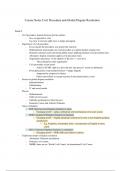
Course Notes Civil Procedure and Global Dispute Resolution
Week 2
- Civil procedure: dispute between private entities
- How as opposed to what
- E.g. how to exercise right, how to lodge and appeal
- Importance of civil procedure
- If you master the procedure, you master the outcome
- Multinationals increasingly use civil procedure as a global market strategy tool
- Domestic national courts rule about global issues applying national civil procedural rules
- Alternative dispute resolution applies civil procedure rules
- Negotiation takes place ‘in the shadow of the law’ (= case law)
- “Best alternative after negotiation”
- Civil procedure as last resort
- Article 6 ECHR: right to a fair trial and ‘due process’ notion in arbitration
- Procedural justice or procedural fairness = happy litigants
- Supported by empirical evidence
- Parties more likely to accept outcome if procedural justice is met
- Factors in global dispute resolution
- Industrialisation
- Globalisation
- IT and social media
- Players
- Multinationals
- NGO’s/Civil society
- Globally operating law firms/lawyers
- Domestic Courts and Arbitral Tribunals
- Types of disputes
- B2S: State Investor Disputes (business to state)
- Emerging trend? – replace arbitration with international civil court system
- B2B: Commercial Disputes (business to business)
- Emerging trend? – English speaking Commercial Courts in non-English speaking
jurisdictions
- E.g. Frankfurt, Amsterdam, Paris - incorporation of English in some
courts
- B2C: Consumer Disputes (business to consumer)
- Emerging trend? – ODR/ADR and collective redress
- Traditional modes of dispute resolution
- Arbitration Tribunals (mediation)
- Domestic civil courts
- NOTE: there are no ‘World Civil Courts’ or International Civil Courts
, - Specific to national courts
Reading Notes
T.R. Tyler&H. Thorisdottir, ‘A Psychological Perspective On Compensation For Harm: Examining The
September 11th Victim Compensation Fund’, DePaul Law Review 2003, vol. 53, issue 2, Part V, p. 380-382
- Understanding of ‘fair’ procedure
- 4 elements influence fairness
- Is there opportunity to state case (voice/participation)
- Importance of participating in case as much as possible
- Feeling heard by authorities
- Are authorities neutral, honest and principled in decision making
- Authorities demonstrate evenhandedness or impartiality
- Are authorities benevolent and caring (trustworthiness)
- Are people involved treated with dignity and respect
- Restoring status of victim
Week 3: Dispute Resolution by Adjudication
Frank E.A. Sander and Stephen B. Goldberg, Fitting the Forum to the Fuss: A User Friendly Guide to
Selecting an ADR Procedure, Negotiation Journal, Harvard Law School, Vol.10, Issue 1, January 1994,
pp. 49-68
- ADR: alternative dispute resolution
- Negotiation – allows parties to control process and solution
- If parties cannot agree, third party takes some control over process
- 2 types of third party processes
- Adjudication / imposing solution – performed by court or private adjudicator
(arbitration, private judge) - binding
- Mediation / helping parties achieve own solution
- Minitrial: presentation of evidence and arguments + high level principals on each side, then
negotiation between principals
- Presentation to mock jury - summary jury trial
- (early) neutral evaluation - brief early presentation leading to assessment early in case
- Client goal important in establishing appropriate ADR
- Opinion concerning merits of claim in order to establish claim strength - nonbinding
evaluative procedure (minitrial, summary jury trial, neutral evaluation)
- Example sexual harassment case - other people with same complaint - formal complaint,
can be used as precedent in other cases
- Prompt and inexpensive resolution usually preferred, maintains / improves party relationships
(mediation)
- Summary jury trial, neutral evaluation - less privacy (if neutral party is chosen by court)
- Summary jury trial and minitrial better at maintaining and improving party relationship than early
neutral evaluation
- If parties agree on rule for future cases, can turn into formal precedent
, - prospect of a victory in litigation is not reason enough for avoiding ADR
- Impediments / obstacles to settlement
- Poor communication
- Most likely best ADR process to overcome: mediation
- Need to express emotion
- Most likely best ADR process to overcome: mediation
- Informal atmosphere, full participation
- Different view of facts
- Most likely best ADR process to overcome: mediation, minitrial, summary jury
trial, early neutral evaluation
- Some form of adjudication may be required to establish facts
- Different view of legal outcome
- Most likely best ADR process to overcome: minitrial, summary jury trial, early
neutral evaluation
- Important principle
- Most likely best ADR process to overcome: mediation
- One or both parties unwilling to compromise a fundamental principle
- Involvement of personal aspect
- Constituent pressure
- Most likely best ADR process to overcome: mediation
- Differing political (?) views
- E.g. parties are institutions or groups
- E..g negotiator is staking political or job positions on getting a certain result from
dispute
- Mediator can act as scapegoat, take blame for outcome
- Linkage to other disputes
- Most likely best ADR process to overcome: mediation
Week 2
- Civil procedure: dispute between private entities
- How as opposed to what
- E.g. how to exercise right, how to lodge and appeal
- Importance of civil procedure
- If you master the procedure, you master the outcome
- Multinationals increasingly use civil procedure as a global market strategy tool
- Domestic national courts rule about global issues applying national civil procedural rules
- Alternative dispute resolution applies civil procedure rules
- Negotiation takes place ‘in the shadow of the law’ (= case law)
- “Best alternative after negotiation”
- Civil procedure as last resort
- Article 6 ECHR: right to a fair trial and ‘due process’ notion in arbitration
- Procedural justice or procedural fairness = happy litigants
- Supported by empirical evidence
- Parties more likely to accept outcome if procedural justice is met
- Factors in global dispute resolution
- Industrialisation
- Globalisation
- IT and social media
- Players
- Multinationals
- NGO’s/Civil society
- Globally operating law firms/lawyers
- Domestic Courts and Arbitral Tribunals
- Types of disputes
- B2S: State Investor Disputes (business to state)
- Emerging trend? – replace arbitration with international civil court system
- B2B: Commercial Disputes (business to business)
- Emerging trend? – English speaking Commercial Courts in non-English speaking
jurisdictions
- E.g. Frankfurt, Amsterdam, Paris - incorporation of English in some
courts
- B2C: Consumer Disputes (business to consumer)
- Emerging trend? – ODR/ADR and collective redress
- Traditional modes of dispute resolution
- Arbitration Tribunals (mediation)
- Domestic civil courts
- NOTE: there are no ‘World Civil Courts’ or International Civil Courts
, - Specific to national courts
Reading Notes
T.R. Tyler&H. Thorisdottir, ‘A Psychological Perspective On Compensation For Harm: Examining The
September 11th Victim Compensation Fund’, DePaul Law Review 2003, vol. 53, issue 2, Part V, p. 380-382
- Understanding of ‘fair’ procedure
- 4 elements influence fairness
- Is there opportunity to state case (voice/participation)
- Importance of participating in case as much as possible
- Feeling heard by authorities
- Are authorities neutral, honest and principled in decision making
- Authorities demonstrate evenhandedness or impartiality
- Are authorities benevolent and caring (trustworthiness)
- Are people involved treated with dignity and respect
- Restoring status of victim
Week 3: Dispute Resolution by Adjudication
Frank E.A. Sander and Stephen B. Goldberg, Fitting the Forum to the Fuss: A User Friendly Guide to
Selecting an ADR Procedure, Negotiation Journal, Harvard Law School, Vol.10, Issue 1, January 1994,
pp. 49-68
- ADR: alternative dispute resolution
- Negotiation – allows parties to control process and solution
- If parties cannot agree, third party takes some control over process
- 2 types of third party processes
- Adjudication / imposing solution – performed by court or private adjudicator
(arbitration, private judge) - binding
- Mediation / helping parties achieve own solution
- Minitrial: presentation of evidence and arguments + high level principals on each side, then
negotiation between principals
- Presentation to mock jury - summary jury trial
- (early) neutral evaluation - brief early presentation leading to assessment early in case
- Client goal important in establishing appropriate ADR
- Opinion concerning merits of claim in order to establish claim strength - nonbinding
evaluative procedure (minitrial, summary jury trial, neutral evaluation)
- Example sexual harassment case - other people with same complaint - formal complaint,
can be used as precedent in other cases
- Prompt and inexpensive resolution usually preferred, maintains / improves party relationships
(mediation)
- Summary jury trial, neutral evaluation - less privacy (if neutral party is chosen by court)
- Summary jury trial and minitrial better at maintaining and improving party relationship than early
neutral evaluation
- If parties agree on rule for future cases, can turn into formal precedent
, - prospect of a victory in litigation is not reason enough for avoiding ADR
- Impediments / obstacles to settlement
- Poor communication
- Most likely best ADR process to overcome: mediation
- Need to express emotion
- Most likely best ADR process to overcome: mediation
- Informal atmosphere, full participation
- Different view of facts
- Most likely best ADR process to overcome: mediation, minitrial, summary jury
trial, early neutral evaluation
- Some form of adjudication may be required to establish facts
- Different view of legal outcome
- Most likely best ADR process to overcome: minitrial, summary jury trial, early
neutral evaluation
- Important principle
- Most likely best ADR process to overcome: mediation
- One or both parties unwilling to compromise a fundamental principle
- Involvement of personal aspect
- Constituent pressure
- Most likely best ADR process to overcome: mediation
- Differing political (?) views
- E.g. parties are institutions or groups
- E..g negotiator is staking political or job positions on getting a certain result from
dispute
- Mediator can act as scapegoat, take blame for outcome
- Linkage to other disputes
- Most likely best ADR process to overcome: mediation