100% satisfaction guarantee Immediately available after payment Both online and in PDF No strings attached 4.6 TrustPilot
logo-home
Exam (elaborations)

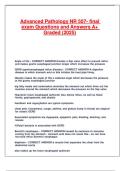
NR507- Midterm Advanced Patho- cardiac, pulmonary, hematology, renal

Rating
-
Sold
-
Pages
8
Grade
A+
Uploaded on
21-11-2024
Written in
2024/2025

Acid/ base disturbance- COPD - answer-chronic obstructive pulmonary disorder. Causes air trapping. Increasing CO2 retention and respiratory acidosis. acute bronchitis - answer-infection and inflammation of bronchial tubes (bronchi) AFTERLOAD (arteries) - answer-resistance to left ventricular ejection (systole) Increased: COPD, hypertension, valve dx (all r/t pulm htn) Decreased: hypotension, vasodilation (shock) Albuterol - answer-Beta 2 Agonist, Short-Acting Aldosterone - answer-Hormone that stimulates the kidney to retain sodium ions and water anatomy and physiology of kidney - answer-consists of 3 distinct areas: *Located in posterior region of the abd cavity behind peritoneum. cortex (outer) medulla (middle) renal pelvis (inner) Anemia - answer-A condition in which the blood is deficient in red blood cells, in hemoglobin, or in total volume. anemia due to gastrectomy - answer-Iron def anemia is major cause after this Removal of stomach often leads to marked decrease in production of gastric acid. This acid is necessary to convert dietary iron to a form that is more readily absorbed by the duodenum Anticholinergic drugs for asthma - answer-Atrovent & Spiriva both prevent the muscle bands around the airways from tightening thus reduce in exacerbation Albuterol is short acting antidiuretic hormone (ADH) - answer-promotes retention of water by kidneys aortic stenosis - answer-calcification/ narrowing of aortic valve cusps that restricts forward flow from left ventricle to aorta (during systole) crescendo- decrescendo systolic heart murmur Asthma - answer-A chronic allergic disorder characterized by episodes of severe breathing difficulty, coughing, and wheezing. T2HIGH eosinophilic inflammation Airway responsiveness AV valves - answer-tricuspid- right side/ pulmonary bicuspid- left side/ aortic side Blood flow of heart - answer-Enters the right side inferior/superior vena cava- emptying deoxygenated blood to right atrium- right ventricle, through tricuspid valve, pulmonary valve, pulmonary artery to lungs (where it is oxygenated). Pulmonary vein empties oxygen rich blood to left atrium/ left ventricle, through mitral valve, aortic valve, aorta---->to the body. blood hydrostatic pressure - answer-The pressure exerted by the water in the blood against the inside wall of a capillary of the bowmans capsule. essential for blood pressure in the glomerulus. Bownman's capsule - answer-cup shaped structure surrounding the glomerulus BPH (benign prostatic hyperplasia) - answer-Age-associated prostate gland enlargement that can cause urination difficulty. non-cancerous BPH treatment - answer--Alpha blockers [relax bladder neck muscles in the prostate making urination easier]; alfuzosin (Uroxatral), doxazosin (Cardura), tamsulosin (Flomax), and silodosin (Rapaflo), -5-alpha reductase inhibitors [shrink your prostate by preventing hormonal changes that cause prostate growth]; finasteride (Proscar), dutasteride (Avodart) bronchioles function - answer-passage of air to alveoli- gas exchange calcium binding - answer-Binding of calcium to subunit of troponin Induces conformation change in troponin Troponin-tropomyosin complex moved Myosin binding sites of actin exposed cardiac contractility (inotropic) - answer-Force generated at any given end diastolic volume Increased: sympathetic stimulation (anxiety, increased thyroxine) Decreased: low ATP levels (inschemia, hypoxia, acidosis) Cardiac Output (CO) - answer-volume of blood ejected by each ventricle per minute CO= HRx SV Causes of heart failure - answer-"MI, afib, infection, shock/trauma, thyroid disease, PE, excess salt, medication noncompliance, beta blockers, NSAIDs" Over time, reduces contractility chronic bronchitis - answer-inflammation of the bronchi persisting over a long time 3 or more months atleast 2 years collecting duct - answer-reabsorption of water/ secretion cor pulmonale - answer-right-sided heart failure arising from chronic lung disease. can be caused by long term pulmonary hypertension Diastole (IN) - answer-Relaxation period when blood fills the relaxed ventricles distal convoluted tubule - answer-reabsorption and secretion Ejection Fraction (EF) - answer-calculation of how much blood a ventricle can eject with one contraction SV / EDV 55-70% of ventricular blood ejected/ systole Erythrocytes - answer-red blood cells Most abundant cell in the body Responsible for tissue oxygenation Mitotic division- 100-120 days Erythropoiesis - answer-formation of red blood cells In kidney in response to hypoxia Erythropoietin (EPO) - answer-Hormone secreted by the kidney to stimulate the production of red blood cells by bone marrow In response to hypoxia In the fetus the liver produces this factors that affect cardiac output - answer-preload after-load heart rate myocardial contractility Formation of urine steps - answer-1. glomerular filtration 2. tubular reabsorption 3. tubular secretion function of kidneys - answer-Filter blood and produce urine maintain homeostasis PH BP Waste (urea) glomerular - answer-filtration glomerular filtration - answer-the movement of substances from the blood within the glomerulus into bowman's space glomerulonephritis - answer-inflammation of the glomeruli within the kidney (immune response) glomerulus - answer-A ball of capillaries surrounded by Bowman's capsule in the nephron and serving as the site of filtration in the vertebrate kidney. Hematopoiesis - answer-blood cell formation Fetus- liver and spleen Adult- bone marrow Hemoglobin - answer-Iron-containing protein in red blood cells that carries oxygen for delivery to cells 4 molecules of O2 Made of polypeptide, heme, iron hemolytic anemia - answer-Characterized by an inadequate number of circulating red blood cells due to the premature destruction of red blood cells by the spleen Pancytopenia- reduction in all 3 types of blood cells (RBC, WBC, Plt) hemolytic anemia causes - answer-Sickle cell disease, ABO or Rh incompatibility, drug induced hilum - answer-depression in an organ where blood vessels and nerves enter and leave homeostasis in kidneys - answer-remove waste from blood, leave nutrients alone, maintaining the acid-base, regulating water and electrolyte balance Hypertension - answer-consistent elevation of systemic arterial blood pressure, increases in cardiac output or total peripheral resistance or both. CO is increased by any condition that increases HR or SV, whereas peripheral resistance is increased by any factor that increases blood viscosity or reduces vessel diameter (vasoconstriction) Intrarenal causes (intrinsic) - answer-Systemic disease or drug toxicity DIC tumor growth antibiotics malignant hypertension *ATN caused by ischemia is the most common cause usually after surgery/ sepsis iron deficiency anemia - answer-anemia resulting when there is not enough iron to build hemoglobin for red blood cells Affects children, poverty, child bearing age Juxtuglomerular Cells - answer-Secrete RENIN which in turn: Increases blood volume increases sodium reabsorption constricts blood vessels increases blood pressure Laplace's Law - answer-Wall tension = (pressure x radius)/ (2 x wall thickness) heart must work harder- increased tension Left sided heart failure symptoms - answer--Left = lungs (and heart) -Crackles, increased HR, SOB, palpitations, dizzy, lightheaded, confused, restless, cough, dyspnea Loop of Henle - answer-The part of a kidney tubule that forms a long loop in the medulla of the kidney, from which water and salts are resorbed into the blood. macrocytic normochromic anemia - answer-Large RBC's, normal hemoglobin Folic acid or Vitamin B12 deficiency major calyces - answer-areas that collect urine from minor calyces, empty urine into renal pelvis mesangial cells - answer-control blood pressure and filtration within glomerulus. they also have phagocytic properties similar to monocytes and release inflammatory cytokines and growth factor. microcytic hypochromic anemia - answer-small, abnormally shaped erythrocytes that are not able to carry normal hemoglobin Thalassemia- mediterranean minor calyces - answer-cup-shaped areas that collect urine draining from pyramidal papillae mitral stenosis - answer-narrowing of the mitral (bicuspid) valve, impairs blood from LA to LV. Most common rheumatic heart disease Low rumbling diastolic murmur heard at apex and radiating to axilla. Heard during S1 nephron - answer-Functional unit of the kidney filtration collection nephron damage - answer-1 thing that causes an increase in creatinine. number of nephrons decrease with age. Change in renal vasculature causing shunt between efferent and afferent arterioles. specific gravity in elderly tends to be low. normocytic normochromic anemia - answer-Characterized by red cells that are relatively normal in size and normal hemoglobin Aplastic, hemorrhagic, hemolytic, sickle cell Perfusion - answer-The passage of fluid to an organ or a tissue, usually referring to the delivery of blood to an area. pernicious anemia - answer-Lack of mature erythrocytes caused by inability to absorb vitamin B12 into the bloodstream polycythemia vera - answer-condition characterized by too many erythrocytes; blood becomes too thick to flow easily through blood vessels. Blood clots can lead to stroke and heart attack. Gene mutation in the protein janus kinase 2. Postrenal causes - answer-Obstruction of urine leaving the kidney Enlarged prostate Stones preload (venous return) - answer-volume of blood in ventricles at end of diastole Increased: CHF, hypervolemia Decreased: cardiac tamponade, hypovolemia prerenal causes - answer-Severe decrease in perfusion to the kidneys Caused by: hypovolemia trauma n/v/d

Show more Read less
Institution
NR507- Advanced Patho- Cardiac, Pulmonary,
Module
NR507- Advanced Patho- cardiac, pulmonary,


Whoops! We can’t load your doc right now. Try again or contact support.

Written for

Institution
NR507- Advanced Patho- cardiac, pulmonary,
Module
NR507- Advanced Patho- cardiac, pulmonary,

Document information

Uploaded on
November 21, 2024
Number of pages
8
Written in
2024/2025
Type
Exam (elaborations)
Contains
Questions & answers

Subjects

Content preview

NR507- MIDTERM ADVANCED PATHO-
CARDIAC, PULMONARY, HEMATOLOGY,
RENAL
Acid/ base disturbance- COPD - answer-chronic obstructive pulmonary disorder.
Causes air trapping. Increasing CO2 retention and respiratory acidosis.

acute bronchitis - answer-infection and inflammation of bronchial tubes (bronchi)

AFTERLOAD (arteries) - answer-resistance to left ventricular ejection (systole)

Increased: COPD, hypertension, valve dx (all r/t pulm htn)

Decreased: hypotension, vasodilation (shock)

Albuterol - answer-Beta 2 Agonist, Short-Acting

Aldosterone - answer-Hormone that stimulates the kidney to retain sodium ions
and water

anatomy and physiology of kidney - answer-consists of 3 distinct areas:

*Located in posterior region of the abd cavity behind peritoneum.

cortex (outer)
medulla (middle)
renal pelvis (inner)

Anemia - answer-A condition in which the blood is deficient in red blood cells, in
hemoglobin, or in total volume.

anemia due to gastrectomy - answer-Iron def anemia is major cause after this
Removal of stomach often leads to marked decrease in production of gastric
acid. This acid is necessary to convert dietary iron to a form that is more readily
absorbed by the duodenum

Anticholinergic drugs for asthma - answer-Atrovent & Spiriva both prevent the
muscle bands around the airways from tightening thus reduce in exacerbation
Albuterol is short acting

antidiuretic hormone (ADH) - answer-promotes retention of water by kidneys

aortic stenosis - answer-calcification/ narrowing of aortic valve cusps that
restricts forward flow from left ventricle to aorta (during systole)
crescendo- decrescendo systolic heart murmur

Asthma - answer-A chronic allergic disorder characterized by episodes of severe
breathing difficulty, coughing, and wheezing.
T2HIGH eosinophilic inflammation
Airway responsiveness

AV valves - answer-tricuspid- right side/ pulmonary

, bicuspid- left side/ aortic side

Blood flow of heart - answer-Enters the right side inferior/superior vena cava-
emptying deoxygenated blood to right atrium- right ventricle, through tricuspid
valve, pulmonary valve, pulmonary artery to lungs (where it is oxygenated).
Pulmonary vein empties oxygen rich blood to left atrium/ left ventricle, through
mitral valve, aortic valve, aorta---->to the body.

blood hydrostatic pressure - answer-The pressure exerted by the water in the
blood against the inside wall of a capillary of the bowmans capsule. essential for
blood pressure in the glomerulus.

Bownman's capsule - answer-cup shaped structure surrounding the glomerulus

BPH (benign prostatic hyperplasia) - answer-Age-associated prostate gland
enlargement that can cause urination difficulty.
non-cancerous

BPH treatment - answer--Alpha blockers [relax bladder neck muscles in the
prostate making urination easier]; alfuzosin (Uroxatral), doxazosin (Cardura),
tamsulosin (Flomax), and silodosin (Rapaflo),
-5-alpha reductase inhibitors [shrink your prostate by preventing hormonal
changes that cause prostate growth]; finasteride (Proscar), dutasteride (Avodart)

bronchioles function - answer-passage of air to alveoli- gas exchange

calcium binding - answer-Binding of calcium to subunit of troponin
Induces conformation change in troponin
Troponin-tropomyosin complex moved
Myosin binding sites of actin exposed

cardiac contractility (inotropic) - answer-Force generated at any given end
diastolic volume
Increased:
sympathetic stimulation (anxiety, increased thyroxine)

Decreased:
low ATP levels (inschemia, hypoxia, acidosis)

Cardiac Output (CO) - answer-volume of blood ejected by each ventricle per
minute
CO= HRx SV

Causes of heart failure - answer-"MI, afib, infection, shock/trauma, thyroid
disease, PE, excess salt, medication noncompliance, beta blockers, NSAIDs"
Over time, reduces contractility

chronic bronchitis - answer-inflammation of the bronchi persisting over a long
time
3 or more months atleast 2 years

collecting duct - answer-reabsorption of water/ secretion
Get to know the seller

Seller avatar
Reputation scores are based on the amount of documents a seller has sold for a fee and the reviews they have received for those documents. There are three levels: Bronze, Silver and Gold. The better the reputation, the more your can rely on the quality of the sellers work.
TOPDOCTOR Abacus College, Oxford
Follow You need to be logged in order to follow users or courses
Sold
10
Member since
2 year
Number of followers
5
Documents
3396
Last sold
3 months ago
TOPGRADER!!

Looking for relevant and updated study material to help you ace your exams? TOPTIERGRADES has your back!!! I have essential exams, test-banks, study bites, assignments all graded A+, Have Complete solutions, and are updated regularly. Please feel free to message me if you are looking for a specific test bank that is not listed on my profile or want a test bank or exam sent to you directly as google doc link. In the event that any of the materials have an issue, please let me know and I\'ll do my best to resolve it or provide an alternative. Thank You & All The Very BEST!!!!!

Read more Read less
5.0

1 reviews

5
1
4
0
3
0
2
0
1
0

Recently viewed by you

Why students choose Stuvia

Created by fellow students, verified by reviews

Quality you can trust: written by students who passed their exams and reviewed by others who've used these revision notes.

Didn't get what you expected? Choose another document

No problem! You can straightaway pick a different document that better suits what you're after.

Pay as you like, start learning straight away

No subscription, no commitments. Pay the way you're used to via credit card and download your PDF document instantly.

Student with book image

“Bought, downloaded, and smashed it. It really can be that simple.”

Alisha Student

Frequently asked questions