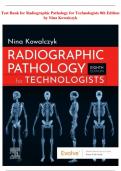
Test Bank for Radiographic Pathology for Technologists 8th Edition
by Nina Kowalczyk
,Chapter 1: Introduction to Pathology
Test Bank
MULTIPLE CHOICE
1. The sequence of events producing cellular changes following injury best explains:
a. manifestations.
b. pathogenesis.
c. sign.
d. symptom.
RIGHT ANSWER- B SOURCE- p. 2
2. An abnormal disturbance of the function and structure of the human body following injury
is known as:
a. disease.
b. etiology.
c. manifestations.
d. pathogenesis.
RIGHT ANSWER- A SOURCE- p. 2
3. The study of the cause of disease is called:
a. disease.
b. etiology.
c. pathogenesis.
d. prognosis.
RIGHT ANSWER- B SOURCE- p. 2
4. Common elements that cause disease include:
1. bacteria.
2. chemicals.
3. heat.
a. 1 and 2 only
b. 1 and 3 only
c. 2 and 3 only
d. 1, 2, and 3
RIGHT ANSWER- D SOURCE- p. 2
5. A syndrome is best defined as:
a. a genetic abnormality of a single protein.
b. an adverse response to medical treatment.
c. the hospital patient’s perception of the disease.
d. signs and symptoms that characterize a specific abnormal disturbance.
RIGHT ANSWER- D SOURCE- p. 2
6. An adverse response to medical treatment itself is called:
a. autoimmune.
, b. iatrogenic.
c. idiopathic.
d. nosocomial.
RIGHT ANSWER- B SOURCE- p. 3
7. Prognosis is known as:
a. diseases usually having a quick onset.
b. the name of the particular disease.
c. the predicted course and outcome of the disease.
d. the structure of cells or tissue.
RIGHT ANSWER- C SOURCE- p. 3
8. Diseases that generally require a decrease in the exposure technique are considered:
a. destructive.
b. lytic.
c. subtractive.
d. all of the above.
RIGHT ANSWER- D SOURCE- p. 3
9. The investigation of disease occurring in large groups best explains:
a. epidemiology.
b. incidence.
c. prevalence.
d. all of the above.
RIGHT ANSWER- A SOURCE- p. 3
10. Data regarding the number of deaths caused by a particular disease averaged over a population
are collected and reported by the:
a. American College of Radiology.
b. Centers for Disease Control.
c. Food and Drug Administration.
d. National Center for Health Statistics.
RIGHT ANSWER- D SOURCE- p. 2
11. Which of these are leading causes of death in the United States for adults aged 45years
and greater?
1. Heart disease
2. Malignant neoplasm
3. Polycystic kidney disease
a. 1 and 2 only
b. 1 and 3 only
c. 2 and 3 only
d. 1, 2, and 3
RIGHT ANSWER- A SOURCE- p. 4
12. In 2010, health spending accounted for approximately % of the U.S. gross domestic
product.
, a. 12
b. 17
c. 21
d. 33
RIGHT ANSWER- B SOURCE- p. 7
13. Each cell in the human body, except the reproductive cells, contains pairs of autosomal
chromosomes and sex chromosomes.
a. 11; 1
b. 11; 2
c. 22; 1
d. 22; 2
RIGHT ANSWER- D SOURCE- p. 8
14. The types of gene maps that grew out of the identification of DNA sequences include
maps.
1. genetic
2. SNP
3. physical
a. 1 and 2 only
b. 1 and 3 only
c. 2 and 3 only
d. 1, 2, and 3
RIGHT ANSWER- B SOURCE- p. 8
15. The identification of common DNA pattern sequences and common patterns of genetic
variations of single DNA bases resulted in:
a. the Genome Project.
b. genetic linkage maps.
c. haplotype mapping.
d. physical mapping.
RIGHT ANSWER- C SOURCE- p. 8
16. Diseases that are present at birth from genetic or environmental factors are classified as:
a. congenital.
b. degenerative.
c. genetic.
d. metabolic.
RIGHT ANSWER- A SOURCE- p. 10
17. A genetic disorder caused by an abnormality on one of the 22 nonsex chromosomes is
considered:
a. autosomal.
b. dominant.
c. recessive.
d. sex linked.
by Nina Kowalczyk
,Chapter 1: Introduction to Pathology
Test Bank
MULTIPLE CHOICE
1. The sequence of events producing cellular changes following injury best explains:
a. manifestations.
b. pathogenesis.
c. sign.
d. symptom.
RIGHT ANSWER- B SOURCE- p. 2
2. An abnormal disturbance of the function and structure of the human body following injury
is known as:
a. disease.
b. etiology.
c. manifestations.
d. pathogenesis.
RIGHT ANSWER- A SOURCE- p. 2
3. The study of the cause of disease is called:
a. disease.
b. etiology.
c. pathogenesis.
d. prognosis.
RIGHT ANSWER- B SOURCE- p. 2
4. Common elements that cause disease include:
1. bacteria.
2. chemicals.
3. heat.
a. 1 and 2 only
b. 1 and 3 only
c. 2 and 3 only
d. 1, 2, and 3
RIGHT ANSWER- D SOURCE- p. 2
5. A syndrome is best defined as:
a. a genetic abnormality of a single protein.
b. an adverse response to medical treatment.
c. the hospital patient’s perception of the disease.
d. signs and symptoms that characterize a specific abnormal disturbance.
RIGHT ANSWER- D SOURCE- p. 2
6. An adverse response to medical treatment itself is called:
a. autoimmune.
, b. iatrogenic.
c. idiopathic.
d. nosocomial.
RIGHT ANSWER- B SOURCE- p. 3
7. Prognosis is known as:
a. diseases usually having a quick onset.
b. the name of the particular disease.
c. the predicted course and outcome of the disease.
d. the structure of cells or tissue.
RIGHT ANSWER- C SOURCE- p. 3
8. Diseases that generally require a decrease in the exposure technique are considered:
a. destructive.
b. lytic.
c. subtractive.
d. all of the above.
RIGHT ANSWER- D SOURCE- p. 3
9. The investigation of disease occurring in large groups best explains:
a. epidemiology.
b. incidence.
c. prevalence.
d. all of the above.
RIGHT ANSWER- A SOURCE- p. 3
10. Data regarding the number of deaths caused by a particular disease averaged over a population
are collected and reported by the:
a. American College of Radiology.
b. Centers for Disease Control.
c. Food and Drug Administration.
d. National Center for Health Statistics.
RIGHT ANSWER- D SOURCE- p. 2
11. Which of these are leading causes of death in the United States for adults aged 45years
and greater?
1. Heart disease
2. Malignant neoplasm
3. Polycystic kidney disease
a. 1 and 2 only
b. 1 and 3 only
c. 2 and 3 only
d. 1, 2, and 3
RIGHT ANSWER- A SOURCE- p. 4
12. In 2010, health spending accounted for approximately % of the U.S. gross domestic
product.
, a. 12
b. 17
c. 21
d. 33
RIGHT ANSWER- B SOURCE- p. 7
13. Each cell in the human body, except the reproductive cells, contains pairs of autosomal
chromosomes and sex chromosomes.
a. 11; 1
b. 11; 2
c. 22; 1
d. 22; 2
RIGHT ANSWER- D SOURCE- p. 8
14. The types of gene maps that grew out of the identification of DNA sequences include
maps.
1. genetic
2. SNP
3. physical
a. 1 and 2 only
b. 1 and 3 only
c. 2 and 3 only
d. 1, 2, and 3
RIGHT ANSWER- B SOURCE- p. 8
15. The identification of common DNA pattern sequences and common patterns of genetic
variations of single DNA bases resulted in:
a. the Genome Project.
b. genetic linkage maps.
c. haplotype mapping.
d. physical mapping.
RIGHT ANSWER- C SOURCE- p. 8
16. Diseases that are present at birth from genetic or environmental factors are classified as:
a. congenital.
b. degenerative.
c. genetic.
d. metabolic.
RIGHT ANSWER- A SOURCE- p. 10
17. A genetic disorder caused by an abnormality on one of the 22 nonsex chromosomes is
considered:
a. autosomal.
b. dominant.
c. recessive.
d. sex linked.