Table of Contents:
1. Therapeutic Relationships
4. Cultural Considerations
2. Therapeutic
5. NCLEX Practice Questions
Communication
3. Nontherapeutic
Communication
Therapeutic Communication
1. Therapeutic Relationships
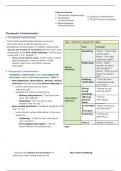
Time-limited relationships between nurse and TABLE 1. THERAPEUTIC COMMUNICATION THEMES
client that serve a specific purpose (e.g.,
developing communication or healthy coping skills) Type Example
Discuss the timeline for termination of the nurse- client
Restating Client: “I have been
relationship at the first client meeting (“I will be your
up all night.”
nurse until 7 p.m. tonight.”).
Nurse: “You didn’t
Focus on the client’s needs, not the nurse’s needs.
sleep last night?”
Uses therapeutic communication to build
rapport, gain trust, and gather relevant Reflecting Client: “What
information should I do about
Active
this situation?”
listening
2. Therapeutic Communication Nurse: “What do you
Therapeutic communication uses non-judgmental think you should
do?”
observations and/or open-ended questions (TABLE 1).
Seeking “I am not sure I
Non-judgmental observations: Neutral, factual
clarification understand what
statements that demonstrate active listening to:
you mean.”
Let the client know you’ve heard
Giving “Where do you
what was said.
broad want to start?”
Validate the client’s emotions by:
openings
Making observations: “That must have
Offering “Tell me
been very difficult.” Open-ended
general more about
Restating: “This has been a very questions
leads .”
stressful time for you.”
Open-ended questions: Cannot be answered with Encouragin “What makes you
“yes” or “no” g feel that way?”
description
Invite clients to share information in their own
Exploring “Could you
words by:
describe ?
Exploring: “I’d like to hear more about
”
your concerns.”
Silence Sitting in silence
Encouraging description: “Tell me
about how you are feeling now.” Non-
Discuss the timeline for termination of first client meeting.
the nurse-client relationship at the
, @ Therapeutic communication uses non- judgmental observations and/or open-ended
questions.
1. Therapeutic Relationships
4. Cultural Considerations
2. Therapeutic
5. NCLEX Practice Questions
Communication
3. Nontherapeutic
Communication
Therapeutic Communication
1. Therapeutic Relationships
Time-limited relationships between nurse and TABLE 1. THERAPEUTIC COMMUNICATION THEMES
client that serve a specific purpose (e.g.,
developing communication or healthy coping skills) Type Example
Discuss the timeline for termination of the nurse- client
Restating Client: “I have been
relationship at the first client meeting (“I will be your
up all night.”
nurse until 7 p.m. tonight.”).
Nurse: “You didn’t
Focus on the client’s needs, not the nurse’s needs.
sleep last night?”
Uses therapeutic communication to build
rapport, gain trust, and gather relevant Reflecting Client: “What
information should I do about
Active
this situation?”
listening
2. Therapeutic Communication Nurse: “What do you
Therapeutic communication uses non-judgmental think you should
do?”
observations and/or open-ended questions (TABLE 1).
Seeking “I am not sure I
Non-judgmental observations: Neutral, factual
clarification understand what
statements that demonstrate active listening to:
you mean.”
Let the client know you’ve heard
Giving “Where do you
what was said.
broad want to start?”
Validate the client’s emotions by:
openings
Making observations: “That must have
Offering “Tell me
been very difficult.” Open-ended
general more about
Restating: “This has been a very questions
leads .”
stressful time for you.”
Open-ended questions: Cannot be answered with Encouragin “What makes you
“yes” or “no” g feel that way?”
description
Invite clients to share information in their own
Exploring “Could you
words by:
describe ?
Exploring: “I’d like to hear more about
”
your concerns.”
Silence Sitting in silence
Encouraging description: “Tell me
about how you are feeling now.” Non-
Discuss the timeline for termination of first client meeting.
the nurse-client relationship at the
, @ Therapeutic communication uses non- judgmental observations and/or open-ended
questions.