L5: TUMOUR SUPPRESSOR GENES [03/10/2022]
I. TUMOUR SUPPRESSOR GENES (TSGs): can be considered the ‘brakes’ of the cell for
keeping a check on unwanted growth.
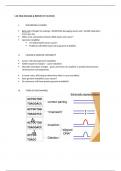
Loss of Function:
Functionally RECESSIVE – both copies of gene must undergo a deactivating mutation in order
to have an effect.
Familial Cancers:
, II. HOW CAN TUMOUR SUPPRESSOR GENES BE LOST?
Mutation
Deletion
Loss of heterozygosity (allelic deletion)
Methylation
Up-regulation of oncogenic miRNAs (insertion of retrotransposons)
Haploinsufficiency
III. WHAT SORTS OF GENES CAN BE TUMOUR SUPPRESSOR GENES?
Signalling – Smad4, DCC, APC
Transcription – WT-1, p53
Gene Expression – VHL
Cell Cycle Control – pRb, p53
Cell Adhesion – E-cadherin
Cytoskeletal Architecture – NF-2
DNA Damage and Repair – p53, ATM, BRCA1/2
miRNAs – let-7 (targets ras and myc)
IV. NF1
GTPase-activating protein (GAP) for Ras provokes Ras to activate intrinsic GAP activity
NF1 expressed throughout the body, but especially n adult PNS and CNS
Upon growth factor stimulation, NF1 degraded, RAS signalling proceeds. After 60-90 mins
NF1 levels back to normal, shuts down Ras signalling
Loss of NF1 mimics activated Ras
V. PTEN
Mutations in NF1 and PTEN affect linked pathways leading to proliferation and survival.
VI. APC
Familial adenomatous polyposis (FAP)
- inherited susceptibility to develop adenomatous polyps in colon (1 in 8000)
- polyps are non-malignant, but are prone to develop m=into carcinomas at a low but
predictable frequency
in the absence of Wnt
(but presence of APC)
β-catenin levels are
low, TLE represses
TCF mediated gene
expression
I. TUMOUR SUPPRESSOR GENES (TSGs): can be considered the ‘brakes’ of the cell for
keeping a check on unwanted growth.
Loss of Function:
Functionally RECESSIVE – both copies of gene must undergo a deactivating mutation in order
to have an effect.
Familial Cancers:
, II. HOW CAN TUMOUR SUPPRESSOR GENES BE LOST?
Mutation
Deletion
Loss of heterozygosity (allelic deletion)
Methylation
Up-regulation of oncogenic miRNAs (insertion of retrotransposons)
Haploinsufficiency
III. WHAT SORTS OF GENES CAN BE TUMOUR SUPPRESSOR GENES?
Signalling – Smad4, DCC, APC
Transcription – WT-1, p53
Gene Expression – VHL
Cell Cycle Control – pRb, p53
Cell Adhesion – E-cadherin
Cytoskeletal Architecture – NF-2
DNA Damage and Repair – p53, ATM, BRCA1/2
miRNAs – let-7 (targets ras and myc)
IV. NF1
GTPase-activating protein (GAP) for Ras provokes Ras to activate intrinsic GAP activity
NF1 expressed throughout the body, but especially n adult PNS and CNS
Upon growth factor stimulation, NF1 degraded, RAS signalling proceeds. After 60-90 mins
NF1 levels back to normal, shuts down Ras signalling
Loss of NF1 mimics activated Ras
V. PTEN
Mutations in NF1 and PTEN affect linked pathways leading to proliferation and survival.
VI. APC
Familial adenomatous polyposis (FAP)
- inherited susceptibility to develop adenomatous polyps in colon (1 in 8000)
- polyps are non-malignant, but are prone to develop m=into carcinomas at a low but
predictable frequency
in the absence of Wnt
(but presence of APC)
β-catenin levels are
low, TLE represses
TCF mediated gene
expression