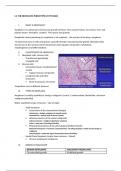
L2: THE NEOPLASTIC PHENOTYPE [27/09/2022]
I. WHAT IS NEOPLASM?
Neoplasm is an abnormal and excessive growth of tissue. From ancient Greek, neo means ‘new’ and
plasma means ‘formation, creation’. This means new growth.
Neoplastic means pertaining to neoplasms or to neoplasia – the process of forming a neoplasm.
‘An abnormal mass of cells arising from a growth disorder characterised by genetic alterations that
lead to loss of the normal control mechanisms that regulate cell growth, metabolism,
morphogenesis and differentiation.’
II. CONSTITUENTS OF NEOPLASM
1. Neoplastic cells: tumour cells
- Transformed (genetically
changed) cells
2. Stromal cells
- Connective tissue, including blood
vessels
Support tumour cell growth
- Lymphoid cells and other
leucocytes
React to presence of tumour
Proportions vary in different tumours.
III. TYPES OF NEOPLASM
Neoplasm is crudely classified as: benign, malignant (‘cancer’), indeterminate (borderline; uncertain
malignant potential).
Better classified by type of tumour + site of origin
- Solid Neoplasm
Leiomyoma of the myometrium (benign)
Leiomyoma = benign neoplasm of smooth muscle
Myometrium = muscle wall of uterus (womb)
Adenocarcinoma of the colon (malignant)
Adenocarcinoma = malignant glandular neoplasm
Colon = main part of the large intestine
Phaeochromocytoma of the adrenal gland (indeterminate)
Phaeochromocytoma = hormone (catecholamine) -secreting neoplasm, which may be benign or
malignant
Adrenal gland = endocrine organ situated just above the kidney
- Liquid Phase Neoplasm (origin: bone marrow -> blood)
Chronic lymphocytic leukaemia
IV. BENIGN VS MALIGNANT
BENIGN NEOPLASMS MALIGNANT NEOPLASMS
Circumscribed growth Ill-defined growth
, Smooth boundary with normal tissues Irregular boundary with normal tissues
(capsule)
Well-differentiated – resemble normal Differentiation varies (good -> poor)
counterpart
Slow growth Rate of growth varied (slow -> rapid)
May be multiple Local invasion and tissue destruction
Never invade normal tissue May metastasise (DDC and gliomas
exceptions; they rarely metastasise)
Never metastasises
Indeterminate Neoplasms: uncertain maligant potential
Pathological features not conclusive
Await events to be sure of nature
EXAMPLES:
Certain endocrine tumours (e.g. adrenal phaechromocytoma; Leydic cell tumour of
the testis)
Stromal tumours of the gastro-intestinal tract
V. HARMFUL EFFECTS ON THE PATIENT
Local:
- Mass (benign and malignant)
Effects depends on location: small mass in crucial situation may have profound
effects
May be complicated by:
(a) Ulceration
(b) Haemorrhage
(c) Obstruction
(d) Rupture
I. WHAT IS NEOPLASM?
Neoplasm is an abnormal and excessive growth of tissue. From ancient Greek, neo means ‘new’ and
plasma means ‘formation, creation’. This means new growth.
Neoplastic means pertaining to neoplasms or to neoplasia – the process of forming a neoplasm.
‘An abnormal mass of cells arising from a growth disorder characterised by genetic alterations that
lead to loss of the normal control mechanisms that regulate cell growth, metabolism,
morphogenesis and differentiation.’
II. CONSTITUENTS OF NEOPLASM
1. Neoplastic cells: tumour cells
- Transformed (genetically
changed) cells
2. Stromal cells
- Connective tissue, including blood
vessels
Support tumour cell growth
- Lymphoid cells and other
leucocytes
React to presence of tumour
Proportions vary in different tumours.
III. TYPES OF NEOPLASM
Neoplasm is crudely classified as: benign, malignant (‘cancer’), indeterminate (borderline; uncertain
malignant potential).
Better classified by type of tumour + site of origin
- Solid Neoplasm
Leiomyoma of the myometrium (benign)
Leiomyoma = benign neoplasm of smooth muscle
Myometrium = muscle wall of uterus (womb)
Adenocarcinoma of the colon (malignant)
Adenocarcinoma = malignant glandular neoplasm
Colon = main part of the large intestine
Phaeochromocytoma of the adrenal gland (indeterminate)
Phaeochromocytoma = hormone (catecholamine) -secreting neoplasm, which may be benign or
malignant
Adrenal gland = endocrine organ situated just above the kidney
- Liquid Phase Neoplasm (origin: bone marrow -> blood)
Chronic lymphocytic leukaemia
IV. BENIGN VS MALIGNANT
BENIGN NEOPLASMS MALIGNANT NEOPLASMS
Circumscribed growth Ill-defined growth
, Smooth boundary with normal tissues Irregular boundary with normal tissues
(capsule)
Well-differentiated – resemble normal Differentiation varies (good -> poor)
counterpart
Slow growth Rate of growth varied (slow -> rapid)
May be multiple Local invasion and tissue destruction
Never invade normal tissue May metastasise (DDC and gliomas
exceptions; they rarely metastasise)
Never metastasises
Indeterminate Neoplasms: uncertain maligant potential
Pathological features not conclusive
Await events to be sure of nature
EXAMPLES:
Certain endocrine tumours (e.g. adrenal phaechromocytoma; Leydic cell tumour of
the testis)
Stromal tumours of the gastro-intestinal tract
V. HARMFUL EFFECTS ON THE PATIENT
Local:
- Mass (benign and malignant)
Effects depends on location: small mass in crucial situation may have profound
effects
May be complicated by:
(a) Ulceration
(b) Haemorrhage
(c) Obstruction
(d) Rupture