

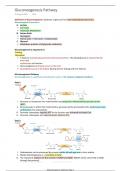
Gluconeogenesis Pathway
09 August 2020 14:01
Definition of Gluconeogenesis: Synthesis of glucose from non-carbohydrate precursors.
Gluconeogenic Precursors:
A. Lactate
• Cori Cycle
• Anaerobic Metabolism
B. Amino Acids
• Glucogenic
• Amino acids -> TCA cycle -> Oxaloacetate
C. Glycerol
• Breakdown product of triglyceride catabolism
Gluconeogenesis is important in:
-Fasting
-Starvation
• It helps to maintain glucose levels and concentrations. The blood glucose is required by the
brain and
erythrocytes to function.
• Gluconeogenesis primarily occurs in the liver.
• Secondarily occurs in the kidney (during chronic fasting and liver failure).
Gluconeogenesis Pathway
Gluconeogenesis is a pathway consisting of a series of 11 enzyme-catalysed reactions.
Step 1:
i. Pyruvate is transported into mitochondria by transporter mitochondrial pyruvate carrier
(NPC).
ii. Once pyruvate is within the mitochondria, pyruvate will be processed by the enzyme pyruvate
carboxylase into oxaloacetate.
iii. Pyruvate carboxylase requires ATP for its function and activated by Acetyl CoA.
iv. Pyruvate carboxylase also requires biotin (Vitamin B7).
Step 2:
i. Oxaloacetate can be processed by enzyme malate dehydrogenase to form malate.
ii. Malate dehydrogenase is a reversible enzyme.
iii. The important cofactor for this enzyme is NADH and NAD+ (NADH will be converted to NAD+
through the process).
iv. Within the mitochondria, there is a higher level of NADH (conversion from oxaloacetate to
Gluconeogenesis pathway Page 1
09 August 2020 14:01
Definition of Gluconeogenesis: Synthesis of glucose from non-carbohydrate precursors.
Gluconeogenic Precursors:
A. Lactate
• Cori Cycle
• Anaerobic Metabolism
B. Amino Acids
• Glucogenic
• Amino acids -> TCA cycle -> Oxaloacetate
C. Glycerol
• Breakdown product of triglyceride catabolism
Gluconeogenesis is important in:
-Fasting
-Starvation
• It helps to maintain glucose levels and concentrations. The blood glucose is required by the
brain and
erythrocytes to function.
• Gluconeogenesis primarily occurs in the liver.
• Secondarily occurs in the kidney (during chronic fasting and liver failure).
Gluconeogenesis Pathway
Gluconeogenesis is a pathway consisting of a series of 11 enzyme-catalysed reactions.
Step 1:
i. Pyruvate is transported into mitochondria by transporter mitochondrial pyruvate carrier
(NPC).
ii. Once pyruvate is within the mitochondria, pyruvate will be processed by the enzyme pyruvate
carboxylase into oxaloacetate.
iii. Pyruvate carboxylase requires ATP for its function and activated by Acetyl CoA.
iv. Pyruvate carboxylase also requires biotin (Vitamin B7).
Step 2:
i. Oxaloacetate can be processed by enzyme malate dehydrogenase to form malate.
ii. Malate dehydrogenase is a reversible enzyme.
iii. The important cofactor for this enzyme is NADH and NAD+ (NADH will be converted to NAD+
through the process).
iv. Within the mitochondria, there is a higher level of NADH (conversion from oxaloacetate to
Gluconeogenesis pathway Page 1


