--------------------------------------------------------------------------------------------------------------------------------------------------------------------------------------
Lesson: POPULATION ECOLOGY-GRADE 11
--------------------------------------------------------------------------------------------------------------------------------------------------------------------------------------
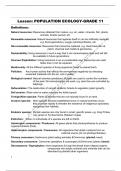
Definitions:
Natural resources: Resources obtained from nature, e.g. air, water, minerals, fish, plants,
animals, forests (wood), etc.
Renewable resources: Natural resources that replaces itself or can be artificially replaced,
e.g. food (agriculture), oxygen (photosynthesis), etc.
Non-renewable resources: Resources that cannot be replaced, e.g. fossil fuels like oil,
petrol, charcoal and metals & gemstones.
Sustainability: Using resources in such a way that it can renew/replace itself and will still
be available to future generations.
Overuse/ Exploitation: Using resources in an un-sustainable way: Resources are used
faster than it can be replaced.
Biodiversity: All the different species of living organisms found on planet Earth.
Pollution: Any human activity that effects the environment negatively by releasing
unwanted materials into the air, soil or water.
Biological control: Natural enemies (predators) of pests are used to control the numbers
of the pest. No toxins/poisons are used, e.g. plant lice are controlled by
ladybugs.
Deforestation: The destruction of natural, endemic forests & vegetation (plant growth).
Soil erosion: When wind or water removes the fertile topsoil.
Foreign/Alien species: Plants & animals that are not naturally found in an area.
Invasive species: Alien species become established since no natural enemies occur;
they increase rapidly & threaten the existence of indigenous speciesby
occupying their habitats.
Endemic species: Certain species are only found in small, specific areas, e.g. King Protea
only grows in Fynbos biome (Western Cape).
Extinction: When no individuals of a species are left on Earth.
Autotrophic components / Producers: All green plants that photosynthesise to produce
organic nutrients (food).
Heterotrophic components / Consumers: All organisms that obtain nutrients from an
external source (do not photosynthesise).
Primary consumers: Herbivores (plant-eating animals) &Omnivores (plants& meat)
Secondary consumers: Carnivores (predators & scavengers) &Omnivores (plants &meat)
Decomposers / Saprophytes: micro-organisms & fungi that break down (digest) organic
compounds into simple nutrients and minerals that can be
absorbed by plants& other organisms.
1
, Species: Animals belong to the same species, if they can produce fertile offspring.
Population: A group of organisms of the same species that inhabits a specific area at a
certain time, so that interbreeding can take place.
Community: A group of interdependent organisms of different species(biotic organisms)
growing or living together in a specified habitat.
Ecosystem: All the biotic organisms in an area & the abiotic factors of their
environment.
Ecology: The study of an organism's interactions with other living organisms &
their environment.
Ecological niche: The role an organism plays in the ecosystem. E.g. a fly’s niche is as
decomposer & food source.
--------------------------------------------------------------------------------------------------------------------------------------------------------------------------------------
Size of a population
1. Natality: The birth rate/ reproduction rate
2. Mortality: The death rate/ number of deaths
3. Dispersal:
a) Immigration: Permanent movement into the area
b) Emigration: Permanent movement out of the area
c) Migration: Temporary/seasonal movement into & out of the area
Increase/Decrease in Population size
= (natality + immigration) – (mortality + emigration)
Challenge: Calculate how many of Mike’s chickens flew away (emigrated):
Mike has a chicken farm. Since he started his farm with 200 chickens, 73 new chicks were
born and 7 chickens flew in over his neighbor’s fence and decided to stay. 21 chickens died
of bird flu and 16 died of natural causes. Mike counted his chickens this morning and the
total was 232 chickens.
_________________________________________________________________________
_________________________________________________________________________
_________________________________________________________________________
_________________________________________________________________________
________________________________________________________________________
4. Population growth curves
Geometric/Exponential (J) growth curve
1
Lesson: POPULATION ECOLOGY-GRADE 11
--------------------------------------------------------------------------------------------------------------------------------------------------------------------------------------
Definitions:
Natural resources: Resources obtained from nature, e.g. air, water, minerals, fish, plants,
animals, forests (wood), etc.
Renewable resources: Natural resources that replaces itself or can be artificially replaced,
e.g. food (agriculture), oxygen (photosynthesis), etc.
Non-renewable resources: Resources that cannot be replaced, e.g. fossil fuels like oil,
petrol, charcoal and metals & gemstones.
Sustainability: Using resources in such a way that it can renew/replace itself and will still
be available to future generations.
Overuse/ Exploitation: Using resources in an un-sustainable way: Resources are used
faster than it can be replaced.
Biodiversity: All the different species of living organisms found on planet Earth.
Pollution: Any human activity that effects the environment negatively by releasing
unwanted materials into the air, soil or water.
Biological control: Natural enemies (predators) of pests are used to control the numbers
of the pest. No toxins/poisons are used, e.g. plant lice are controlled by
ladybugs.
Deforestation: The destruction of natural, endemic forests & vegetation (plant growth).
Soil erosion: When wind or water removes the fertile topsoil.
Foreign/Alien species: Plants & animals that are not naturally found in an area.
Invasive species: Alien species become established since no natural enemies occur;
they increase rapidly & threaten the existence of indigenous speciesby
occupying their habitats.
Endemic species: Certain species are only found in small, specific areas, e.g. King Protea
only grows in Fynbos biome (Western Cape).
Extinction: When no individuals of a species are left on Earth.
Autotrophic components / Producers: All green plants that photosynthesise to produce
organic nutrients (food).
Heterotrophic components / Consumers: All organisms that obtain nutrients from an
external source (do not photosynthesise).
Primary consumers: Herbivores (plant-eating animals) &Omnivores (plants& meat)
Secondary consumers: Carnivores (predators & scavengers) &Omnivores (plants &meat)
Decomposers / Saprophytes: micro-organisms & fungi that break down (digest) organic
compounds into simple nutrients and minerals that can be
absorbed by plants& other organisms.
1
, Species: Animals belong to the same species, if they can produce fertile offspring.
Population: A group of organisms of the same species that inhabits a specific area at a
certain time, so that interbreeding can take place.
Community: A group of interdependent organisms of different species(biotic organisms)
growing or living together in a specified habitat.
Ecosystem: All the biotic organisms in an area & the abiotic factors of their
environment.
Ecology: The study of an organism's interactions with other living organisms &
their environment.
Ecological niche: The role an organism plays in the ecosystem. E.g. a fly’s niche is as
decomposer & food source.
--------------------------------------------------------------------------------------------------------------------------------------------------------------------------------------
Size of a population
1. Natality: The birth rate/ reproduction rate
2. Mortality: The death rate/ number of deaths
3. Dispersal:
a) Immigration: Permanent movement into the area
b) Emigration: Permanent movement out of the area
c) Migration: Temporary/seasonal movement into & out of the area
Increase/Decrease in Population size
= (natality + immigration) – (mortality + emigration)
Challenge: Calculate how many of Mike’s chickens flew away (emigrated):
Mike has a chicken farm. Since he started his farm with 200 chickens, 73 new chicks were
born and 7 chickens flew in over his neighbor’s fence and decided to stay. 21 chickens died
of bird flu and 16 died of natural causes. Mike counted his chickens this morning and the
total was 232 chickens.
_________________________________________________________________________
_________________________________________________________________________
_________________________________________________________________________
_________________________________________________________________________
________________________________________________________________________
4. Population growth curves
Geometric/Exponential (J) growth curve
1