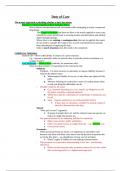
Duty of Care
The proper approach to deciding whether a duty has arisen:
Robinson v Chief Constable of West Yorkshire Police –
Police officers knocked down frail old woman while attempting to arrest a suspected
drug dealer.
The Caparo v Dickman test does not have to be strictly applied in every case,
instead the courts should look to existing statutes and precedents and identify
duties through analogy.
Where there is an existing or analogous duty that can be applied, the courts
do not need to consider the Caparo test, as such consideration has already
been determined, recognising the duty.
Only in novel situations does this need to be considered.
Liability for Omissions:
General rule = there is no liability in respect of a pure omission.
e.g., a person is generally under no tortious duty to provide positive assistance to a
stranger in peril.
Lord Hoffmann in Stovin v Wise (authority for omissions rule) –
There are three clusters of reasoning for this omissions rule:
Political:
- Freedom – it is more invasive to autonomy to impose liability because it
reduces the options more.
o When impose liability for an act, it only takes one option off the
table.
o Whereas insisting on a particular course of conduct means there
is only one thing the defendant can do.
- Wouldn’t hold for all cases?
o E.g., someone drowning in a river, merely an obligation to call
the police would be a minimal demand.
o While this could be a rationale for certain kinds of omissions, not
for all.
o Steel – requires someone to act with particular motive.
If have duty to call police, wouldn’t be breach of duty if
only do it because have the duty.
Moral:
- “Why pick on me?” argument.
o If group of people don’t act and the claimant sues one person, no
reason to single that person out.
- Not general reason for not imposing liability for omissions.
o Many cases involve public authorities.
o Often very good reasons to single them out – e.g., Michael case.
o Even private actors.
Economic:
- When person performs an action, it is important to internalise costs
because only then will those costs factor into the decision to perform the
act in the first place – we should have to bear cost of activities.
o Doesn’t apply if liability for not making someone better.
- This premises on a particular understanding of tort law – maximising
efficiency.
o Relies on believing that only economic reasons for tort law rather
than correcting justice or a rights-based approach.
, - Nolan – “the law’s insistence that public authorities are liable for failing
to confer benefits only when private parties would be casts doubt on the
common assumption that the general no-liability rule in omissions cases
is based on policy concerns such as the autonomy objection and the “Why
pick on me” argument.”
o “The fact that these arguments have little or no force where
public authority defendants are concerned, but that such
defendants are still shielded by the no-liability rule, suggests that
the reasons why negligence law distinguishes between making
things worse and not making things better lie elsewhere.”
Exception to general rule = assumption of responsibility:
Home Office v Dorset Yacht Co –
Borstal trainees working at a harbour were left unsupervised by their borstal
officers in breach of their instructions. Trainees escape and damaged C’s
yacht. C sued the Home Office, which employed the borstal officers.
For there to be a duty of care for the acts of the borstal trainees, there
must be some special relationship between the custodian and the
person to whom the duty is owed, which distinguishes the particular
risk owed to the general risk from criminal acts shared by the public.
The liability can arise where a person is under a duty to control
another due to special relations – e.g., between parent and child.
In this case, control of the borstal boys imports responsibility
Sandy Steel:
The distinction between acts and omissions is at best itself only a rule of thumb for
identifying situations where the defendant’s conduct is at best itself only a rule of
thumb.
An alternative formulation of general rule = A is not generally liable to B in
negligence for failing to confer a benefit upon B, but only for making B worse off.
Appealing because it “tracks an intuitively important moral difference
between affecting the world for the worse and failing to improve the world.”
Omission = proxy for idea that we don’t have a duty to make someone else’s
life/position better.
Liability for Public Authorities:
1. Starting point = exactly same principles apply
Robinson v Chief Constable of West Yorkshire Police –
Public authorities are subject to the same liabilities in tort law as private
individuals. They are under a duty not to cause the public harm via their own
actions but are not under a duty to prevent harm from third parties.
The police are not exempt from claims in negligence.
This means that:
(1) If private body would have been under a duty, so would the public
authority – PA does not have special immunity.
(2) Same starting point that don’t have a duty to make life better.
Two categories of case:
Call handlers
Local authorities.
2. Call Handlers:
Two contrasting cases:
Kent v Griffiths – ambulance services:
C was a pregnant woman who suffered severe asthma attack. Her doctor
attended and called 999, requested an ambulance and informing the operator
of C’s condition. Operator told the doctor that an ambulance would arrive in
about 8 minutes, but it in fact took 34 minutes to arrive. By the time C
arrived at the hospital, she had suffered respiratory arrest which resulted in
The proper approach to deciding whether a duty has arisen:
Robinson v Chief Constable of West Yorkshire Police –
Police officers knocked down frail old woman while attempting to arrest a suspected
drug dealer.
The Caparo v Dickman test does not have to be strictly applied in every case,
instead the courts should look to existing statutes and precedents and identify
duties through analogy.
Where there is an existing or analogous duty that can be applied, the courts
do not need to consider the Caparo test, as such consideration has already
been determined, recognising the duty.
Only in novel situations does this need to be considered.
Liability for Omissions:
General rule = there is no liability in respect of a pure omission.
e.g., a person is generally under no tortious duty to provide positive assistance to a
stranger in peril.
Lord Hoffmann in Stovin v Wise (authority for omissions rule) –
There are three clusters of reasoning for this omissions rule:
Political:
- Freedom – it is more invasive to autonomy to impose liability because it
reduces the options more.
o When impose liability for an act, it only takes one option off the
table.
o Whereas insisting on a particular course of conduct means there
is only one thing the defendant can do.
- Wouldn’t hold for all cases?
o E.g., someone drowning in a river, merely an obligation to call
the police would be a minimal demand.
o While this could be a rationale for certain kinds of omissions, not
for all.
o Steel – requires someone to act with particular motive.
If have duty to call police, wouldn’t be breach of duty if
only do it because have the duty.
Moral:
- “Why pick on me?” argument.
o If group of people don’t act and the claimant sues one person, no
reason to single that person out.
- Not general reason for not imposing liability for omissions.
o Many cases involve public authorities.
o Often very good reasons to single them out – e.g., Michael case.
o Even private actors.
Economic:
- When person performs an action, it is important to internalise costs
because only then will those costs factor into the decision to perform the
act in the first place – we should have to bear cost of activities.
o Doesn’t apply if liability for not making someone better.
- This premises on a particular understanding of tort law – maximising
efficiency.
o Relies on believing that only economic reasons for tort law rather
than correcting justice or a rights-based approach.
, - Nolan – “the law’s insistence that public authorities are liable for failing
to confer benefits only when private parties would be casts doubt on the
common assumption that the general no-liability rule in omissions cases
is based on policy concerns such as the autonomy objection and the “Why
pick on me” argument.”
o “The fact that these arguments have little or no force where
public authority defendants are concerned, but that such
defendants are still shielded by the no-liability rule, suggests that
the reasons why negligence law distinguishes between making
things worse and not making things better lie elsewhere.”
Exception to general rule = assumption of responsibility:
Home Office v Dorset Yacht Co –
Borstal trainees working at a harbour were left unsupervised by their borstal
officers in breach of their instructions. Trainees escape and damaged C’s
yacht. C sued the Home Office, which employed the borstal officers.
For there to be a duty of care for the acts of the borstal trainees, there
must be some special relationship between the custodian and the
person to whom the duty is owed, which distinguishes the particular
risk owed to the general risk from criminal acts shared by the public.
The liability can arise where a person is under a duty to control
another due to special relations – e.g., between parent and child.
In this case, control of the borstal boys imports responsibility
Sandy Steel:
The distinction between acts and omissions is at best itself only a rule of thumb for
identifying situations where the defendant’s conduct is at best itself only a rule of
thumb.
An alternative formulation of general rule = A is not generally liable to B in
negligence for failing to confer a benefit upon B, but only for making B worse off.
Appealing because it “tracks an intuitively important moral difference
between affecting the world for the worse and failing to improve the world.”
Omission = proxy for idea that we don’t have a duty to make someone else’s
life/position better.
Liability for Public Authorities:
1. Starting point = exactly same principles apply
Robinson v Chief Constable of West Yorkshire Police –
Public authorities are subject to the same liabilities in tort law as private
individuals. They are under a duty not to cause the public harm via their own
actions but are not under a duty to prevent harm from third parties.
The police are not exempt from claims in negligence.
This means that:
(1) If private body would have been under a duty, so would the public
authority – PA does not have special immunity.
(2) Same starting point that don’t have a duty to make life better.
Two categories of case:
Call handlers
Local authorities.
2. Call Handlers:
Two contrasting cases:
Kent v Griffiths – ambulance services:
C was a pregnant woman who suffered severe asthma attack. Her doctor
attended and called 999, requested an ambulance and informing the operator
of C’s condition. Operator told the doctor that an ambulance would arrive in
about 8 minutes, but it in fact took 34 minutes to arrive. By the time C
arrived at the hospital, she had suffered respiratory arrest which resulted in