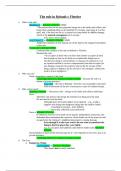
The rule in Rylands v Fletcher
1. What is the rule?
Blackburn J in Rylands v Fletcher [1866]
“The person who for his own purposes brings on to his lands and collects and
keeps there anything likely to do mischief if it escapes, must keep it in at his
peril, and, if he does not do so, is prima facie answerable for all the damage
which is the natural consequence of its escape.”
Very strict, strict liability.
Lord Cairns LC in Rylands v Fletcher [1868]
Added the condition of non-natural use of the land to the original formulation
of the rule.
Transco plc v Stockport MBC –
Confirmed the validity of the rule in Rylands v Fletcher.
Restated the rule:
“An occupier of land who can show that another occupier of land
has brought or kept on his land an exceptionally dangerous or
mischievous thing in extraordinary or unusual circumstances is in
my opinion entitled to recover compensation from that occupier for
any damage caused to his property interest by the escape of that
thing, subject to defences of Act of God or of a stranger, without the
need to prove negligence.”
2. Who can sue?
Need a proprietary interest in the land.
Cambridge Water Co v Eastern Counties Leather – because the rule is a
subset of private nuisance.
Lord Goff – the rule in Rylands v Fletcher was essentially concerned
with an extension of the law of nuisance to cases of isolated escape.
3. Who can be sued?
Rylands v Fletcher – “the person who…brings on his lands and collects and keeps
there…”
Therefore, the person who brings the mischievous thing onto the land.
Do not need to own the land.
Although may need some degree of occupation – e.g., would a
supplier who brings the dangerous thing onto the land be liable?
Unwilling to expand – strict liability.
Have they collected if just delivered?
Facts of Rylands v Fletcher –
D ordered a reservoir to be built on his land by independent contractors, the
defendant then maintained the reservoir. Water broke out of the reservoir and
escaped onto the claimant’s neighbouring property causing damage.
Even though D in this case wasn’t the one who accumulated the
thing in the first place they were liable.
e.g., so, occupier and landlord could both be liable under Rylands v
Fletcher.
Foreseeability of harm of the relevant type by D = pre-requisite of recovery, just as in
private nuisance.
Cambridge Water Co v Eastern Counties Leather –
4. The Test:
a. Dangerous Thing:
Lord Bingham in Transco v Stockport –
This should not be easily satisfied.
1. What is the rule?
Blackburn J in Rylands v Fletcher [1866]
“The person who for his own purposes brings on to his lands and collects and
keeps there anything likely to do mischief if it escapes, must keep it in at his
peril, and, if he does not do so, is prima facie answerable for all the damage
which is the natural consequence of its escape.”
Very strict, strict liability.
Lord Cairns LC in Rylands v Fletcher [1868]
Added the condition of non-natural use of the land to the original formulation
of the rule.
Transco plc v Stockport MBC –
Confirmed the validity of the rule in Rylands v Fletcher.
Restated the rule:
“An occupier of land who can show that another occupier of land
has brought or kept on his land an exceptionally dangerous or
mischievous thing in extraordinary or unusual circumstances is in
my opinion entitled to recover compensation from that occupier for
any damage caused to his property interest by the escape of that
thing, subject to defences of Act of God or of a stranger, without the
need to prove negligence.”
2. Who can sue?
Need a proprietary interest in the land.
Cambridge Water Co v Eastern Counties Leather – because the rule is a
subset of private nuisance.
Lord Goff – the rule in Rylands v Fletcher was essentially concerned
with an extension of the law of nuisance to cases of isolated escape.
3. Who can be sued?
Rylands v Fletcher – “the person who…brings on his lands and collects and keeps
there…”
Therefore, the person who brings the mischievous thing onto the land.
Do not need to own the land.
Although may need some degree of occupation – e.g., would a
supplier who brings the dangerous thing onto the land be liable?
Unwilling to expand – strict liability.
Have they collected if just delivered?
Facts of Rylands v Fletcher –
D ordered a reservoir to be built on his land by independent contractors, the
defendant then maintained the reservoir. Water broke out of the reservoir and
escaped onto the claimant’s neighbouring property causing damage.
Even though D in this case wasn’t the one who accumulated the
thing in the first place they were liable.
e.g., so, occupier and landlord could both be liable under Rylands v
Fletcher.
Foreseeability of harm of the relevant type by D = pre-requisite of recovery, just as in
private nuisance.
Cambridge Water Co v Eastern Counties Leather –
4. The Test:
a. Dangerous Thing:
Lord Bingham in Transco v Stockport –
This should not be easily satisfied.