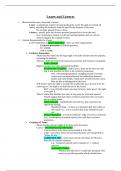
Leases and Licences
1. Distinction between a lease and a licence
Lease = a proprietary interest in land, granting the owner the right to exclude all
others, including the landlord, from the land for the duration of the term.
On stronger ground if have a lease.
Licence = merely gives the licensee personal permission to be on the land.
Not a proprietary interest so will not bind third parties and can only be
enforced against the original licensor.
2. Content Requirements for a lease:
Lord Templeman in Street v Mountford – there are three requirements:
- Exclusive possession of defined premises,
- For a term,
- And at a rent.
a. Exclusive Possession:
Means that the tenant has the legal right to exclude anyone from the property,
including the landlord.
There is a difference between exclusive possession and exclusive occupation.
Watts v Stewart
Right to occupy one room and shared facilities:
AG Securities v Vaughan – didn’t have a lease on the facts but said
that it was possible for there to be exclusive possession.
Was a fluctuating population, changing around of tenants,
rooms were not being allocated by landlord but between
people and some people would move around between rooms.
May be able to distinguish on the facts.
If B doesn’t have the right to exclude the world (only has a licence from A),
cannot give C the right to exclude the rest of the world.
BUT – even if B did acquire an estate in land, cannot give C the right
to exclude A.
What if clause that landlord can enter at any point for structural repairs?
Would suggest that don’t have exclusive possession but can read it
out as a sham clause.
Aslan v Murphy – landlord held onto the key, just a pretence not
significant enough.
Significant thing = is there any indication that they relied on
this clause? I.e., was it a clause they truly intended to rely
on?
Street v Mountford – as long as landlord’s right of access is restricted
(e.g., to emergency structural repairs), then still have exclusive
possession.
b. Certainty of Term:
Means that the precise length of the lease must be known.
Caveat = Mexfield Housing v Berrisford
If an uncertain term, lease can be treated as if for life.
Logic = pre-1925, leases for uncertain duration were interpreted as
“leases for life”.
s.149(6) LPA 1925 – turns leases for life into leases for 90 years.
Must be no contrary intention:
e.g., “temporary period until A requires it” = contrary
intention.
Southward v Walker –
Tenancy provided that C would only terminate with
notice on specified grounds which included non-
1. Distinction between a lease and a licence
Lease = a proprietary interest in land, granting the owner the right to exclude all
others, including the landlord, from the land for the duration of the term.
On stronger ground if have a lease.
Licence = merely gives the licensee personal permission to be on the land.
Not a proprietary interest so will not bind third parties and can only be
enforced against the original licensor.
2. Content Requirements for a lease:
Lord Templeman in Street v Mountford – there are three requirements:
- Exclusive possession of defined premises,
- For a term,
- And at a rent.
a. Exclusive Possession:
Means that the tenant has the legal right to exclude anyone from the property,
including the landlord.
There is a difference between exclusive possession and exclusive occupation.
Watts v Stewart
Right to occupy one room and shared facilities:
AG Securities v Vaughan – didn’t have a lease on the facts but said
that it was possible for there to be exclusive possession.
Was a fluctuating population, changing around of tenants,
rooms were not being allocated by landlord but between
people and some people would move around between rooms.
May be able to distinguish on the facts.
If B doesn’t have the right to exclude the world (only has a licence from A),
cannot give C the right to exclude the rest of the world.
BUT – even if B did acquire an estate in land, cannot give C the right
to exclude A.
What if clause that landlord can enter at any point for structural repairs?
Would suggest that don’t have exclusive possession but can read it
out as a sham clause.
Aslan v Murphy – landlord held onto the key, just a pretence not
significant enough.
Significant thing = is there any indication that they relied on
this clause? I.e., was it a clause they truly intended to rely
on?
Street v Mountford – as long as landlord’s right of access is restricted
(e.g., to emergency structural repairs), then still have exclusive
possession.
b. Certainty of Term:
Means that the precise length of the lease must be known.
Caveat = Mexfield Housing v Berrisford
If an uncertain term, lease can be treated as if for life.
Logic = pre-1925, leases for uncertain duration were interpreted as
“leases for life”.
s.149(6) LPA 1925 – turns leases for life into leases for 90 years.
Must be no contrary intention:
e.g., “temporary period until A requires it” = contrary
intention.
Southward v Walker –
Tenancy provided that C would only terminate with
notice on specified grounds which included non-